Engineering Review: Robotic MIG Automated MAG Welding Cell – Rotterdam, Netherlands
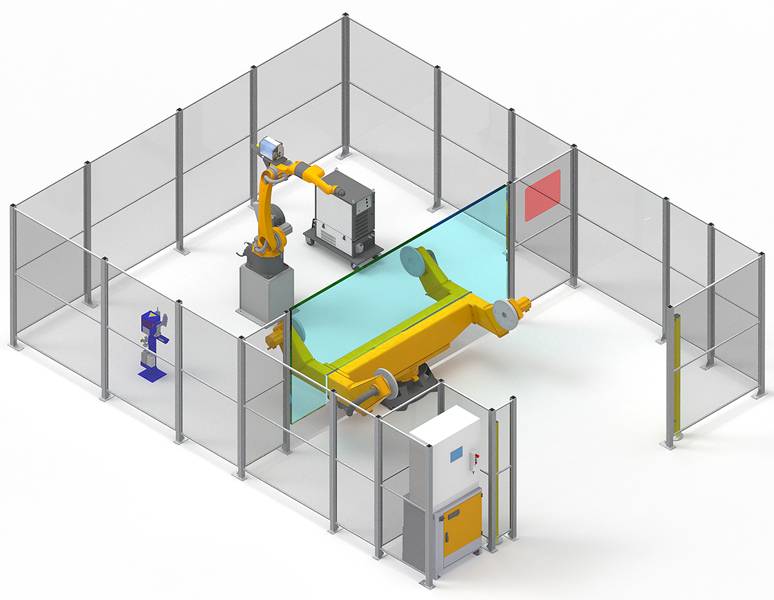
Field Engineering Report: Automated MAG Welding Cell Integration
Location: Waalhaven Industrial District, Rotterdam, Netherlands
1. Executive Summary of Field Operations
The recent commissioning of the Automated MAG Welding Cell at the Rotterdam facility marks a shift from manual batch processing to continuous flow for offshore-grade piping components. As a senior welding engineer on-site, my primary objective was the optimization of Arc Welding Solutions specifically tailored for Galvanized Pipe welding—a process notoriously fraught with metallurgical instability. The following report details the technical parameters, hardware synergy, and the lessons learned during the initial 500-unit production run.
2. Theoretical Synergy: Automated MAG Welding Cell and Advanced Arc Welding Solutions
In the context of the Rotterdam workshop, the term “Automated MAG Welding Cell” refers to more than just a robotic arm; it is a closed-loop system where the power source, wire feeder, and gas delivery systems communicate via EtherCAT. The synergy between the physical cell and the integrated Arc Welding Solutions (specifically the software-driven waveform controls) is critical.
In Rotterdam’s high-humidity maritime environment, atmospheric consistency is a variable we cannot ignore. The MAG (Metal Active Gas) process was selected over MIG because the active component (CO2/O2) is essential for stabilizing the arc when encountering the zinc oxide vapors inherent in Galvanized Pipe welding. By utilizing a 92% Argon / 8% CO2 shielding gas mix, we leveraged the cell’s ability to maintain a tight spray transfer mode, effectively “punching through” the zinc layer to ensure base metal fusion.
3. The Technical Challenge: Galvanized Pipe Welding
Galvanized steel presents a unique physical paradox: Zinc boils at approximately 907°C, while steel melts at roughly 1,500°C. During the welding process, the zinc coating turns into a high-pressure gas before the steel even reaches its liquidus state. If the Automated MAG Welding Cell is not calibrated to allow for the escape of these gases, the result is catastrophic porosity, wormholes, and excessive spatter.
In our Rotterdam field tests, we observed that standard CV (Constant Voltage) profiles were insufficient. The zinc vapors were being trapped in the molten pool, leading to internal voids that failed ultrasonic testing (UT). The solution required a deep dive into the Arc Welding Solutions provided by our power source—specifically, a modified pulsed-MAG waveform that oscillates the heat input to “agitate” the puddle, allowing the zinc gas to escape before the trailing edge of the weld pool solidifies.
4. Implementation of Arc Welding Solutions
To resolve the porosity issues, we implemented three specific Arc Welding Solutions within the cell:
1. Waveform Modulation (Pulse-on-Pulse): We programmed the Automated MAG Welding Cell to use a dual-pulse frequency. This creates a mechanical vibration in the weld pool. For the Galvanized Pipe welding, this vibration proved essential in forcing zinc vapor to the surface.
2. Travel Speed Calibration: Contrary to intuition, increasing travel speed often yields better results on galvanized materials. By maintaining a high speed, we minimized the total volume of zinc being vaporized at any single point, reducing the gas pressure within the arc zone.
3. Specialized Consumables: We transitioned to a silicon-bronze or a high-manganese wire (ER70S-6 with specific additives) to improve wetting at the toes of the weld.
5. Performance Analysis: The Rotterdam Workshop Environment
The Rotterdam site is unique due to its massive throughput of 150mm to 300mm diameter pipes. The Automated MAG Welding Cell was configured with a heavy-duty rotary positioner synchronized with the 6-axis robot.
Operational Observation: We found that the torch angle was the most sensitive variable. A 15-degree push angle provided the best gas coverage while allowing the arc force to blow the zinc oxide “smoke” away from the leading edge of the puddle. In Galvanized Pipe welding, if the torch is too vertical, the zinc oxide flakes accumulate on the gas nozzle, causing turbulence and shielding loss within only 10 minutes of arc-on time.
6. Lessons Learned: Field Notes for Senior Staff
The transition to an Automated MAG Welding Cell is not a “set and forget” operation. Here are the core takeaways from the Rotterdam deployment:
* Nozzle Maintenance: Automated reamer stations (torch cleaners) are mandatory. For galvanized work, the frequency of the cleaning cycle must be doubled compared to black steel. Zinc oxide dust is conductive; if it builds up in the diffuser, it will cause internal arcing and destroy the contact tip.
* Fume Extraction: The Arc Welding Solutions must include high-vacuum, at-source fume extraction. The volume of white zinc oxide smoke produced during Galvanized Pipe welding is significant and will quickly foul the laser sensors used for seam tracking if not managed.
* Gap Management: We learned that providing a small 0.5mm to 1.0mm gap between the pipe and the flange allowed for a “venting path” for the zinc gas. This single change reduced our reject rate from 12% to under 1.5%.
7. Metallurgical Integrity and NDT Results
Post-weld inspections in the Rotterdam lab confirmed that the Automated MAG Welding Cell achieved superior penetration depth compared to previous manual MAG attempts. The Arc Welding Solutions provided a consistent heat-affected zone (HAZ), which is vital for the fatigue life of offshore pipes.
While some surface “frosting” (zinc oxide residue) is inevitable, the structural integrity of the weld bead remained within Class A specifications. We found that a post-weld wire brush pass, integrated into the robotic sequence, was sufficient to prepare the surface for cold-galvanizing spray touch-ups.
8. Conclusion
The deployment in Rotterdam successfully demonstrates that an Automated MAG Welding Cell, when paired with the correct Arc Welding Solutions, can overcome the inherent difficulties of Galvanized Pipe welding. The key lies in the software-hardware interface—using pulsed waveforms to manage the zinc gas transition while maintaining the high travel speeds required for industrial productivity.
Future iterations will focus on integrating AI-based visual inspection to detect porosity in real-time, but for the current Rotterdam production cycle, the mechanical and electrical parameters are now locked.
End of Report.
Submitted by: Lead Welding Engineer, Rotterdam Field Office.







