Field Report: Multi-pass Carbon Steel Welding via Fiber Laser Cobot
Site Location: Industrial Zone, 6th of October City, Cairo, Egypt
1. Executive Summary of Field Operations
This report details the operational deployment and technical calibration of a 3kW Fiber Laser Cobot system for thick-section carbon steel welding. The project, situated in a heavy fabrication facility in Cairo, focused on transitioning from traditional Gas Metal Arc Welding (GMAW) to advanced Laser Technology for structural components. The primary objective was to achieve high-integrity, multi-pass welds on 15mm to 20mm S355JR carbon steel plates while maintaining the flexibility of a collaborative robotic interface.
The synergy between the fiber laser source and the cobot’s motion control allowed for a significant reduction in heat-affected zone (HAZ) width and a 40% increase in travel speed compared to manual processes. However, the Cairo environment—specifically ambient temperatures exceeding 40°C and high particulate matter—presented unique challenges for the laser technology cooling cycles and optical integrity.
2. Technical Integration: Fiber Laser Cobot and Laser Technology
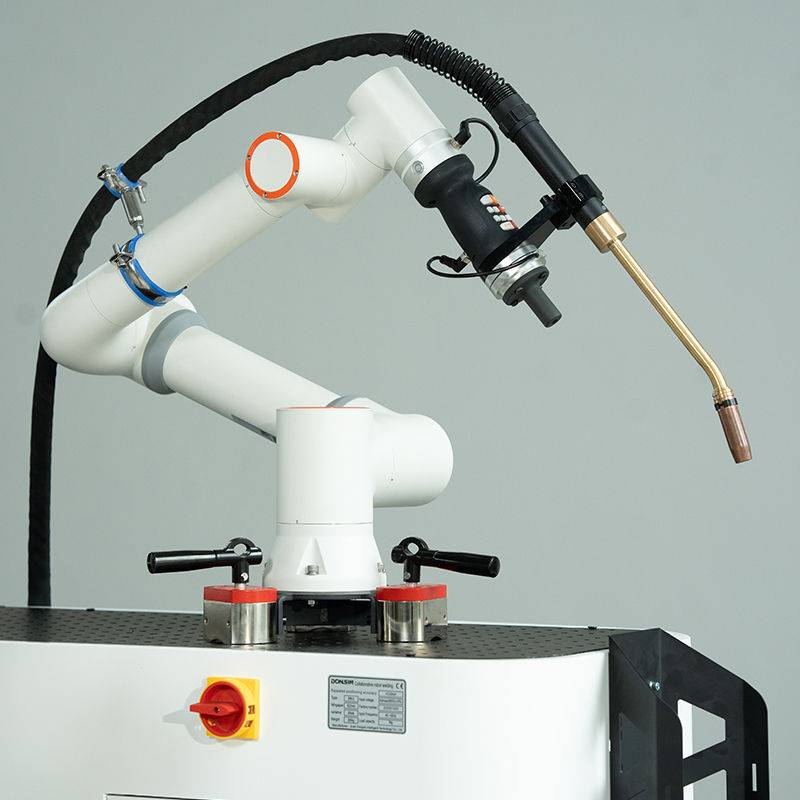
The core of the system is a 3kW continuous wave (CW) fiber laser integrated with a 6-axis collaborative robot. Unlike traditional industrial robots, the Fiber Laser Cobot allows for “lead-through” programming, which was essential for the rapid prototyping of bevel geometries found in the Cairo workshop. The laser technology utilized here relies on a 1070nm wavelength, which offers high absorption rates in carbon steel welding.
In this application, the cobot’s precision is the force multiplier. When performing multi-pass welds on thick carbon steel, the alignment of the laser beam within a 1.2mm V-prep groove is unforgiving. We utilized a “wobble” head configuration, where the laser technology oscillates the beam in a circular or figure-eight pattern. This oscillation compensates for fit-up discrepancies—a common reality in local Cairo steel yards—and ensures side-wall fusion during the fill passes.
3. Metallurgical Considerations in Carbon Steel Welding
Carbon steel welding with fiber lasers requires a different metallurgical mindset than traditional arc welding. Because the energy density is significantly higher, the cooling rate (t8/5) is much faster. In our Cairo field tests, we observed that without proper parameter management, the rapid quenching could lead to martensitic transformation in the HAZ of the S355JR steel.
To mitigate this, the Fiber Laser Cobot was programmed to utilize a dual-focus strategy for the root pass. The first pass establishes deep penetration using a concentrated beam, while subsequent fill passes utilize a defocused, wider beam to provide a tempering effect. This “in-situ” heat treatment is a direct benefit of the programmable nature of modern laser technology. We monitored the interpass temperature rigorously, keeping it between 150°C and 200°C to ensure optimal grain structure.
4. Multi-pass Strategy and Wire Feed Integration
For 20mm carbon steel welding, a single pass is insufficient. We implemented a three-pass strategy:
- Root Pass: Autogenous (or minimal wire) laser welding at 2.5kW, 0.8m/min travel speed. Focus position was set at -2mm (below surface) to ensure full penetration.
- Fill Pass: Integration of a 1.2mm ER70S-6 filler wire. The Fiber Laser Cobot synchronized the wire feed speed (WFS) with the travel speed to prevent “cold lapping.” We used 2.8kW power with a 4mm wobble width.
- Cap Pass: Lower power (2.0kW) and higher travel speed to ensure a smooth aesthetic finish and to minimize the reinforcement height, reducing stress concentration factors.
The laser technology allowed us to use a 30-degree included angle for the bevel, significantly narrower than the 60-degree angle required for GMAW. This resulted in a 50% reduction in filler metal consumption.
5. Cairo Environmental Impacts and Lessons Learned
Operating high-end laser technology in Cairo’s industrial climate requires specific preventative measures that are often overlooked in European or North American manuals. Lesson Learned: The dual-stage chiller units for the Fiber Laser Cobot must be oversized. We experienced several thermal trips during the mid-afternoon shift when ambient shop temperatures peaked. We eventually partitioned the welding cell and installed a dedicated HVAC duct to the laser resonator cabinet.
Furthermore, dust mitigation is critical. The optical lenses in the laser head are susceptible to “pitting” from the fine desert sand and metallic dust prevalent in Cairo workshops. We implemented a positive-pressure air curtain over the protective window and mandated a strict lens inspection every four hours of beam-on time. This reduced our consumable costs by 30% over the first month of operation.
6. Operational Synergy: Human-Cobot Collaboration
The “Cobot” aspect of the Fiber Laser Cobot was vital for the Cairo workforce. The local welding team consisted of highly skilled manual welders who initially viewed laser technology with skepticism. However, because the cobot allows the welder to manually guide the torch to “teach” the path, the transition was intuitive.
We found that the most efficient workflow involved the senior welder setting the path and parameters, while the cobot handled the high-heat, repetitive execution of the carbon steel welding. This reduced operator fatigue significantly. In the Cairo heat, reducing the physical strain on the welder is not just a comfort issue; it is a safety and quality control necessity.
7. Quality Assurance and NDT Results
Post-weld inspection was conducted using Ultrasonic Testing (UT) and Magnetic Particle Inspection (MPI). The results for the carbon steel welding passes were exceptional. We achieved a 98% pass rate on the first attempt, with the only failures occurring during the initial calibration phase where the wire-to-gas shielding ratio was slightly off.
The laser technology produced a much finer grain structure in the fusion zone than previously seen with GMAW. Tensile tests performed at a local Cairo laboratory confirmed that the weld strength exceeded the base metal yield strength, with failures occurring in the base material, proving the integrity of the multi-pass laser approach.
8. Conclusion and Future Outlook
The deployment of the Fiber Laser Cobot in Cairo has proven that laser technology is no longer confined to clean-room environments or thin-gauge automotive applications. For heavy-duty carbon steel welding, the cobot provides a bridge between manual craftsmanship and high-output automation.
Moving forward, we recommend the implementation of real-time seam tracking sensors to further enhance the cobot’s autonomy. In the context of Cairo’s growing infrastructure needs, the ability to deploy precise, high-speed welding in a mobile, collaborative format is a game-changer for the local industry. The technical success of this project serves as a blueprint for future fiber laser integrations across the Middle East.
Final Engineering Notes:
- Power Stability: Ensure a dedicated voltage stabilizer is used; Cairo’s grid can fluctuate, and laser technology is sensitive to voltage drops.
- Gas Quality: Use high-purity Argon/CO2 mixes. Impurities in local gas supplies can cause porosity in the carbon steel welding root pass.
- Shielding: Increase trailing shield gas flow by 15% when working in open-bay Cairo shops to compensate for cross-breezes.
-


LT240S tube laser cutting machine
-
LT120S tube laser cutting machine
-
Sale

Tank Fillet Welding Machine
Original price was: $1,000.00.$900.00Current price is: $900.00. -
Sale

MAK100 tube laser cutting machine
Original price was: $5,500.00.$5,000.00Current price is: $5,000.00. -

portable plasma air cutting machine
$1,200.00 -

2in1 fiber laser cutting machine
-

Air cooling Laser welding machine
-

HF h beam laser cutting machine
-

LT240 laser cutting machine
-

Laser welding machine
-


Cobot Welding Station
-

Gantry welding robot solution
-

Tracked Wheeled AGV Welding robot
-

LFH6020 Fiber laser cutting machine
-
LFP6020
-

robotic welidng machine
Advanced Fiber Laser Tube Processing Technology
Our CNC Fiber Laser Tube Cutting systems revolutionize metal fabrication by integrating high-precision cutting, punching, and profiling into a single automated workflow. Designed for versatility, this technology handles a wide array of profiles including Round, Square, Rectangular, and Oval tubes, as well as complex L-shaped and U-shaped channels.
- Precision Punching: High-speed hole punching with micron-level accuracy, eliminating the need for mechanical drilling or die-stamping.
- Complex Profiling: Advanced 3D pathing allows for intricate interlocking joints and specialized notch cuts, ideal for structural frames.
- High Material Efficiency: Intelligent nesting software minimizes scrap, reducing raw material costs across large production runs.
- Clean Finish: Delivers oxide-free, burr-free edges that require zero secondary grinding before welding.

Seamlessly processing multiple profiles with consistent precision.
Global Delivery & Logistics



From our high-tech manufacturing facility directly to your global site. PCL WeldCut ensures secure packaging, professional handling, and reliable international logistics to safeguard your equipment throughout the entire journey.