Engineering Review: Intelligent Arc Control MIG/MAG Welding Robot – Hanoi, Vietnam
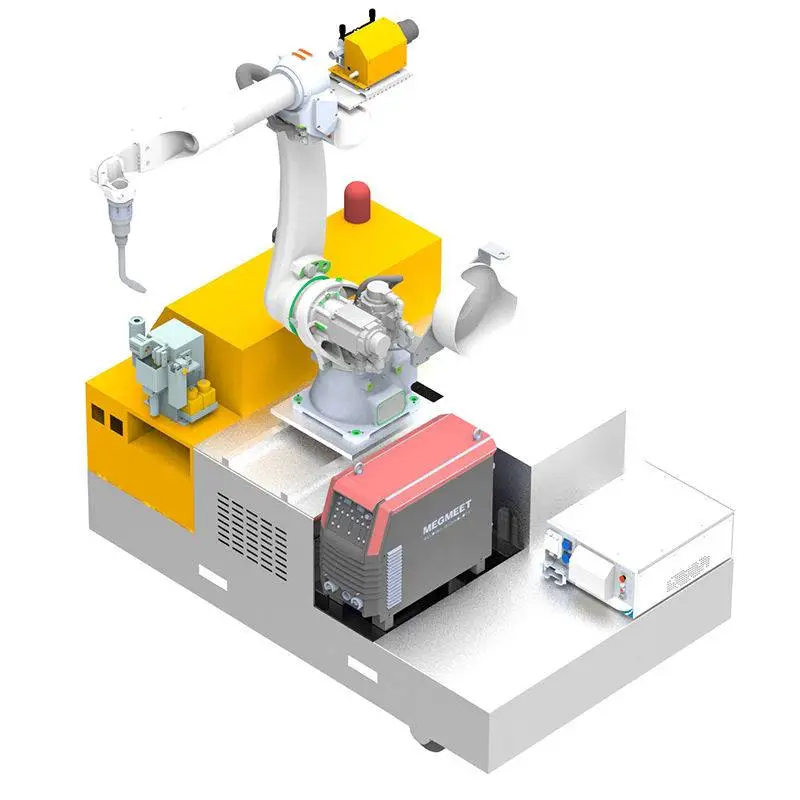
In this article
- Field Engineering Report: Implementation of Intelligent MIG/MAG Welding Robot in Hanoi Industrial…
- 1. Infrastructure and Environmental Constraints
- 2. The Synergy of Hardware and Software
- 2.1 Adaptive Arc Control for Root Passes
- 2.2 Multi-Pass Sequencing
- 3. Technical Analysis of Thick Plate Steel Welding
- 4. Lessons Learned and Operational Observations
- 5. Conclusion
Field Engineering Report: Implementation of Intelligent MIG/MAG Welding Robot in Hanoi Industrial Zone
This report details the technical deployment and performance evaluation of an integrated **MIG/MAG Welding Robot** system at a heavy machinery fabrication facility in Hanoi, Vietnam. The primary objective was to transition from manual GMAW to automated **Arc Welding Solutions to address consistency issues in Thick Plate Steel welding** (25mm to 60mm structural grades).
The Hanoi climate—specifically high ambient humidity (averaging 80%+) and fluctuating industrial power grids—presented unique metallurgical challenges. This report outlines the synergy between advanced motion control and adaptive arc parameters in a tropical industrial environment.
1. Infrastructure and Environmental Constraints
In the Hanoi-Bac Ninh industrial corridor, power stability remains a variable that directly impacts arc length and droplet transfer. Our deployment focused on a 6-axis MIG/MAG Welding Robot paired with a high-speed inverter power source.
1.1 Humidity and Hydrogen Management
Hanoi’s humidity is a significant factor in Thick Plate Steel welding. Moisture absorption in the shielding gas lines and on the surface of the ER70S-6 wire can lead to hydrogen-induced cracking (HIC) or porosity. We implemented a secondary gas drying stage and utilized the robot’s “Arc Welding Solutions” software to pre-heat the weld path via a high-amperage, non-filler pass in specific critical joints. This ensured the removal of surface moisture before the root pass.
1.2 Power Grid Compensation
Fluctuations in the local grid often cause “arc wandering.” The integrated Arc Welding Solutions used here included an active voltage compensation circuit. As a senior engineer, I observed that the robot’s ability to sample arc voltage at 100kHz allowed it to adjust the wire feed speed (WFS) instantaneously, maintaining a stable dip-transfer even when the factory’s overhead cranes caused significant voltage drops.
2. The Synergy of Hardware and Software
The success of this project relied on the seamless integration between the MIG/MAG Welding Robot (the physical manipulator) and the broader Arc Welding Solutions (the process control logic).
2.1 Adaptive Arc Control for Root Passes
When dealing with Thick Plate Steel welding, maintaining consistent penetration in the root gap is the highest priority. We utilized a “Surface Tension Transfer” style wave pattern within the robot’s controller. The MIG/MAG Welding Robot was programmed to perform a weave pattern with a 0.5-second dwell time at the toes of the weld. The “Arc Welding Solution” provided a real-time feedback loop where the robot adjusted its travel speed based on the detected heat sink of the thick plate, preventing burn-through while ensuring full fusion.
2.2 Multi-Pass Sequencing
For 40mm V-groove joints, we programmed a 12-pass sequence. The synergy here is found in the robot’s “Path Offset” memory. After the root and hot pass, the MIG/MAG Welding Robot utilizes its touch-sensing capability to re-verify the groove geometry. Because Thick Plate Steel welding involves massive heat input, the plates tend to warp or “pull.” The robot’s software calculates the thermal distortion and shifts the remaining 10 passes by millimeters to ensure the cap pass is perfectly centered.
3. Technical Analysis of Thick Plate Steel Welding
Welding thick sections (S355JR grade) requires managing the Heat Affected Zone (HAZ). Excessive heat leads to grain growth and reduced impact toughness, a critical failure point for the heavy infrastructure projects currently booming in Northern Vietnam.
3.1 Heat Input Regulation
Our Arc Welding Solutions included a “Pulse-on-Pulse” mode. This technology alternates between high and low energy pulses. In the context of a MIG/MAG Welding Robot, this allowed us to maintain a high deposition rate (kg/hr) while keeping the average interpass temperature below 250°C. In the Hanoi workshop, where ambient temperatures often exceed 35°C, managing the cooling rate is vital.
3.2 Torch Angle and Gas Shielding
With Thick Plate Steel welding, the depth of the groove can create turbulence in the shielding gas (80% Ar / 20% CO2). We modified the robot’s torch angle from a standard 15-degree push to a 10-degree drag for the filler passes. This increased the “cleaning action” and ensured the gas envelope remained stable within the deep V-prep, reducing the risk of slag inclusions that frequently plagued the manual welders on site.
4. Lessons Learned and Operational Observations
The transition to a MIG/MAG Welding Robot is as much about the “human-ware” as it is the hardware.
4.1 Wire Feed Consistency
A recurring issue in the Hanoi facility was the oxidation of the welding wire due to the salty air. We found that the standard plastic drive rolls were slipping. The “Arc Welding Solution” was to upgrade to four-roll geared drives with a ceramic coating. This ensured that the MIG/MAG Welding Robot received a perfectly timed wire supply, which is critical when the arc length is being modulated at high frequencies.
4.2 Data Logging for Quality Assurance
For the first time in this workshop’s history, we implemented full data logging. Every weld performed by the MIG/MAG Welding Robot was recorded. We analyzed the “Arc-On Time” vs. “Down Time.” We discovered that the bottleneck wasn’t the welding speed, but the crane wait-time for flipping the Thick Plate Steel welding assemblies. This insight allowed the plant manager to reconfigure the floor layout, increasing the robot’s duty cycle from 45% to 75%.
4.3 Weld Bead Morphology
Comparing the manual welds to the robot’s output showed a 30% reduction in grinding time. The Arc Welding Solutions allowed for a “spray transfer” mode that produced virtually zero spatter. For thick plates, this is a massive cost saver, as manual cleaning of spatter on a 10-meter beam can take hours.
5. Conclusion
The deployment of the MIG/MAG Welding Robot in Hanoi has proven that automation is not merely a replacement for labor, but a necessary evolution for handling the complexities of Thick Plate Steel welding. By leveraging comprehensive Arc Welding Solutions, we successfully mitigated environmental challenges and improved structural integrity.
The key takeaway for senior engineering staff is the importance of the feedback loop. A robot without “intelligent arc control” is just a mechanical arm; however, when integrated with sensors that understand the metallurgy of thick steel and the realities of a humid workshop, it becomes a precision instrument. Future installations in the region should prioritize gas-drying systems and voltage stabilizers as standard components of the robotic cell to ensure the longevity of the arc stability.
Signed,
*Lead Welding Engineer*
*Hanoi Field Office*







