Field Report: Deployment of Intelligent Arc Control in High-Capacity Structural Steel Fabrication
1. Project Overview and Site Conditions
This report details the technical deployment and optimization of an Intelligent Arc Control MIG/MAG Welding Robot system at a Tier-1 structural steel facility located in the Samut Prakan industrial corridor, Bangkok. The facility specializes in heavy-duty structural steel welding for high-rise infrastructure and bridge components. The primary objective was to transition from manual GMAW (Gas Metal Arc Welding) to an automated framework to address labor shortages and inconsistent penetration profiles in thick-plate sections.
Operating in Bangkok presents a specific set of environmental variables that are often underestimated in temperate-climate engineering manuals. During the commissioning phase, ambient temperatures averaged 34°C (93°F) with relative humidity levels peaking at 88%. These conditions directly impact the performance of Arc Welding Solutions, particularly concerning the cooling efficiency of the power source and the hygroscopic nature of wire surface contaminants. This report outlines how we synchronized hardware and software to maintain arc stability under these stressors.
2. Technical Specifications of the MIG/MAG Welding Robot
The core of the installation is a 6-axis articulated MIG/MAG Welding Robot equipped with a high-speed communication interface linked to a 500A digital inverter power source. Unlike standard robotic arms, this unit utilizes an “Intelligent Arc Control” software layer that monitors the short-circuiting phase in real-time.
2.1 Dynamic Arc Regulation
In structural steel welding, plate fit-up is rarely perfect. Gaps vary by 1.5mm to 3.0mm across long seams. The MIG/MAG Welding Robot was programmed using an adaptive arc logic. By sampling the current and voltage at 100kHz, the system detects a pending short-circuit and retracts the wire feed slightly or modulates the current waveform to prevent explosive spatter. This level of control is the cornerstone of modern Arc Welding Solutions, as it minimizes post-weld grinding—a significant cost-center in Thai fabrication shops.
2.2 Wire Feed Synchronization
We utilized a 1.2mm ER70S-6 solid wire. The synergy between the robot’s servo-motor and the wire feeder allowed for “Cold Metal Transfer” (CMT) style behaviors during the root pass. This is critical for structural steel welding where excessive heat input can lead to grain growth in the Heat Affected Zone (HAZ), reducing the seismic resilience of the joint.
3. Integrating Holistic Arc Welding Solutions
The term Arc Welding Solutions refers to the entire ecosystem—not just the robot. In Bangkok, the “solution” had to include a specialized gas delivery system and a robust thermal management plan.
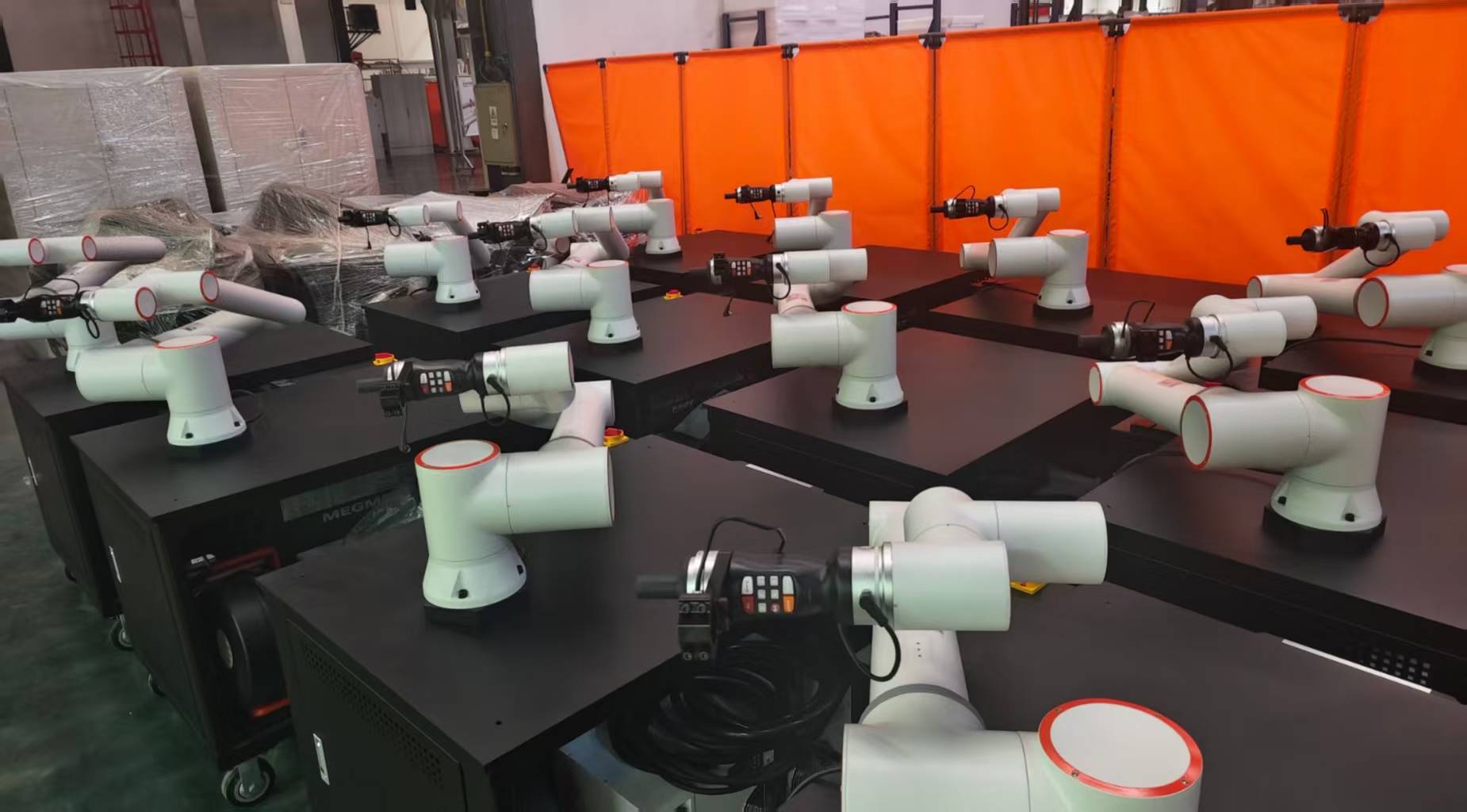
3.1 Gas Management and Shielding Integrity
In the high-humidity environment of Bangkok, moisture in the air can lead to hydrogen-induced cracking or porosity if the shielding gas is compromised. Our Arc Welding Solutions included the installation of a centralized gas mixing station (80% Argon / 20% CO2) with high-efficiency inline dryers. We found that increasing the flow rate to 22 L/min was necessary to counteract the draft from the massive industrial fans required for worker cooling in the facility, which otherwise would have disturbed the arc envelope.
3.2 Torch Cooling and Duty Cycle
Continuous structural steel welding demands a 100% duty cycle. Standard air-cooled torches are insufficient for the 40°C ambient temperatures of a Bangkok afternoon. We implemented a liquid-cooled torch system. During the field test, we observed that the liquid-cooled MIG/MAG Welding Robot maintained a stable tip-to-work distance (CTWD) without thermal expansion issues that typically plague air-cooled units in tropical climates.
4. Structural Steel Welding: Application and Methodology
The primary workload consisted of multi-pass fillet and groove welds on A36 and SS400 grade structural steel. Thicknesses ranged from 12mm to 40mm. The structural steel welding procedure specification (WPS) was optimized for the MIG/MAG Welding Robot to maximize deposition rates without sacrificing mechanical properties.
4.1 Multi-Pass Strategy
For a 20mm V-groove joint, we programmed a 3-layer, 7-pass sequence. The Intelligent Arc Control allowed for a “spray transfer” mode on the fill passes, depositing roughly 5.2kg of weld metal per hour. This is nearly triple the rate of the manual welders previously employed on the site. The robot’s ability to maintain a consistent travel speed of 35cm/min ensured that the interpass temperature did not exceed 250°C, a critical metric for maintaining the structural integrity of the base metal.
4.2 Seam Tracking and Sensing
Given the scale of structural steel welding, thermal distortion is inevitable. We integrated a “Through-Arc Seam Tracking” (TAST) system into our Arc Welding Solutions package. As the MIG/MAG Welding Robot weaves across the joint, it senses changes in the current and automatically adjusts the torch height and lateral position. This compensated for the “bowing” effect common in long 6-meter beams during the welding process.
5. Environmental Challenges and Engineering Workarounds
The Bangkok deployment highlighted two specific challenges: power grid volatility and humidity-induced wire oxidation.
5.1 Power Fluctuations
The industrial park experienced voltage drops during peak afternoon hours (when air conditioning loads across the city are highest). Our Arc Welding Solutions had to include a dedicated voltage stabilizer for the MIG/MAG Welding Robot. Without this, the intelligent arc control logic would occasionally throw “undervoltage” errors, interrupting the duty cycle. Engineering note: Always specify an isolated ground in Southeast Asian industrial zones to prevent electromagnetic interference (EMI) from neighboring heavy machinery.
5.2 Wire Preservation
During the first week, we noticed increased spatter. The cause was surface oxidation on the welding wire due to the 90% humidity. We solved this by implementing “wire tents” with silica desiccant packs and ensuring that wire spools were not left on the MIG/MAG Welding Robot overnight. This simple procedural change restored the arc’s “crispness” and reduced contact tip wear by 30%.
6. Lessons Learned and Future Recommendations
The deployment of an Intelligent Arc Control MIG/MAG Welding Robot in a Bangkok-based structural steel welding environment yields several critical takeaways for senior engineers:
- Software is the Bridge: The synergy between the MIG/MAG Welding Robot and the Arc Welding Solutions software is what makes the system viable for structural work. Adaptive arc control is not a luxury; it is a necessity when dealing with the variable fit-ups of large-scale steel.
- Thermal Management: In tropical climates, the “Solution” must prioritize cooling. This includes the power source, the torch, and even the control cabinet. We added auxiliary fans to the robot controller cabinet to prevent CPU throttling during the 2:00 PM heat peak.
- Parameter Tuning: Standard “out-of-the-box” weld programs fail in high humidity. We had to slightly increase the voltage (0.5V – 1.0V) compared to European benchmarks to maintain the same arc length and penetration profile.
- Training: The shift from manual structural steel welding to robotic automation requires a mindset shift. The Thai technicians were excellent at manual manipulation but needed focused training on “welding by the numbers”—interpreting the digital feedback from the Intelligent Arc Control system.
7. Conclusion
The implementation was a success. The defect rate (as measured by ultrasonic testing) dropped from 4.2% to 0.8% within the first three months. The MIG/MAG Welding Robot has proven that when integrated with high-tier Arc Welding Solutions, it can handle the rigors of structural steel welding even in the demanding climate of Bangkok. The key is not just the hardware, but the intelligent modulation of the arc to compensate for real-world environmental and material variables.
Report Prepared By:
Senior Welding Engineer
Bangkok Field Office
-


LT240S tube laser cutting machine
-
LT120S tube laser cutting machine
-
Sale

Tank Fillet Welding Machine
Original price was: $1,000.00.$900.00Current price is: $900.00. -
Sale

MAK100 tube laser cutting machine
Original price was: $5,500.00.$5,000.00Current price is: $5,000.00. -

portable plasma air cutting machine
$1,200.00 -

2in1 fiber laser cutting machine
-

Air cooling Laser welding machine
-

HF h beam laser cutting machine
-

LT240 laser cutting machine
-

Laser welding machine
-


Cobot Welding Station
-

Gantry welding robot solution
-

Tracked Wheeled AGV Welding robot
-

LFH6020 Fiber laser cutting machine
-
LFP6020
-

robotic welidng machine
Advanced Fiber Laser Tube Processing Technology
Our CNC Fiber Laser Tube Cutting systems revolutionize metal fabrication by integrating high-precision cutting, punching, and profiling into a single automated workflow. Designed for versatility, this technology handles a wide array of profiles including Round, Square, Rectangular, and Oval tubes, as well as complex L-shaped and U-shaped channels.
- Precision Punching: High-speed hole punching with micron-level accuracy, eliminating the need for mechanical drilling or die-stamping.
- Complex Profiling: Advanced 3D pathing allows for intricate interlocking joints and specialized notch cuts, ideal for structural frames.
- High Material Efficiency: Intelligent nesting software minimizes scrap, reducing raw material costs across large production runs.
- Clean Finish: Delivers oxide-free, burr-free edges that require zero secondary grinding before welding.

Seamlessly processing multiple profiles with consistent precision.
Global Delivery & Logistics



From our high-tech manufacturing facility directly to your global site. PCL WeldCut ensures secure packaging, professional handling, and reliable international logistics to safeguard your equipment throughout the entire journey.