Field Engineering Report: Implementation of Double Pulse Cobot Systems in Istanbul’s Metalworking Sector
1. Site Overview and Technical Context
This report details the operational deployment and performance evaluation of a Double Pulse Cobot Welding Machine within a high-output fabrication facility located in the Dudullu Industrial Zone, Istanbul. The facility specializes in stainless steel and aluminum sheet metal fabrication welding, primarily for the European export market. The primary objective was to replace traditional manual Gas Metal Arc Welding (GMAW) with a Collaborative Robotics framework to address consistency issues in thin-gauge assemblies.
In the Istanbul manufacturing landscape, space is a premium and the labor market is currently experiencing a shortage of high-level TIG welders. This environment necessitated a solution that offers the footprint of a manual station but the repeatability of an industrial robot. The introduction of the Cobot Welding Machine was not merely a hardware upgrade but a strategic shift toward “Collaborative Robotics”—where the human welder transitions from a manual torch-handler to a process controller.
2. The Synergy of Collaborative Robotics and Precision Welding
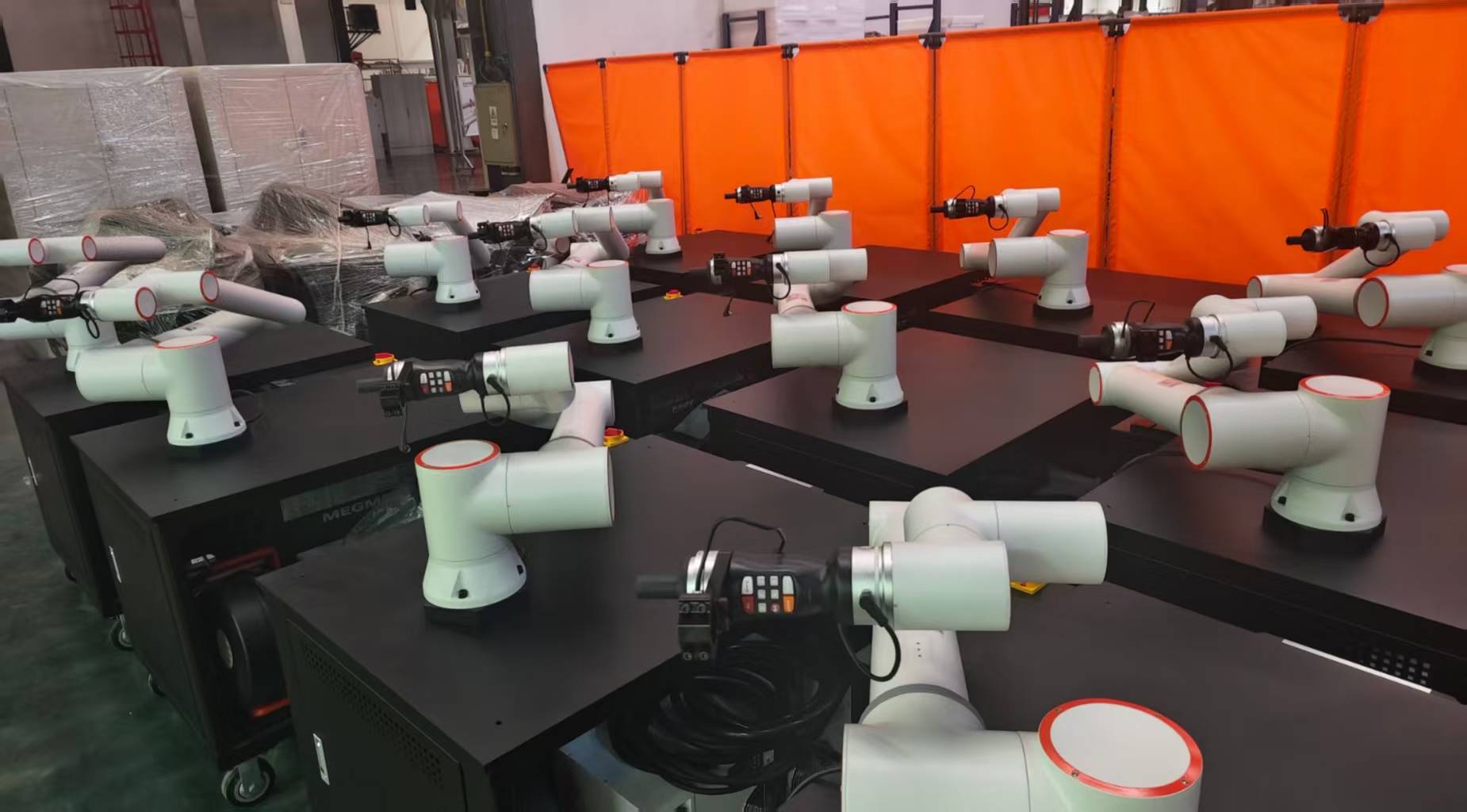
The core advantage observed during the Istanbul field trial was the seamless synergy between the human operator and the robotic arm. Unlike traditional industrial robots that require extensive safety caging and complex PLC programming, collaborative robotics allows the arm to work in the same physical space as the technician. In the context of a cramped Istanbul workshop, this eliminated the need for a 20-square-meter footprint for a single cell.
The “Cobot Welding Machine” functions as a force-multiplier. We utilized lead-through teaching (hand-guiding the robot to the start and end points) which reduced setup time from hours to approximately ten minutes for a new joint geometry. This is critical for the “High-Mix, Low-Volume” (HMLV) production cycles typical of Turkish SMEs. The synergy is realized when the welder uses their intuitive knowledge of “puddle behavior” to set the parameters, while the cobot provides the mechanical steadiness that human hands lack over a 12-hour shift.
3. Technical Deep-Dive: Double Pulse Functionality in Sheet Metal
Control of Heat Input and HAZ
Sheet metal fabrication welding, specifically on 1.0mm to 3.0mm gauges, is plagued by two enemies: burn-through and thermal distortion. The Double Pulse technology integrated into our Cobot Welding Machine provides a solution by modulating the current between two different energy levels. This “pulse-on-pulse” approach creates a refined droplet detachment, allowing the weld pool to cool slightly between pulses.
In our Istanbul trials, we focused on 304L stainless steel kitchen exhaust components. Manual welding often resulted in a 5% scrap rate due to warping. By utilizing the Double Pulse setting on the cobot, we achieved a “stacked-dime” aesthetic—traditionally only possible with TIG—but at the travel speeds of MIG/MAG. The reduced Heat Affected Zone (HAZ) meant that post-weld straightening processes were reduced by 85%.
Gap Bridging and Adaptive Logic
One of the “lessons learned” in this field report concerns material fit-up. In many Istanbul shops, upstream processes like laser cutting or shearing may have tolerances of +/- 0.5mm. A standard industrial robot would fail here. However, the collaborative robotics setup allowed our operators to quickly adjust the “weave” parameters on the fly via the tablet interface. The Double Pulse frequency was adjusted to 2.5Hz, which broadened the arc and allowed the machine to bridge inconsistent gaps without blowing through the root.
4. Practical Application: The Istanbul Workshop Environment
The environmental conditions in Istanbul’s industrial districts present unique challenges. Power grid fluctuations and high ambient humidity near the Sea of Marmara can affect arc stability and gas shielding integrity.
During the deployment, we identified that the Cobot Welding Machine’s sensitivity to voltage drops required the installation of a dedicated industrial stabilizer. Furthermore, the collaborative nature of the setup meant that the “welding curtain” was often moved to allow for material flow. We had to recalibrate the gas pre-flow and post-flow settings to compensate for localized drafts in the open-bay workshop, ensuring the Double Pulse arc remained shielded from oxidation.
5. Metrics and Performance Data
The following observations were recorded over a 30-day trial period compared to a manual welding baseline:
- Cycle Time: Reduced by 40% per unit. While the cobot doesn’t necessarily move faster than a human, its “arc-on” time is significantly higher due to lack of fatigue.
- Wire Consumption: Decreased by 12% due to precise control of the pulse parameters and reduced over-welding (avoiding excessively large fillets).
- Consumable Life: Contact tip life increased by 30% because the cobot maintains a perfect Contact-Tip-to-Work-Distance (CTWD), preventing the overheating common in manual “dragging.”
- Rework Rate: Dropped from 8% to less than 1%.
6. Lessons Learned from the Field
The Importance of Workholding
A critical lesson learned is that while a Cobot Welding Machine is flexible, it is only as good as the jigging. We initially attempted to use modular clamps, but the high-frequency vibration of the Double Pulse arc necessitated heavy-duty, toggle-clamp fixtures to prevent “creep” during the weld cycle. Collaborative robotics doesn’t mean “lax standards”; it means the precision shifts from the hand to the fixture.
Software Over Hardware
In the Istanbul fab shop, we found that the welders’ biggest hurdle wasn’t the robotics—it was understanding the relationship between “Base Current” and “Pulse Frequency.” We spent more time training the team on the digital interface of the power source than on moving the robotic arm. For senior engineers, the takeaway is clear: transition your veteran welders into “Robot Supervisors” early in the process.
Safety and Interaction
The “Collaborative” aspect was tested when an operator accidentally entered the cobot’s path during a rapid move. The force-sensing joints worked as advertised, stopping the machine instantly without injury. This validated the choice of collaborative robotics over traditional automation for this specific high-traffic workshop layout.
7. Conclusion and Recommendations
The implementation of the Double Pulse Cobot Welding Machine in Istanbul has proven that high-end sheet metal fabrication welding can be successfully automated even in SMEs. The synergy between the human’s tactical adjustments and the machine’s mechanical precision addresses the specific quality demands of the export market.
For future deployments, I recommend a 3-day “Pulse Theory” workshop for all operators before the hardware arrives. The hardware is remarkably robust, but the mastery of the double-pulse waveform is what ultimately determines the quality of the finish. Istanbul’s fabrication sector is ripe for this technology, provided the transition focuses on the collaborative relationship rather than mere machine replacement.
Engineer’s Note: Always check the grounding in older Istanbul facilities. We found a 2V stray voltage on the shop floor that was interfering with the cobot’s encoder signals. Dedicated grounding is non-negotiable for collaborative robotics.
-


LT240S tube laser cutting machine
-
LT120S tube laser cutting machine
-
Sale

Tank Fillet Welding Machine
Original price was: $1,000.00.$900.00Current price is: $900.00. -
Sale

MAK100 tube laser cutting machine
Original price was: $5,500.00.$5,000.00Current price is: $5,000.00. -

portable plasma air cutting machine
$1,200.00 -

2in1 fiber laser cutting machine
-

Air cooling Laser welding machine
-

HF h beam laser cutting machine
-

LT240 laser cutting machine
-

Laser welding machine
-


Cobot Welding Station
-

Gantry welding robot solution
-

Tracked Wheeled AGV Welding robot
-

LFH6020 Fiber laser cutting machine
-
LFP6020
-

robotic welidng machine
Advanced Fiber Laser Tube Processing Technology
Our CNC Fiber Laser Tube Cutting systems revolutionize metal fabrication by integrating high-precision cutting, punching, and profiling into a single automated workflow. Designed for versatility, this technology handles a wide array of profiles including Round, Square, Rectangular, and Oval tubes, as well as complex L-shaped and U-shaped channels.
- Precision Punching: High-speed hole punching with micron-level accuracy, eliminating the need for mechanical drilling or die-stamping.
- Complex Profiling: Advanced 3D pathing allows for intricate interlocking joints and specialized notch cuts, ideal for structural frames.
- High Material Efficiency: Intelligent nesting software minimizes scrap, reducing raw material costs across large production runs.
- Clean Finish: Delivers oxide-free, burr-free edges that require zero secondary grinding before welding.

Seamlessly processing multiple profiles with consistent precision.
Global Delivery & Logistics



From our high-tech manufacturing facility directly to your global site. PCL WeldCut ensures secure packaging, professional handling, and reliable international logistics to safeguard your equipment throughout the entire journey.