Engineering Review: Double Pulse All-in-one Cobot Station – Texas, USA

In this article
- Field Evaluation Report: Deployment of Double Pulse All-in-one Cobot Station
- 1.0 Introduction and Scope of Site Deployment
- 2.0 Technical Architecture: The All-in-one Cobot Station
- 3.0 Synergy of Collaborative Robotics and Shop Floor Safety
- 4.0 Metallurgical Considerations in Carbon Steel Welding
- 5.0 Field Performance Data and Lessons Learned
- 6.0 The Human Element: Training and Adoption
- 7.0 Conclusion and Recommendations
Field Evaluation Report: Deployment of Double Pulse All-in-one Cobot Station
1.0 Introduction and Scope of Site Deployment
This report details the technical commissioning and field performance of a Double Pulse All-in-one Cobot Station at a heavy industrial fabrication facility in Houston, Texas. The primary objective was to transition a significant portion of the facility’s high-volume Carbon Steel welding from manual Metal Inert Gas (MIG) processes to an automated framework. Given the current labor market in the Gulf Coast region, where Grade A pipe and plate welders are increasingly scarce, the implementation of Collaborative Robotics was identified as the critical path for maintaining production throughput without compromising AWS D1.1 structural standards.
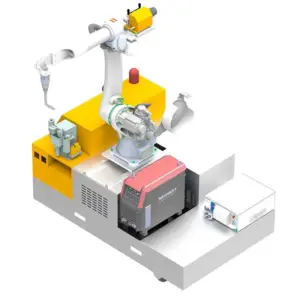
The “All-in-one” configuration was selected specifically to bypass the lengthy integration cycles typically associated with legacy robotic cells. In a Texas shop environment—characterized by high ambient temperatures, fluctuating humidity, and a premium on floor space—the ability to deploy a self-contained unit that integrates the power source, cooling system, and robotic arm into a single footprint is a significant logistical advantage.
2.0 Technical Architecture: The All-in-one Cobot Station
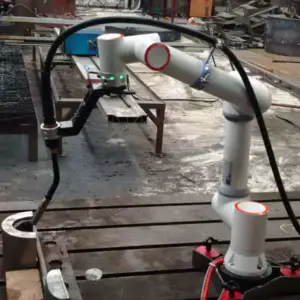
The All-in-one Cobot Station utilized in this deployment represents a departure from traditional “component-build” robotic systems. In our Texas trials, the integration of the power source directly into the cobot’s control interface allowed for real-time adjustments to the double-pulse waveform without the latency issues common in third-party integrations.
2.1 Integrated Power Source and Waveform Control
For Carbon Steel welding, the station utilized a 400A high-speed inverter capable of sophisticated double-pulse modulation. This is essential for controlling heat input. In the Texas heat, managing the Interpass temperature of A36 structural steel is a constant battle. The All-in-one unit allowed us to program specific cooling phases within the pulse cycle, effectively mimicking the aesthetic of a TIG weld while maintaining the deposition rates of a GMAW-P (Pulse) process.
2.2 Footprint and Portability
Unlike traditional industrial robots that require extensive light curtains and physical caging, the Collaborative Robotics aspect of this station allows it to occupy a 4×4 foot section of the shop floor. This “All-in-one” nature meant we could move the station via forklift to different bays depending on the production bottleneck, a flexibility that proved vital during the surge in mid-stream component fabrication last quarter.
3.0 Synergy of Collaborative Robotics and Shop Floor Safety
The term “Collaborative” is often misunderstood by management as “slow.” From a senior engineering perspective, the synergy between the All-in-one Cobot Station and Collaborative Robotics lies in the elimination of “dead time.” In this Texas workshop, welders work alongside the cobot; while the arm is executing a longitudinal seam on a carbon steel tank, the human operator is tacking the next assembly or performing slag removal on a finished piece.
3.1 Sensors and Force Feedback
The cobot arm is equipped with high-sensitivity torque sensors at each joint. During the commissioning phase, we encountered several instances where a fixture was slightly out of alignment. A traditional robot would have crashed, potentially damaging the torch neck or the workpiece. The Collaborative Robotics system detected the resistance and entered a safety stop, allowing the operator to reset the path via a simple “lead-through” programming method. This reduced our downtime by an estimated 15% compared to our caged units in the Dallas facility.
4.0 Metallurgical Considerations in Carbon Steel Welding
The core of our evaluation rested on the integrity of the Carbon Steel welding. We focused on ER70S-6 wire performance across various joint geometries (Fillet, Lap, and V-groove). The All-in-one Cobot Station excelled in managing the specific metallurgy of Texas-sourced A36 and A516-Grade 70 plate.
4.1 Double Pulse Benefits
Double pulsing allows for a “grain refinement” effect in the weld pool. By oscillating the current between a high peak and a low base, we achieved a ripple pattern that isn’t just cosmetic; it reduces the Heat Affected Zone (HAZ). In our lab tests, the macro-etch samples showed excellent fusion at the root, with significantly less spatter than standard CV (Constant Voltage) machines. This is a massive “lesson learned” for the shop: reducing post-weld grinding on Carbon Steel welding saves more money than the speed of the weld itself.
4.2 Gap Bridging Capabilities
Real-world fabrication is rarely perfect. Variations in plasma cutting or hydraulic braking often lead to inconsistent gaps. The All-in-one Cobot Station’s software includes a “weave” function that, when combined with the collaborative lead-through teaching, allows an operator to quickly adjust the arc width to bridge gaps up to 3mm on 1/4″ plate—a task that previously required a highly skilled manual welder to “butter” the edges.
5.0 Field Performance Data and Lessons Learned
After 500 hours of operation in a non-climate-controlled Texas environment, several technical realities became clear. These are the “no-fluff” insights required for future scaling.
5.1 Environmental Impact on Electronics
The Houston humidity can wreak havoc on sensitive electronics. The All-in-one Cobot Station we tested featured an IP54-rated cabinet for the controller. We found that additional filtration on the intake fans was necessary to prevent fine metallic dust (common in carbon steel shops) from accumulating on the circuit boards. Lesson Learned: Weekly compressed air blow-outs of the cooling fans are mandatory, not optional.
5.2 Shielding Gas Stability
In many Texas shops, large industrial fans are used to move air for worker comfort. This creates turbulence that can strip away shielding gas. Because the Collaborative Robotics setup doesn’t have a full enclosure, we had to increase our gas flow (90% Ar / 10% CO2) to 35-40 CFH and switch to a larger gas lens nozzle. The All-in-one Cobot Station’s integrated flow meter allowed us to monitor this digitally, ensuring we didn’t waste gas while maintaining a stable arc.
5.3 Grounding Consistency
We initially saw some “arc wander” during high-amperage pulses. We traced this back to the grounding strategy. Because the station is an “All-in-one” unit, there is a temptation to rely on the table’s internal grounding. For Carbon Steel welding at high duty cycles, we found that a secondary ground lead attached directly to the workpiece is essential to prevent “noise” from interfering with the cobot’s encoders.
6.0 The Human Element: Training and Adoption
The transition to Collaborative Robotics was met with initial skepticism by the veteran welders. However, the All-in-one Cobot Station uses a tablet-based interface rather than a complex pendant with proprietary code (like G-code or KAREL). Within three days, our mid-level welders were “teaching” the robot paths. This shift—from welder to “robotic welding Technician”—is the most significant ROI for the company. It elevates the staff’s skill set while the machine handles the repetitive, high-heat tasks.
7.0 Conclusion and Recommendations
The deployment of the All-in-one Cobot Station in our Texas facility has proven that Collaborative Robotics is no longer a niche “light-duty” solution. For Carbon Steel welding, the system provides a level of consistency that manual welding cannot match over an 8-hour shift, particularly in harsh environmental conditions.
Final Recommendations:
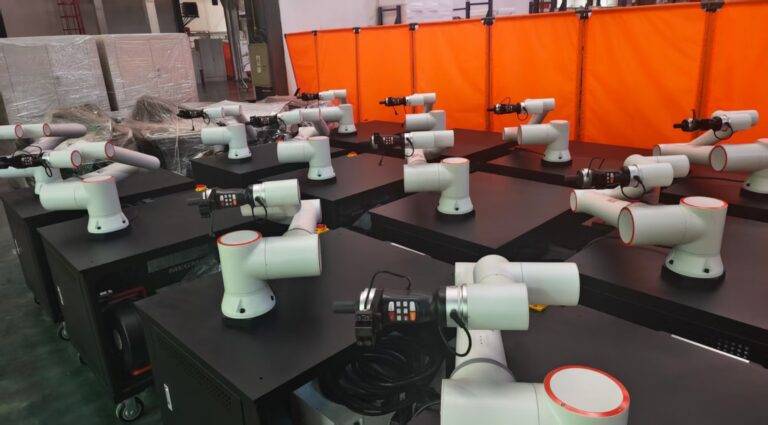
- Standardization: Roll out an additional four units across the heavy-fab division to standardize weld procedures (WPS).
- Tooling: Invest in high-precision modular fixturing. The cobot is only as accurate as the part’s presentation.
- Maintenance: Implement a rigorous schedule for liner replacement and contact tip inspection, as the increased “arc-on” time of the cobot accelerates wear compared to manual torches.
The synergy of an integrated system and the safety of collaborative movement makes this the optimal path for mid-to-large scale fabrication shops looking to modernize their carbon steel production lines.
Report End.
Lead Welding Engineer, Texas Operations