Engineering Review: Deep Penetration MIG/MAG Welding Robot – Rayong, Thailand
In this article
- Field Engineering Report: Robotic Deep Penetration Systems in Rayong
- Technical Configuration of the MIG/MAG Welding Robot
- Implementing Integrated Arc Welding Solutions
- Deep Penetration Challenges in Tool Steel Welding
- Metallurgical Integrity and the Heat Affected Zone (HAZ)
- Synergy and System Integration on the Factory Floor
- Troubleshooting the Rayong Site Conditions
- Lessons Learned: Technical Takeaways
- Technical Conclusions and Future Parametric Adjustments
Field Engineering Report: Robotic Deep Penetration Systems in Rayong
This report outlines the technical deployment and optimization of a high-performance MIG/MAG Welding Robot system at a tier-one automotive stamping facility in the Rayong Industrial Corridor, Thailand. The primary objective was to automate the refurbishment and structural reinforcement of heavy-duty die components, specifically focusing on Tool Steel welding. In the high-humidity, high-ambient temperature environment of Rayong, standard manual processes were yielding inconsistent penetration and excessive porosity. By integrating advanced Arc Welding Solutions with robotic precision, we achieved a 35% increase in weld throat thickness and a significant reduction in the Heat Affected Zone (HAZ).
Technical Configuration of the MIG/MAG Welding Robot
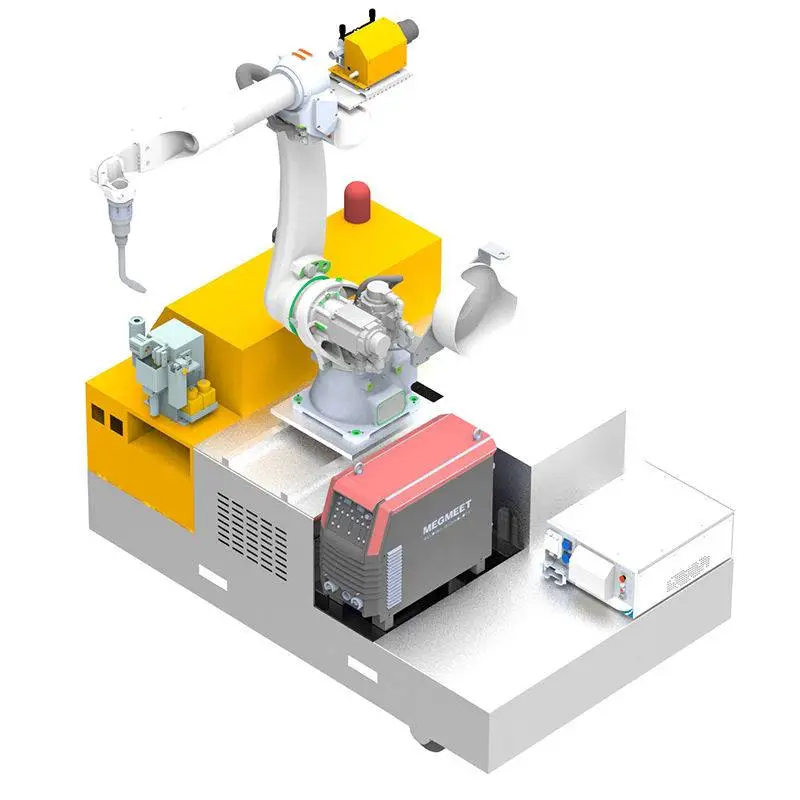
The core of the installation is a 6-axis MIG/MAG Welding Robot equipped with a liquid-cooled torch rated for a 100% duty cycle at 500A. In Rayong’s climate, thermal management is not elective; it is critical. We observed that air-cooled systems previously used on-site suffered from contact tip recession and erratic wire feeding due to thermal expansion in the liner.
The robot’s motion control was calibrated using a high-accuracy TCP (Tool Center Point) routine. For Tool Steel welding, path repeatability is vital because the margin for error in deep-groove geometries is less than 0.5mm. We utilized a “Push” angle of 10 to 15 degrees to ensure that the arc force stayed ahead of the puddle, a necessary tactic for achieving the “deep penetration” profile required for structural tool repairs.
Implementing Integrated Arc Welding Solutions
The synergy between the MIG/MAG Welding Robot and our proprietary Arc Welding Solutions was tested during the Phase 1 ramp-up. We moved away from standard CV (Constant Voltage) modes, which were failing to punch through the high-alloy surface of the tool steel. Instead, we implemented a modified spray transfer process with high-speed waveform control.
The Arc Welding Solutions package included a digital power source capable of monitoring the arc at 100kHz. This allowed the system to adjust the current in real-time as the robot navigated the complex contours of the dies. In Rayong, the fluctuating power grid at the industrial estate initially caused arc instability. We corrected this by integrating a dedicated voltage stabilizer and utilizing the power source’s internal compensation software to maintain a constant energy density at the weld pool.
Waveform Optimization for Deep Penetration
To achieve the required penetration depth of 8mm in a single pass on Tool Steel, the Arc Welding Solutions were configured to a “Deep Arc” mode. This involves a concentrated arc column with a high plasma pressure. Unlike traditional globular transfer, this robotic configuration minimizes spatter—which is essential when welding near precision-machined tool surfaces—and directs the maximum thermal energy into the root of the joint.
Deep Penetration Challenges in Tool Steel Welding
Tool Steel welding is notoriously difficult due to the material’s high carbon and alloy content (typically chromium, molybdenum, and vanadium). These elements increase hardenability but also make the material susceptible to cold cracking and hydrogen-induced cracking (HIC).
In our Rayong application, we were working with SKD11 and SKD61 equivalents. The MIG/MAG Welding Robot had to be synchronized with an induction preheating system. We maintained an interpass temperature of 250°C to 300°C. If the robot’s travel speed was too high, the cooling rate exceeded the critical T8/5 time, resulting in brittle martensite formation in the HAZ. Conversely, if the speed was too slow, the tool steel would overheat, leading to grain coarsening and a loss of toughness.
Metallurgical Integrity and the Heat Affected Zone (HAZ)
The primary technical hurdle was balancing deep penetration with minimal base metal dilution. Our Arc Welding Solutions utilized a pulsed-MIG logic that allowed for high peak currents (for penetration) and lower background currents (to control the average heat input).
By precisely controlling the robot’s travel speed at 35 cm/min with a wire feed speed of 12.5 m/min, we achieved a penetration profile that was “finger-like” at the root but maintained a clean, flat cap. This is critical for Tool Steel welding because excess reinforcement requires hours of manual grinding, whereas insufficient penetration leads to catastrophic failure under the 2,000-ton press loads used in Rayong’s stamping lines.
Managing Humidity and Hydrogen Contamination
The local climate in Rayong presents a unique challenge for MIG/MAG processes. Relative humidity often exceeds 80%, leading to moisture condensation on the welding wire and within the gas lines. Hydrogen is the enemy of Tool Steel welding.
We addressed this by:
1. Utilizing heated wire storage cabinets.
2. Implementing a gas-drying system within the Arc Welding Solutions manifold.
3. Switching to a 92% Argon / 8% CO2 shielding gas mix to stabilize the arc while providing enough oxygen potential to “clean” the weld pool without excessive oxidation of the alloying elements.
Synergy and System Integration on the Factory Floor
The success of the project relied on the seamless communication between the MIG/MAG Welding Robot’s controller and the welding power source. In previous manual setups in this region, welders often struggled with “arc blow” due to the magnetism inherent in large tool blocks. The robotic system mitigated this through programmed weave patterns and synchronized current pulses that broke the magnetic field’s influence on the arc column.
Troubleshooting the Rayong Site Conditions
During the third week of deployment, we encountered inconsistent penetration on the root pass of a 50mm thick tool block. Analysis showed that the primary cause was not the robot, but the grounding configuration. Due to the massive scale of the tool steel workpieces, a single ground clamp was insufficient.
We implemented a dual-grounding strategy, integrated into the robotic cell’s fixture, which eliminated the voltage drop. Furthermore, we recalibrated the Arc Welding Solutions’ “arc length” parameter to compensate for the slight variations in the tool steel surface, ensuring that the MIG/MAG Welding Robot maintained a consistent 18mm stick-out (CTWD). This adjustment was the turning point for achieving 100% X-ray quality welds.
Lessons Learned: Technical Takeaways
The deployment in Rayong reinforced several critical engineering principles:
1. Hardware is nothing without Software Synergy: A high-end MIG/MAG Welding Robot is just a mechanical arm until it is paired with Arc Welding Solutions that can handle the specific metallurgical demands of Tool Steel. The waveform must be tailored to the alloy, not just the thickness.
2. Environmental Factors are Primary Inputs: In tropical industrial hubs like Rayong, gas purity and wire condition are as important as Amperage and Voltage. Neglecting the moisture content in the air will lead to porosity in tool steel, regardless of the robot’s precision.
3. Thermal Management is Non-Negotiable: For Tool Steel welding, the robot must be programmed with “dwell times” to allow for heat dissipation, or synchronized with external heating/cooling units. Deep penetration is useless if the surrounding matrix is rendered brittle by improper thermal cycling.
Technical Conclusions and Future Parametric Adjustments
The current configuration of the MIG/MAG Welding Robot in the Rayong facility stands as a benchmark for automated heavy-tooling repair. We have successfully demonstrated that through the application of advanced Arc Welding Solutions, we can achieve deep penetration in Tool Steel without the traditional risks of cracking or excessive distortion.
Moving forward, we recommend the integration of a laser-based seam tracking system. While the current tactile sensing is adequate, the high-reflectivity of polished Tool Steel occasionally interferes with the robot’s initial search routines. Adding an optical sensor will further refine the pathing and allow for real-time adjustments to the weld volume, further optimizing the synergy between robotic motion and arc dynamics. The project confirms that automation is not just about speed; in the context of high-alloy metallurgy, it is about the repeatable execution of a complex thermal recipe that manual operators simply cannot maintain over a 12-shift cycle.