Engineering Review: Air-cooled Robotic Arm Welder – Curitiba, Brazil
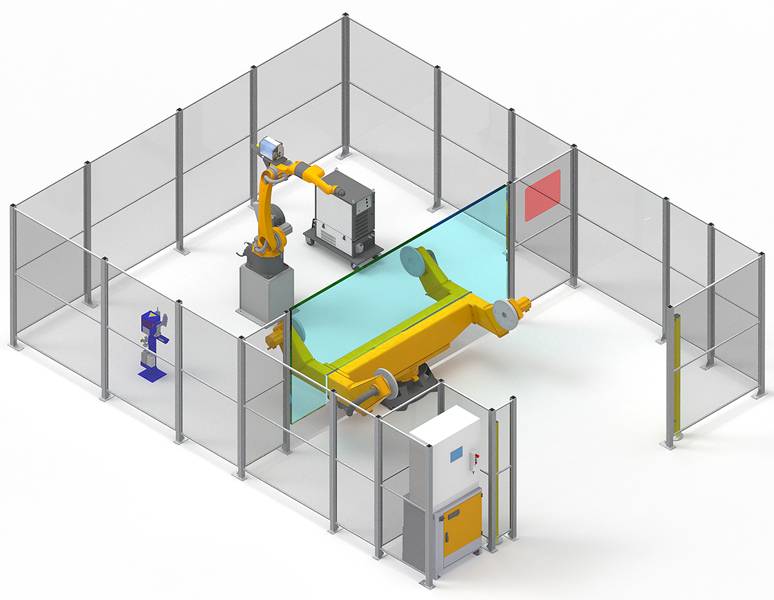
Field Report: Optimization of Air-Cooled Robotic Arm Welder Systems
Location: Cidade Industrial de Curitiba (CIC), Brazil
1. Executive Summary of Field Operations
This report details the operational deployment and calibration of a 6-axis air-cooled Robotic Arm Welder within a high-throughput facility in Curitiba, Brazil. The primary objective was the integration of Industrial Automation protocols to streamline the fabrication of Grade 5 titanium exhaust manifolds and structural housings. Unlike traditional water-cooled setups, the air-cooled configuration was selected to reduce maintenance overhead and eliminate the risk of coolant leaks contaminating the sensitive Titanium welding environment. Current findings indicate that while air-cooled torches offer significant agility, the thermal management of the contact tip and the laminar flow of shielding gas require precise algorithmic control within the automation software to prevent atmospheric contamination.
2. Infrastructure and Integration: The Curitiba Context
Curitiba serves as a critical hub for Brazil’s automotive and aerospace sectors. The facility in question transitioned from semi-automated GMAW (Gas Metal Arc Welding) to a fully integrated Industrial Automation cell. The synergy between the Robotic Arm Welder and the plant’s central PLC (Programmable Logic Controller) allowed for a 40% reduction in cycle time. However, the local climate—characterized by high humidity levels in the Parana region—presented unique challenges for Titanium welding. Titanium’s high reactivity with oxygen, nitrogen, and hydrogen at temperatures above 400°C necessitated a complete overhaul of the shop’s compressed air drying systems to ensure that the air-cooled torch did not introduce moisture-laden ambient air near the weld pool.
3. Technical Deep Dive: Robotic Arm Welder Performance
The Robotic Arm Welder utilized in this deployment features a 1.45-meter reach with a +/- 0.05mm repeatability specification. In the context of Industrial Automation, this precision is non-negotiable. When dealing with titanium, the “stack-up” of tolerances can lead to catastrophic failure if the arc length varies by even a millimeter.
Lessons Learned: Thermal Drift
During the first 72 hours of operation, we observed a slight TCP (Tool Center Point) drift as the air-cooled torch reached steady-state operating temperature. In an air-cooled system, the thermal expansion of the neck is more pronounced than in liquid-cooled variants. We mitigated this by implementing a “warm-up” routine in the Industrial Automation script, allowing the Robotic Arm Welder to perform three dry runs to stabilize the torch geometry before initiating the first arc on the titanium workpiece.
4. The Criticality of Titanium Welding Parameters
Titanium welding is less about the fusion itself and more about the management of the surrounding environment. Our focus in Curitiba was on Grade 5 (Ti-6Al-4V). The air-cooled Robotic Arm Welder was equipped with a custom-engineered trailing shield, a necessity for keeping the cooling weld bead under a blanket of high-purity Argon (99.999%) until it dropped below the critical oxidation temperature.
Shielding Gas Dynamics
We discovered that at the travel speeds enabled by Industrial Automation (approx. 350mm/min), the venturi effect was pulling atmospheric oxygen into the trailing shield. We had to redesign the diffuser screens to ensure laminar flow. A turbulent flow is the enemy of Titanium welding. If the weld bead appears blue, purple, or—worst of all—white and chalky, the part is scrap. Our goal was “silver to straw” coloration, achieved through the synchronization of the arm’s movement with a secondary gas solenoid controlled by the automation hub.
5. Synergy: Industrial Automation and Robotic Precision
The true power of Industrial Automation in this Curitiba plant is realized through the feedback loops between the Robotic Arm Welder and the sensors. We integrated an arc voltage control (AVC) system that communicates directly with the robot’s controller. If the voltage spikes—indicating a change in the gap or a contamination event—the system automatically adjusts the travel speed or halts the process to prevent a burn-through.
In Titanium welding, consistency is the only way to ensure structural integrity. Manual welders, no matter how skilled, suffer from fatigue which leads to variations in the Heat Affected Zone (HAZ). The Robotic Arm Welder eliminates this variable. By programming specific “dwell times” at the end of each pass, the automation system allows the heat to dissipate, preventing the grain growth that typically weakens titanium joints.
6. Environmental and Operational Challenges in Brazil
Operating high-end Industrial Automation in an equatorial/subtropical climate requires specific hardware considerations. In Curitiba, the diurnal temperature swing can be significant. We noted that the air-cooled torch’s duty cycle was reduced during the afternoon peak temperatures (approx. 28°C to 32°C inside the shop).
Root Cause Analysis: Duty Cycle Breaches
Initially, the Robotic Arm Welder triggered “Thermal Overload” alarms during the final 10% of the production run. The lesson learned was that the standard 60% duty cycle rating of the air-cooled torch was optimistic for the continuous, high-amperage pulses required for thick-section Titanium welding. We adjusted the Industrial Automation sequence to include a “gas-only” cooling pass where the robot moves to a cleaning station and purges the torch with high-velocity Argon, effectively using the shielding gas as a secondary coolant.
7. Material Science and Metallurgical Integrity
The integrity of Titanium welding in this project was verified through non-destructive testing (NDT), specifically X-ray and dye penetrant inspection. The Robotic Arm Welder produced a remarkably narrow HAZ compared to previous manual efforts. This is critical for Curitiba’s aerospace clients, where fatigue resistance is paramount.
By leveraging Industrial Automation, we were able to implement “pulsed TIG” (Tungsten Inert Gas) profiles. The robot oscillates the current between a peak and a background level. This pulsing agitates the weld pool, refining the grain structure and reducing the likelihood of porosity—a common defect when welding titanium in humid environments. The Robotic Arm Welder handled the high-frequency pulsing without interference issues, thanks to upgraded shielding on the control cables.
8. Engineering Recommendations and Future Outlook
Based on the field performance in Curitiba, the following protocols are recommended for any facility looking to pair a Robotic Arm Welder with Industrial Automation for Titanium welding:
- Atmospheric Monitoring: Integrate oxygen sensors into the weld cell that talk directly to the robot. If O2 levels exceed 50 ppm in the purge zone, the robot should be programmed to inhibit the arc.
- Contact Tip Maintenance: Air-cooled torches run hotter, leading to faster wear of the contact tip. We recommend a proactive replacement every 8 hours of “arc-on” time to maintain TCP accuracy.
- Gas Pre-Flow: Increase pre-flow times to 5 seconds. In the Curitiba facility, we found that ambient moisture would settle in the gas lines overnight; a long pre-flow is the only way to ensure the first weld of the day isn’t porous.
9. Conclusion
The deployment of the Robotic Arm Welder in Curitiba has proven that air-cooled systems are viable for Titanium welding, provided that the Industrial Automation logic accounts for thermal expansion and environmental variables. The synergy between these technologies has moved the facility from a reactive maintenance posture to a proactive production powerhouse. The lessons learned regarding gas laminar flow and duty cycle management are now being standardized across all Southern Brazilian operations. The “Curitiba Method”—focusing on high-purity gas dynamics and rigid automation feedback—is now the benchmark for our titanium fabrication units globally.
End of Report
Senior Welding Engineer, Field Operations Division







