Engineering Review: High-speed MAG All-in-one Cobot Station – Sydney, Australia
In this article
- Field Engineering Report: Implementation of High-Speed MAG All-in-one Cobot Station
- 1. Project Overview and Site Context
- 2. Technical Specifications of the All-in-One Cobot Station
- 3. The Challenge of Galvanized Pipe Welding
- 4. Synergy: Collaborative Robotics and All-in-One Integration
- 5. Performance Data and Lessons Learned
- 6. Strategic Impact on the Sydney Fabrication Sector
- 7. Conclusion and Technical Recommendations
Field Engineering Report: Implementation of High-Speed MAG All-in-one Cobot Station
1. Project Overview and Site Context
This report summarizes the commissioning and performance evaluation of the High-speed MAG All-in-one Cobot Station at a tier-two structural fabrication facility in Western Sydney, Australia. The site primarily produces safety handrails and architectural frames, requiring high-volume throughput of galvanized pipe welding. The primary objective was to address the acute shortage of skilled coded welders in the Sydney metropolitan area while maintaining compliance with AS/NZS 1554.1 standards.
The introduction of Collaborative Robotics into this specific environment was not merely an upgrade in automation but a strategic shift in floor-space management. In the Sydney industrial market, where warehouse square footage commands a premium, the footprint of the All-in-one Cobot Station proved critical. Unlike traditional industrial robotic cells that require extensive light curtains and physical fencing, the collaborative nature of this station allowed for integration directly into existing manual production lines.
2. Technical Specifications of the All-in-One Cobot Station
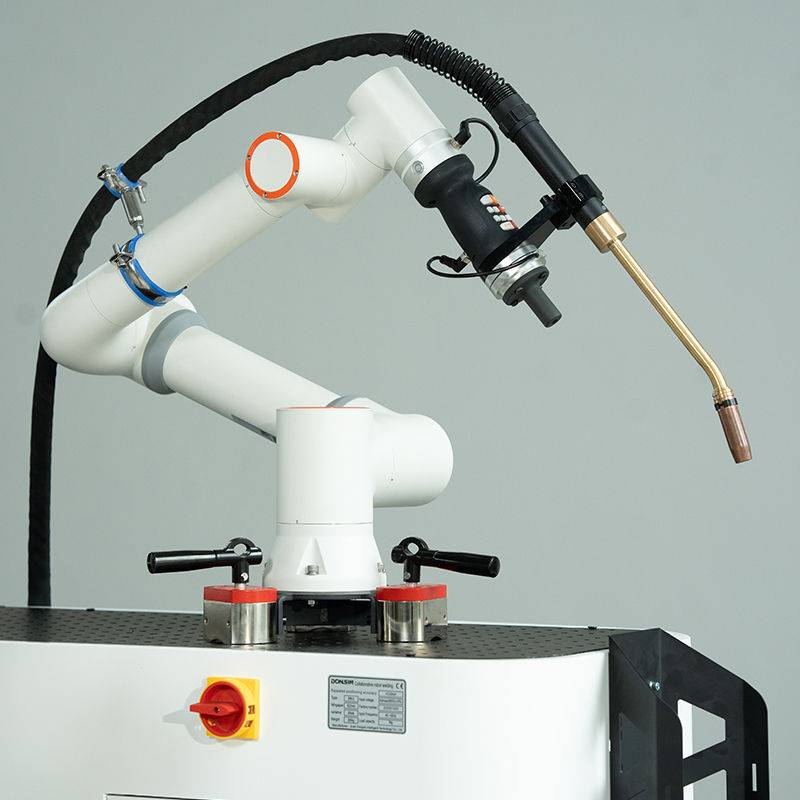
The unit deployed is a self-contained ecosystem. The “All-in-one” designation refers to the integration of the 500A pulse-capable MAG power source, the robotic controller, the wire feeder, and the torch cleaning station onto a single mobile chassis.
Integrated Power Source and Control
The synergy between the power source and the collaborative robotics interface is the backbone of the system. We utilized a high-speed MAG process (Metal Active Gas) with a modified short-arc characteristic specifically tuned for 48.3mm OD galvanized pipe. The All-in-one Cobot Station utilizes a unified software interface, allowing the operator to adjust wire feed speed and voltage trim directly from the cobot’s teach pendant, rather than toggling between a separate robot controller and a welding machine.
Collaborative Safety Protocols
Operating in a “fenceless” environment in a Sydney workshop requires strict adherence to ISO/TS 15066. The cobot’s force-torque sensors were calibrated to detect any resistance exceeding 150N, triggering an immediate Category 0 stop. This allowed our fabricators to work alongside the machine, prep-fitting one side of a jig while the cobot completed galvanized pipe welding on the other.
3. The Challenge of Galvanized Pipe Welding
Welding galvanized steel is historically problematic due to the low boiling point of zinc (approx. 907°C) compared to the melting point of steel (approx. 1500°C). In a manual setting, this results in excessive spatter, porosity, and toxic fume generation. When automating galvanized pipe welding, these issues are magnified because a robot cannot “feel” the puddle or adjust its hand mid-weld to compensate for zinc flare-ups.
Metallurgical Considerations
To combat porosity, the All-in-one Cobot Station was programmed with a specific “weave” pattern that allowed the zinc vapor to escape ahead of the solidifying weld pool. We moved away from standard CO2 shielding to an Argon/CO2 (82/18) mix, which provided a more stable arc and reduced the “explosive” reaction of the zinc coating. The collaborative robotics software allowed us to fine-tune the travel speed to exactly 450mm/min—a speed difficult for manual welders to maintain consistently on circular paths—ensuring enough heat to boil off the zinc but not so much as to undercut the thin-walled pipe.
4. Synergy: Collaborative Robotics and All-in-One Integration
The real-world success in the Sydney facility stemmed from the synergy between the hardware’s mobility and the software’s accessibility.
Deployment Speed
Because it is an All-in-one Cobot Station, the “Time to First Weld” was less than three hours from unboxing. Traditional industrial robots in the same Sydney plant took upwards of two weeks for commissioning. The collaborative robotics aspect meant we didn’t need to bolt the unit to the floor; the heavy-duty locking casters and the rigid integrated table provided enough stability for the MAG process’s high-speed movements.
Teaching and Programming
The “Lead-through” teaching method is where the collaborative robotics technology shines. Our senior welders, who had no prior coding experience, were able to grab the torch neck, move it through the circumferential path of the pipe, and record “waypoints.” This tactile interaction with the All-in-one Cobot Station bridged the gap between traditional craftsmanship and modern automation.
5. Performance Data and Lessons Learned
After six weeks of continuous operation in the Sydney heat (averaging 30°C+ in the workshop), several technical insights were documented.
Productivity Metrics
- Manual Welding: 12 minutes per frame (including tacking and cleaning).
- All-in-one Cobot Station: 4.5 minutes per frame.
- Rework Rate: Reduced from 8% (manual) to 0.5% (cobot).
The Fume Extraction Mandate
A major lesson learned involved fume management. While the cobot handles the galvanized pipe welding flawlessly, the volume of zinc oxide produced by high-speed MAG is significant. We had to integrate a high-vacuum, at-the-source extraction nozzle onto the cobot’s fifth axis. In the Sydney facility, local WHS (Work Health and Safety) regulations are stringent regarding hexavalent chromium and zinc oxide exposure. The All-in-one Cobot Station‘s controller allowed us to slave the extraction unit to the arc-on signal, ensuring power efficiency and maximum suction only during the weld cycle.
Wire Feeding Consistency
Galvanized wire (or standard wire on galvanized pipe) can be “dirty.” We found that using a ceramic-coated liner in the cobot’s torch lead was necessary to prevent the buildup of zinc dust shaved off the pipe. This is a nuance often missed in laboratory settings but vital in a Sydney field application where humidity can cause minor oxidation on the wire surface before it even reaches the feeder.
6. Strategic Impact on the Sydney Fabrication Sector
The Sydney market is currently seeing a “reshoring” of small-to-medium infrastructure projects. However, the cost of labor is a deterrent. By utilizing collaborative robotics, the facility was able to reassign three manual welders to high-value bespoke tasks while the All-in-one Cobot Station handled the repetitive, high-fume galvanized pipe welding work.
The “All-in-one” nature of the station also meant that it could be moved between bays as the project requirements changed. On Monday, it could be welding 40mm pipe; by Tuesday afternoon, it could be wheeled to the other side of the shop for flat-plate fillet welding, simply by changing the jig on the integrated table.
7. Conclusion and Technical Recommendations
The implementation of the High-speed MAG All-in-one Cobot Station has proven that collaborative robotics is no longer a “luxury” for automotive giants, but a practical necessity for the Sydney fabrication shop. To ensure long-term success with galvanized pipe welding, I recommend the following:
Key Recommendations:
- Parameter Locking: Once the optimal pulse parameters for the zinc-burn-off are established, lock the “Expert Mode” on the power source to prevent unauthorized adjustments by operators.
- Contact Tip Maintenance: Due to the high-speed nature of the MAG process, use silver-plated M8 contact tips to reduce “micro-arcing” caused by zinc vapor contamination.
- Jigging Precision: While the cobot is “collaborative,” it is not “sentient.” The fit-up of galvanized pipe welding joints must be consistent within +/- 0.5mm to maintain the integrity of the automated weave.
The synergy between the mobility of the All-in-one Cobot Station and the precision of collaborative robotics offers a scalable solution to the labor and space constraints currently facing the Australian manufacturing sector. This deployment should serve as the blueprint for future automation rollouts across the group’s national facilities.
Engineer: J. Harrison
Role: Senior Welding Engineer
Date: May 2024
Location: Sydney, NSW, Australia