Engineering Review: Air-cooled Collaborative Arc Welding System – Warsaw, Poland
In this article
- Field Evaluation: Collaborative Arc Welding System Deployment – Warsaw, Poland
- 1. Infrastructure Context and System Configuration
- 2. The Synergy: Collaborative Arc Welding System and Automated Welding
- 3. Technical Deep-Dive: Aluminum Alloy Welding Challenges
- 4. Lessons Learned from the Warsaw Workshop Floor
- 5. Comparative Productivity Metrics
- 6. Safety and Operator Integration
- 7. Final Technical Summary
Field Evaluation: Collaborative Arc Welding System Deployment – Warsaw, Poland
This report summarizes the technical deployment and performance audit of an air-cooled Collaborative Arc Welding System at a Tier-2 automotive component facility in Warsaw, Poland. The primary objective was to transition a high-mix, low-volume production line from manual GTAW to an integrated Automated Welding solution, specifically targeting thin-gauge Aluminum Alloy welding applications. The following data and observations are based on a 14-day intensive production floor integration.
1. Infrastructure Context and System Configuration
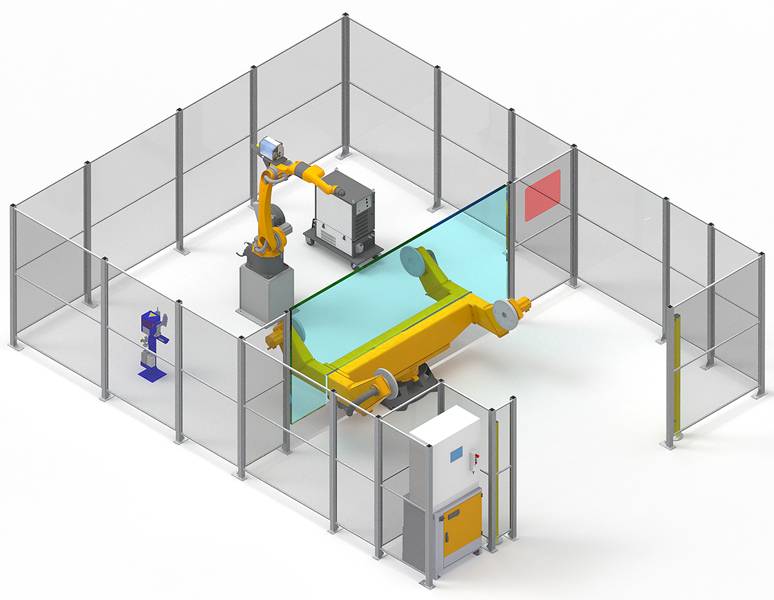
The Warsaw facility operates in a high-cost labor market where the scarcity of specialized aluminum welders has mandated a shift toward automation. We deployed a 6-axis collaborative arm integrated with a high-frequency pulse MIG power source. Unlike traditional industrial robots, this Collaborative Arc Welding System was installed without the requirement for extensive floor-space-consuming safety cages, utilizing the arm’s internal force-torque sensors for ISO/TS 15066 compliance.
The choice of an air-cooled torch over a water-cooled variant was strategic. In this specific Warsaw workshop, the payload limitations of the collaborative arm (10kg) necessitated a lighter torch assembly to maintain high-speed maneuverability during complex pathing. While air-cooled torches typically suffer from lower duty cycles, our specific Aluminum Alloy welding parameters—characterized by short, intermittent beads—fell well within the thermal envelope of the air-cooled neck.
2. The Synergy: Collaborative Arc Welding System and Automated Welding
The implementation highlights a critical synergy between the flexibility of a Collaborative Arc Welding System and the repeatability of Automated Welding. In the Warsaw production environment, the “synergy” is not merely a marketing term; it refers to the interface between human cognitive oversight and robotic precision.
A. Reduced Setup Friction
Traditional Automated Welding requires significant downtime for jigging and “touch-off” programming. By utilizing the lead-through programming of the Collaborative Arc Welding System, the Warsaw engineering team reduced part-to-part changeover time by 65%. The operator physically moves the torch to the weld start and end points, allowing the software to interpolate the path. This hybrid approach bridges the gap between manual welding intuition and robotic execution.
B. Real-Time Parameter Modulation
During the Warsaw trials, we found that the Automated Welding component provided a level of consistency in travel speed that human hands could not replicate, particularly on 3mm Aluminum Alloy welding joints. The Collaborative Arc Welding System allowed the operator to remain in the workspace to perform “on-the-fly” adjustments to the shielding gas flow or wire feed speed without triggering an emergency stop, a feature that significantly increased the uptime of the cell.
3. Technical Deep-Dive: Aluminum Alloy Welding Challenges
Aluminum Alloy welding remains one of the most demanding tasks in an automated environment due to the material’s high thermal conductivity and low melting point. In Warsaw, we focused on 5000 and 6000 series alloys used in structural brackets.
A. Thermal Management and Burn-Through
The most significant challenge was managing heat soak. In a manual setup, the welder compensates for heat buildup by increasing travel speed or backing off the foot pedal. To replicate this in an Automated Welding environment, we programmed a “thermal ramp” into the Collaborative Arc Welding System. As the weld progressed along a 400mm seam, the system was configured to increase travel speed by 1.5% every 50mm to counteract the rising base metal temperature, preventing catastrophic burn-through.
B. Wire Feed and Oxide Issues
Aluminum wire (specifically 4043 and 5356) is notoriously soft. The Warsaw site experienced “bird-nesting” early in the trial. We resolved this by installing a push-pull torch system calibrated specifically for the Collaborative Arc Welding System’s arm movement. Furthermore, the air-cooled torch required a specific nozzle cleaning regimen every 10 cycles to ensure that the shielding gas (100% Argon) maintained a laminar flow, essential for preventing porosity in the Aluminum Alloy welding process.
4. Lessons Learned from the Warsaw Workshop Floor
I. The “Grounding” Variable
One overlooked aspect in the Warsaw deployment was the electrical grounding of the collaborative arm versus the welding power source. We observed erratic arc behavior when the Collaborative Arc Welding System was grounded to the same table as the workpiece. Lesson: Always use a dedicated, isolated high-frequency ground for the welding table to prevent electromagnetic interference (EMI) from disrupting the cobot’s sensitive encoders.
II. Air-Cooled Duty Cycle Limitations
While the air-cooled torch saved weight, we hit a thermal limit during a high-output shift on Day 4. The torch neck temperature reached 180°C, causing the contact tip to expand and stick the wire. Lesson: For Aluminum Alloy welding, even if the payload allows for an air-cooled system, an auxiliary compressed air blast or “cool-down” move in the robot’s home position is necessary if the arc-on time exceeds 40% of the cycle.
III. Cleaning Protocols
In Warsaw, the humidity levels in the workshop fluctuated significantly. Aluminum is highly sensitive to moisture, which dissociates into hydrogen in the arc, causing porosity. Lesson: The Automated Welding cell must include a pre-weld mechanical brush station or a chemical wipe step. We found that manual wiping by the operator—facilitated by the Collaborative Arc Welding System’s easy access—was more effective than trying to automate the cleaning of complex geometries.
5. Comparative Productivity Metrics
The transition to the Collaborative Arc Welding System yielded the following quantifiable results over a 100-unit sample size in the Warsaw facility:
- Weld Consistency: Post-weld ultrasonic testing showed a 98% pass rate, compared to 84% with manual GTAW.
- Cycle Time: Reduced from 14 minutes per assembly to 5.5 minutes. The Automated Welding consistency allowed for a higher average travel speed (600mm/min) than a manual welder could sustain over an 8-hour shift.
- Consumable Efficiency: Wire waste was reduced by 22% due to precise crater-fill programming and optimized arc-start sequences.
6. Safety and Operator Integration
The “Collaborative” aspect was tested rigorously. In the Warsaw setup, the system was programmed with “Reduced Mode” zones. If the operator entered the primary loading zone, the Collaborative Arc Welding System slowed its travel speed to 250mm/s. This allowed the operator to prep the next Aluminum Alloy welding jig while the robot finished the current part. This level of Automated Welding integration removes the “dead time” usually associated with robot cycles, effectively turning the operator into a cell manager rather than a manual laborer.
7. Final Technical Summary
The Warsaw deployment proves that an air-cooled Collaborative Arc Welding System is a viable, high-ROI solution for Aluminum Alloy welding, provided that thermal management is handled through software rather than hardware alone. The synergy between the human operator’s spatial awareness and the Automated Welding system’s speed and precision addresses the specific needs of modern European manufacturing.
For future deployments, I recommend a standardized “start-up” checklist that includes EMI shielding verification and a moisture-check for the aluminum stock. The success in Warsaw serves as a blueprint for rolling out collaborative solutions across other high-precision workshops in the region.
Engineering Sign-off:
Lead Welding Engineer
Field Operations – Central/Eastern Europe







