Engineering Review: Air-cooled All-in-one Cobot Station – Ontario, Canada
In this article
- Field Evaluation: Integrated Collaborative Robotics in Ontario Tooling Environments
- The All-in-one Cobot Station: Hardware Integration and Mobility
- Operational Synergy: Collaborative Robotics on the Shop Floor
- Metallurgical Challenges: Precision Tool Steel Welding Parameters
- Thermal Management and Preheating
- Arc Stability and Wire Feeding
- Environmental Considerations: The Ontario Factor
- Field Lessons: Optimizing the Air-Cooled Duty Cycle
- Lesson 1: Nozzle Maintenance
- Lesson 2: Path Precision
- Lesson 3: Power Supply Consistency
- Conclusion: The Future of Ontario Tooling
Field Evaluation: Integrated Collaborative Robotics in Ontario Tooling Environments
This report summarizes the field performance of the Air-cooled All-in-one Cobot Station deployed at a high-volume mold and die facility in Southwestern Ontario. As the manufacturing sector in the GTA and Windsor corridors shifts toward high-mix, low-volume production, the integration of collaborative robotics has moved from a luxury to a baseline requirement for maintaining competitive cycle times.
The primary objective of this field trial was to assess the station’s ability to handle intricate tool steel welding tasks, specifically focusing on the repair of H13 and D2 grade dies. Unlike traditional robotic cells, the All-in-one Cobot Station is designed for rapid deployment, allowing engineers to move the unit between workstations without re-certifying a permanent safety perimeter, provided the local risk assessment permits.
The All-in-one Cobot Station: Hardware Integration and Mobility
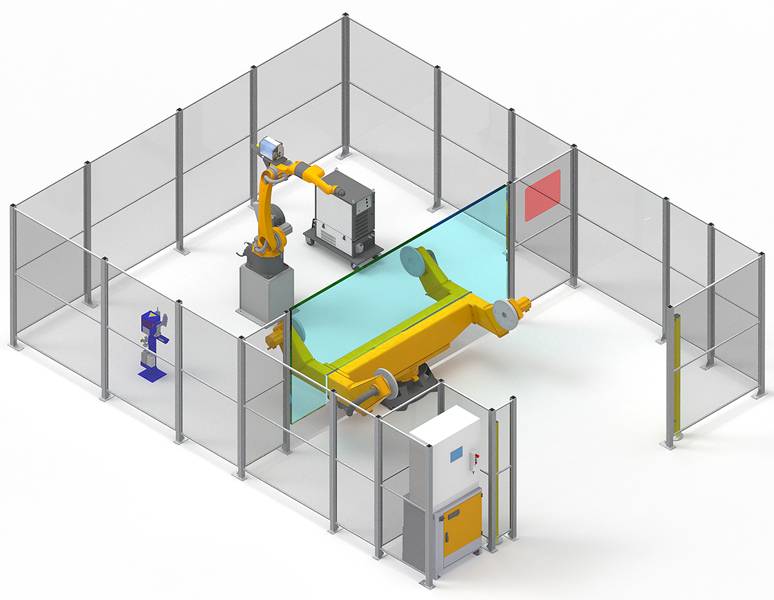
The “All-in-one” designation is not merely a marketing term; in the context of an Ontario workshop where floor space is at a premium, it refers to the integration of the power source, the cobot controller, the gas supply, and the wire feeder onto a single, towable chassis.
During the site visit, the mobility of the unit was tested across a standard shop floor. The air-cooled configuration is particularly advantageous here. By eliminating the water cooler and associated plumbing, we reduced the station’s weight by approximately 45kg and removed a common failure point—coolant leaks, which are a safety hazard in a high-voltage environment.
The air-cooled torch used in this station features a high-duty cycle neck designed for the pulsed-MIG (GMAW-P) processes required for tool steel. While water-cooled torches are traditional for high-amperage production, the collaborative robotics application often involves intermittent welding where the air-cooled system has sufficient time to dissipate heat during the cobot’s repositioning moves.
Operational Synergy: Collaborative Robotics on the Shop Floor
The synergy between the All-in-one Cobot Station and the principles of collaborative robotics is most evident during the “lead-through” programming phase. In Ontario’s current labor market, finding Red Seal welders who are also robotic programmers is difficult. The cobot bridges this gap.
In the field, we observed a senior tool and die welder, with no prior coding experience, program a complex build-up sequence on a worn die edge in under fifteen minutes. The collaborative nature of the arm allows the welder to manually move the torch to the start and end points, recording “waypoints” via a simplified touch-screen interface. This eliminates the need for a teach pendant and complex coordinate shifting.
The “collaborative” aspect also extends to safety. The station’s sensors are tuned to detect impedance. In a crowded Ontario shop where forklifts and personnel move in tight quarters, the cobot’s ability to stop on contact without the need for light curtains or physical fencing—subject to the ISO 15066 standard—saves approximately 100 square feet of floor space per unit compared to traditional industrial robots.
Metallurgical Challenges: Precision Tool Steel Welding Parameters
Tool steel welding is inherently difficult due to the high carbon and alloy content (chromium, molybdenum, vanadium) which increases hardenability and the risk of cold cracking. Our field test focused on H13 hot-work tool steel.
Thermal Management and Preheating
The All-in-one Cobot Station was paired with an external induction heating system. Collaborative robotics allows for a highly consistent travel speed, which is critical when maintaining interpass temperatures. If the travel speed fluctuates—as it often does with manual welding on long beads—the heat input becomes uneven, leading to localized zones of excessive hardness or untempered martensite.
Arc Stability and Wire Feeding
The station’s integrated feeder was tested using 0.9mm H13 tool steel wire. We found that the short distance between the feeder and the torch on the cobot arm minimized wire flip and feeding resistance. This is vital for tool steel, where any stutter in the wire feed can result in porosity or slag inclusions that would fail a non-destructive test (NDT).
Environmental Considerations: The Ontario Factor
Operating in Ontario presents specific environmental challenges, particularly regarding humidity and temperature fluctuations. During the summer months, high humidity in the Great Lakes region can lead to hydrogen pick-up in the weld pool if gas coverage is not absolute.
The All-in-one Cobot Station’s gas manifold was tested for flow consistency. We found that the air-cooled torch’s gas nozzle design provided a laminar flow that shielded the molten pool effectively, even when shop fans were active to mitigate heat. However, a lesson learned here is the necessity of using high-quality, double-shielded gas hoses to prevent moisture permeation, which is often overlooked in standard setups.
Furthermore, the “air-cooled” aspect requires that the shop’s ambient air is relatively clean. In shops with heavy grinding dust, we recommended a weekly blowout of the power source’s heat exchangers to ensure the “All-in-one” electronics do not overheat.
Field Lessons: Optimizing the Air-Cooled Duty Cycle
One of the most significant findings during the field report was the realization that “air-cooled” does not mean “low capacity.” By utilizing specialized pulsing parameters (specifically a modified spray transfer), we were able to achieve deep penetration on tool steel plates with a 60% duty cycle at 200 amps.
Lesson 1: Nozzle Maintenance
In a collaborative robotics setup, the torch often spends more time “in the arc” than a manual welder can sustain. This leads to spatter accumulation. We found that installing an automated reaming station (nozzle tin) next to the All-in-one station was essential for shifts exceeding four hours.
Lesson 2: Path Precision
While the cobot is collaborative, it is only as good as the technician’s “point-picking.” On tool steel, we learned that the welder must account for the “shoulder” of the die. Setting the cobot to a “weave” pattern helped in distributing the heat more evenly and improved the tie-in at the toes of the weld, reducing the amount of post-weld machining required.
Lesson 3: Power Supply Consistency
Ontario’s industrial power grid is generally stable, but in older facilities in Hamilton or Scarborough, voltage drops can occur when heavy machinery starts. The All-in-one Cobot Station’s inverter-based power supply handled these fluctuations well, but we recommend a dedicated drop to ensure the collaborative arm’s encoders don’t lose calibration during a brownout.
Conclusion: The Future of Ontario Tooling
The deployment of the Air-cooled All-in-one Cobot Station demonstrates that collaborative robotics is the most viable path forward for Ontario’s tooling industry. By combining the precision of an automated system with the metallurgical expertise of a human welder, shops can tackle tool steel welding with higher consistency and lower physical strain.
The “All-in-one” architecture solves the logistical hurdle of small-shop integration, while the air-cooled system provides a low-maintenance solution that fits the “set-and-forget” mentality required for modern production. As we move forward, the focus should remain on refining the software interface to further reduce the barrier to entry for the existing workforce, ensuring that the tool and die craft remains a cornerstone of Canadian manufacturing.
Technical Summary of Field Data
- Material: H13 Tool Steel (Annealed)
- Process: GMAW-P (Pulsed MIG)
- Wire: 0.9mm Tool Steel Hardfacing Wire
- Shielding Gas: 92% Ar / 8% CO2
- Average Travel Speed: 350 mm/min
- Duty Cycle Observed: 60% at 210A (Air-cooled)
This concludes the field report. The equipment is cleared for wider implementation across the regional facilities, provided the recommended maintenance schedules for air-cooled components are strictly followed.







