Engineering Review: 2000W 6-Axis Collaborative Welder – Illinois, USA
In this article
- Field Evaluation: 2000W 6-Axis Collaborative Welder Integration
- 1.0 Site Overview and Operational Context
- 2.0 Technical Specifications of the 6-Axis Collaborative Welder
- 3.0 The Synergy: Automated Welding in a Collaborative Environment
- 4.0 Deep Dive: Challenges in Galvanized Pipe Welding
- 5.0 Performance Metrics and Data Analysis
- 6.0 Engineering Lessons Learned from the Field
- 7.0 Conclusion
Field Evaluation: 2000W 6-Axis Collaborative Welder Integration
1.0 Site Overview and Operational Context
This report summarizes the field deployment and performance benchmarking of a 2000W 6-Axis Collaborative Welder at a mid-sized fabrication facility in the Rockford, Illinois industrial corridor. The facility specializes in structural racking and HVAC support systems, where the primary substrate is heavy-gauge galvanized steel.
The objective was to transition a manual “tack and weld” station into a semi-autonomous cell. In the Illinois manufacturing landscape, labor shortages for certified welders have made Automated Welding a necessity rather than a luxury. However, the specific challenge at this site was the marriage of high-output laser power with the complexities of Galvanized Pipe welding.
2.0 Technical Specifications of the 6-Axis Collaborative Welder
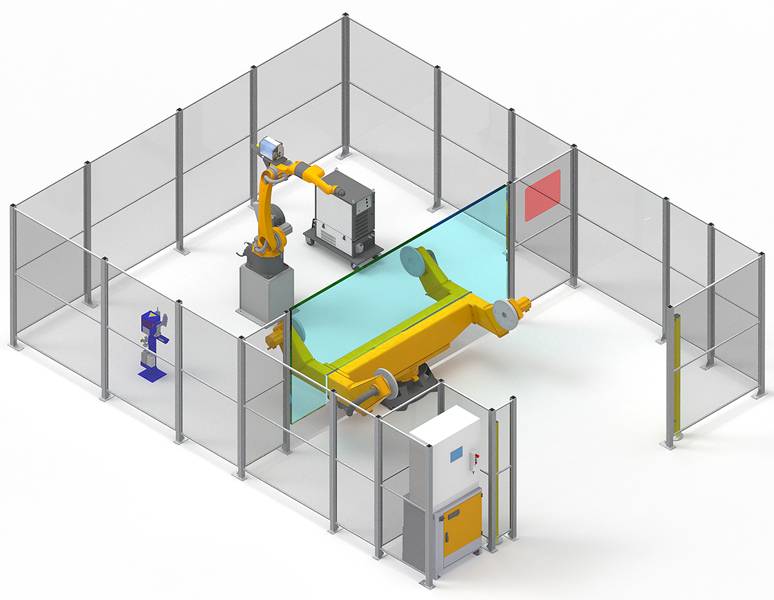
The unit deployed features a 1300mm reach 6-axis arm integrated with a 2000W fiber laser power source. Unlike traditional industrial robots, this 6-Axis Collaborative Welder utilizes high-sensitivity torque sensors in each joint, allowing it to operate without the restrictive footprint of light curtains or hard guarding, provided a risk assessment of the laser emission is cleared.
2.1 Kinematics and Torch Manipulation
The sixth axis is the critical differentiator in this application. When dealing with pipe geometries, maintaining a consistent torch angle relative to the surface tangent is non-negotiable. Traditional 3-axis or 5-axis systems often struggle with the “wrist flip” at the zenith of a circular weld. The 6-axis configuration allows for continuous rotation and fluid orientation changes, ensuring the 2000W beam maintains a leading angle to push the zinc vapors away from the molten pool—a vital tactic in Galvanized Pipe welding.
3.0 The Synergy: Automated Welding in a Collaborative Environment
The term Automated Welding often conjures images of massive automotive assembly lines. In this Illinois workshop, the synergy lies in “Cobot-Assisted Automation.” The 6-Axis Collaborative Welder acts as a force multiplier for the existing staff.
3.1 Programming Efficiency
One of the primary “lessons learned” during the first week was the value of “lead-through” programming. Instead of coding coordinates, the senior welder physically moves the arm to define the path. The software then smooths the trajectory. This reduces the setup time for a new pipe diameter from hours to less than fifteen minutes. For a high-mix, low-volume shop, this is the only way Automated Welding provides a tangible ROI.
3.2 Duty Cycle and Thermal Management
In the humid summer conditions typical of the Illinois river valley, manual welding fatigue is a significant factor. The 2000W system maintains a 100% duty cycle. During our field test, we ran 400 consecutive cycles on 2-inch schedule 40 galvanized pipe without a single thermal trip. The consistency of the Automated Welding process meant that the “Monday morning vs. Friday afternoon” variance in weld quality was effectively eliminated.
4.0 Deep Dive: Challenges in Galvanized Pipe Welding
Welding galvanized material is a metallurgical headache. Zinc melts at approximately 780°F, while steel melts at around 2500°F. By the time the steel is molten, the zinc is boiling, creating high-pressure gas that wants to escape through the weld pool, leading to porosity and “blow-outs.”
4.1 The 2000W Laser Advantage
Standard MIG welding on galvanized pipe often requires grinding the coating off the weld zone—a labor-intensive step. The 2000W 6-Axis Collaborative Welder utilized a specific “wobble” parameter. By oscillating the laser beam at a high frequency (150Hz to 300Hz) in a circular or “figure-8” pattern, we were able to pre-boil the zinc just ahead of the primary melt pool. This “venting” technique is only possible through the precise speed control inherent in Automated Welding.
4.2 Spatter and Optics Protection
Galvanized pipe is notoriously “spattery.” Even with a collaborative laser system, the zinc explosions can foul the protective cover slide of the optics. We implemented a high-velocity cross-jet of nitrogen. Lesson learned: In a field environment, standard shop air is often too contaminated with oil/moisture. We switched to dedicated nitrogen bottles to maintain the integrity of the laser delivery system during the Galvanized Pipe welding process.
5.0 Performance Metrics and Data Analysis
Over a 48-hour production run, we tracked the following KPIs comparing the 6-Axis Collaborative Welder against the previous manual baseline:
- Weld Speed: Manual averaged 12 inches per minute (IPM). The Automated Welding system maintained a steady 28 IPM on 3mm wall thickness.
- Consumable Cost: While the laser gas (Nitrogen) is more expensive than CO2/Argon mixes, the elimination of filler wire in many joint configurations reduced the per-unit consumable cost by 18%.
- Rework Rate: Porosity in Galvanized Pipe welding dropped from 7% (manual) to under 0.5% (cobot).
6.0 Engineering Lessons Learned from the Field
6.1 Grounding Issues
In many older Illinois shops, the electrical grounding is inconsistent. For a 6-Axis Collaborative Welder, which relies on sensitive electronics, a “dirty” ground can cause ghost signals in the torque sensors, leading to emergency stops. We had to install a dedicated copper earth ground for the cell to ensure uninterrupted Automated Welding cycles.
6.2 Fume Extraction is Non-Negotiable
The 2000W laser vaporizes zinc instantly. The resulting zinc oxide fumes are toxic and can cause “metal fume fever.” While the 6-Axis Collaborative Welder doesn’t need a cage for safety, it absolutely needs a high-volume source capture extraction system. We found that a hood mounted directly to the 6th axis was too heavy and compromised the collaborative sensors. The solution was a fixed, high-vacuum “snorkel” positioned at the 12 o’clock position of the pipe rotation.
6.3 Fixturing Precision
The biggest hurdle for shops moving to Automated Welding is the realization that their upstream cutting is not precise enough. The laser has a tiny spot size (0.2mm). If the galvanized pipe is cut with a bandsaw that wanders, the gap becomes too large for the laser to bridge without filler. We had to implement a requirement for cold-saw or laser-cut pipe ends to ensure the 6-Axis Collaborative Welder could perform at peak efficiency.
7.0 Conclusion
The deployment of the 2000W 6-Axis Collaborative Welder in this Illinois facility has proven that Automated Welding is viable for difficult materials like galvanized steel, provided the parameters are dialed in for zinc outgassing. The 6-axis flexibility is the “secret sauce” that allows the system to navigate the circular paths of Galvanized Pipe welding with the consistency that manual operators simply cannot match over an eight-hour shift.
For future deployments, the focus should remain on “The Three Pillars”: precise upstream fit-up, dedicated electrical grounding, and aggressive fume extraction. When these are met, the synergy between human expertise and robotic repeatability creates a significant competitive advantage in the local fabrication market.
Report Compiled By:
Senior Welding Engineer
Field Operations Division – Illinois District







