Engineering Review: 1500W Robotic Arm Welder – Curitiba, Brazil
In this article
- Field Engineering Report: Deployment of 1500W Robotic Arm Welder in Curitiba Industrial…
- 1. Project Scope and Site Environment
- 2. Hardware Integration: The 1500W Robotic Arm Welder
- 3. The Role of Industrial Automation in Process Stability
- 4. Technical Deep-Dive: Aluminum Alloy Welding Challenges
- 5. Lessons Learned and Field Observations
- 6. Performance Metrics and Conclusion
Field Engineering Report: Deployment of 1500W Robotic Arm Welder in Curitiba Industrial Hub
1. Project Scope and Site Environment
This report details the commissioning and optimization of a 1500W fiber-laser Robotic Arm Welder at a Tier 2 automotive component facility in Curitiba, Paraná. The facility specializes in high-volume heat exchanger production, necessitating a shift toward advanced Industrial Automation to maintain global competitiveness. The primary technical objective was the precision Aluminum Alloy welding of 6000-series extrusions to 5000-series stamped plates.
Curitiba’s industrial climate presents specific environmental challenges. During the commissioning phase in late October, relative humidity levels averaged 82%. For Aluminum Alloy welding, atmospheric moisture is a primary precursor to hydrogen-induced porosity. Our initial site assessment required an immediate overhaul of the facility’s compressed air drying system and the implementation of a localized gas-purging protocol to ensure weld integrity before the Robotic Arm Welder struck its first arc.
2. Hardware Integration: The 1500W Robotic Arm Welder
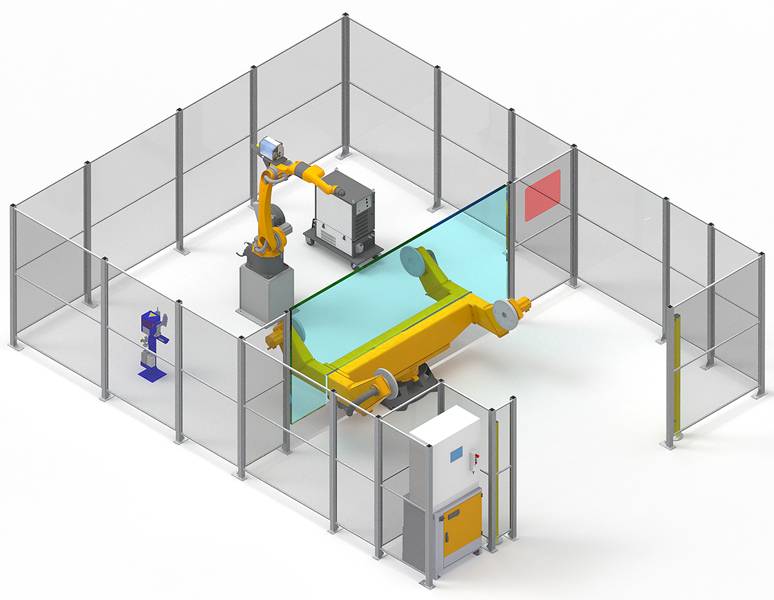
The core of the cell is a 6-axis articulated Robotic Arm Welder equipped with a 1500W continuous wave (CW) fiber laser source and a wobble-head optics package. Unlike manual MIG or TIG processes, the 1500W laser provides a concentrated energy density that significantly reduces the Heat Affected Zone (HAZ).
2.1 Optics and Beam Manipulation
To address the inherent fit-up tolerances of the aluminum stampings, we utilized a “wobble” function on the laser head. By oscillating the beam in a circular pattern at 150Hz with a 1.5mm amplitude, the Robotic Arm Welder effectively bridge gaps that would otherwise result in burn-through or lack of fusion. This oscillation also promotes a more agitated weld pool, which helps in the degassing of the Aluminum Alloy welding zone, mitigating the porosity issues mentioned previously.
2.2 Wire Feed Synchronization
For this 1500W configuration, we integrated a precision cold-wire feeder. The synergy between the wire feed speed (WFS) and the robot’s travel speed is managed via a dedicated Industrial Automation bus (EtherCAT). We found that a lead-in wire angle of 15 degrees provided the most consistent wetting of the aluminum substrate. Deviations beyond 20 degrees resulted in “bird-nesting” at the feed rollers due to the softness of the 4043 filler alloy.
3. The Role of Industrial Automation in Process Stability
In the Curitiba workshop, Industrial Automation is not merely about the movement of the robot; it is the comprehensive control of the welding environment. The integration involves a centralized PLC (Programmable Logic Controller) that monitors gas flow rates, chiller temperatures, and part clamping pressures in real-time.
3.1 Automated Clamping and Fixturing
Aluminum’s high thermal conductivity and high coefficient of thermal expansion make it prone to significant distortion during welding. We replaced manual toggle clamps with a pneumatic sequencing system integrated into the Industrial Automation loop. This ensures that the parts are held under 0.5 MPa of pressure, with the clamping sequence following the robot’s path to “chase” the heat. This level of synchronization is impossible in manual setups and is the primary reason the Robotic Arm Welder outperformed the previous manual TIG station by a 4:1 margin in terms of part flatness.
3.2 Sensor Feedback Loops
We implemented a laser-based seam tracking sensor. In the context of Aluminum Alloy welding, the high reflectivity of the material often confuses standard optical sensors. We calibrated the Industrial Automation software to filter out the 1070nm wavelength of the laser, focusing on the 2D profile of the joint. This allows the Robotic Arm Welder to adjust its path in real-time (±0.1mm) to compensate for part warping during the welding cycle.
4. Technical Deep-Dive: Aluminum Alloy Welding Challenges
Aluminum Alloy welding is notoriously sensitive. In Curitiba, we were working specifically with 6061-T6 (extruded frames) and 5052-H32 (side panels). The 6061 alloy is prone to solidification cracking (liquation cracking) in the HAZ.
4.1 Chemistry and Filler Selection
To combat cracking, we utilized ER4043 filler wire. The silicon content in 4043 lowers the melting point and increases the fluidity of the weld pool, which compensates for the high shrinkage rate of the aluminum as it cools. The Robotic Arm Welder was programmed with a “ramp-down” power profile at the end of each seam to fill the crater, a critical step as craters are the primary initiation points for stress fractures in automotive components.
4.2 Oxide Layer Management
The alumina (Al2O3) layer on the parts had a melting point of approximately 2,000°C, while the base aluminum melts at 660°C. If the 1500W laser isn’t tuned correctly, the base metal can melt and boil while the oxide layer remains intact. We adjusted the Industrial Automation parameters to include a high-frequency pulse at the start of the weld to “shatter” the oxide layer, followed by the 1500W CW beam for deep penetration. This dual-stage approach is only repeatable through the precise timing of a Robotic Arm Welder.
5. Lessons Learned and Field Observations
The deployment in Curitiba provided several hard-earned lessons that should be applied to future Industrial Automation projects in South American manufacturing hubs.
5.1 Power Grid Stability
One unforeseen issue was the voltage fluctuation in the local power grid during peak industrial hours (2 PM – 4 PM). These fluctuations caused the 1500W laser source to trigger “Under Voltage” alarms.
Lesson: Always specify a dedicated voltage stabilizer and a dual-conversion UPS for the Robotic Arm Welder control cabinet. We lost three days of calibration data due to a sudden brownout before the stabilizer was installed.
5.2 Shielding Gas Turbulence
Initially, we experienced intermittent porosity despite using 99.99% pure Argon. We discovered that the high-speed movement of the Robotic Arm Welder (800mm/min) was creating a venturi effect, drawing in atmospheric oxygen at the nozzle.
Lesson: We redesigned the gas shroud to include a “trailing shield” which provides a secondary laminar flow of Argon behind the weld head. This is essential for Aluminum Alloy welding at travel speeds exceeding 600mm/min.
5.3 Operator Skill Gap
While Industrial Automation reduces the need for manual dexterity, it increases the need for “Process Technicians.” The local staff in Curitiba were proficient in manual TIG but struggled with the logic-based troubleshooting of the Robotic Arm Welder.
Lesson: Training must focus on “Logic of the Weld” rather than just button-pushing. Understanding how the focal point of the laser affects the bead profile in Aluminum Alloy welding is more important than knowing how to jog the robot.
6. Performance Metrics and Conclusion
After six weeks of optimization, the system performance was measured against the baseline manual production data:
- Cycle Time: Reduced from 210 seconds (Manual) to 52 seconds (Robotic).
- Scrap Rate: Dropped from 12% to 1.5%, primarily due to the elimination of human-related inconsistencies in Aluminum Alloy welding.
- Gas Consumption: Increased by 15% (due to the trailing shield), but offset by the 4x increase in throughput.
The synergy between the Robotic Arm Welder and the broader Industrial Automation framework has successfully transformed the Curitiba facility’s production capabilities. The 1500W laser source proved sufficient for the material gauges involved, provided that the beam oscillation and gas shielding were meticulously controlled. For future installations, the focus should remain on environmental humidity control and the training of high-level process technicians to oversee the automated cells.
Final Assessment: The system is stable, the metallurgical results for the Aluminum Alloy welding exceed ISO 13919-2 standards, and the site is cleared for full-scale production.







