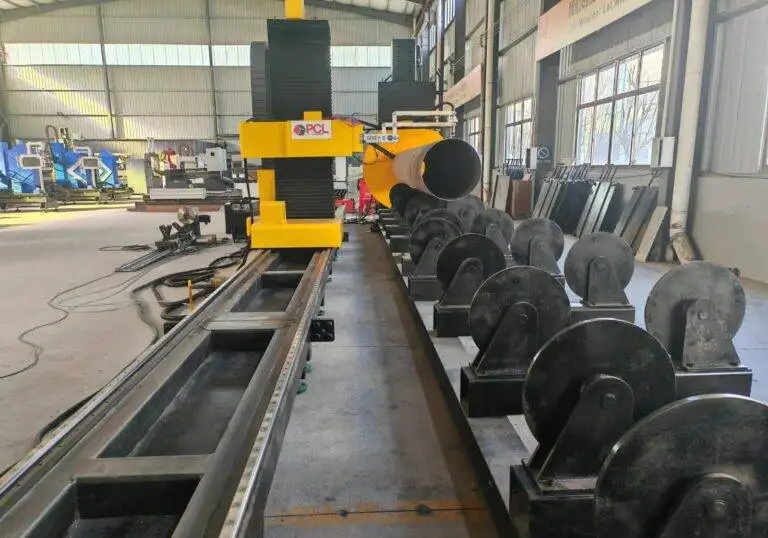
Beam Processing Center with Narrow Gap welding for for Shipbuilding

In this article
- Technical Integration of Plasma Cutting in Shipbuilding Beam Lines
- The Critical Role of Intersection Accuracy
- Geometric Tolerance Management
- Tight Fit-up for Narrow Gap Welding
- Operational Efficiency and H-Beam Low Maintenance
- Robust Component Design
- System Self-Diagnostics
- Beveling Precision for Narrow Gap Welding Preparation
- Optimizing Structural Integrity through Integrated Workflows
Technical Integration of Plasma Cutting in Shipbuilding Beam Lines
In the heavy industrial landscape of shipbuilding, the structural integrity of a vessel depends heavily on the precision of its skeletal framework. The transition toward automated Beam Processing Center technology has redefined how H-beams, channels, and angles are prepared for assembly. Central to this evolution is the utilization of advanced plasma cutting systems. Unlike traditional mechanical methods, plasma cutting provides a non-contact, high-thermal-density solution capable of handling the heavy wall thicknesses characteristic of maritime profiles. The engineering objective is to create a seamless workflow where the cutting phase directly facilitates the subsequent welding stages, specifically for narrow gap configurations.
The Critical Role of Intersection Accuracy
Shipbuilding involves complex geometries where longitudinal and transverse members intersect at various angles. Achieving high plasma cutting accuracy at these intersections is not merely a matter of aesthetics; it is a fundamental requirement for structural load distribution. When an H-beam is notched or coped to fit against another structural member, the tolerance must be kept within sub-millimeter ranges.
Geometric Tolerance Management
The beam processing center utilizes multi-axis robotic arms or gantry systems to navigate the torch around the profile. Intersection accuracy is maintained through sophisticated CNC algorithms that compensate for kerf width—the amount of material removed during the melt process. In shipbuilding, where beams often exceed 12 meters in length, compensation for material camber and sweep is essential. Probing systems or laser sensors integrated into the plasma head map the actual surface of the steel before the arc is struck, ensuring that the programmed path aligns perfectly with the physical beam, regardless of factory deformations.
Tight Fit-up for Narrow Gap Welding
The primary driver for high intersection accuracy is the preparation for narrow gap welding (NGW). NGW requires a consistent, tight root opening to minimize the volume of weld metal deposited. If the plasma cut produces an irregular edge or an oversized gap, the efficiency of the NGW process is compromised. Precision plasma systems allow for the creation of “locked” joints where the fit-up is tight enough to require minimal tacking, leading to a more stable thermal environment during the final weld passes.
Operational Efficiency and H-Beam Low Maintenance
Industrial engineers prioritize uptime and Mean Time Between Failures (MTBF). In high-volume shipyards, the beam line must operate continuously. One of the significant advantages of modern plasma-based centers is the H-beam low maintenance profile compared to mechanical sawing or older oxy-fuel systems. Mechanical systems suffer from blade wear, coolant contamination, and mechanical stress. In contrast, plasma systems are solid-state in their power delivery and use compressed air or specialized gases as the primary medium.
Robust Component Design
Maintenance reduction is achieved through specialized torch consumables designed for long-life cycles. Modern electrode and nozzle geometries are engineered to withstand the high-amperage cycles required for thick-walled maritime steel. Furthermore, the integration of automated dross management and dust extraction systems prevents the accumulation of metallic particulates on the linear ways and drive racks. By minimizing the physical contact between the cutting tool and the workpiece, the mechanical strain on the gantry is drastically reduced, leading to longer service intervals and lower Total Cost of Ownership (TCO).
System Self-Diagnostics
Advanced beam processing centers incorporate real-time monitoring of gas flow, arc voltage, and coolant temperature. These sensors provide predictive maintenance data, allowing engineers to replace consumables during scheduled shifts rather than during active production. This data-driven approach ensures that the plasma arc remains stable, which is crucial for maintaining the edge quality required for narrow gap prep.
Beveling Precision for Narrow Gap Welding Preparation
The hallmark of a high-end beam processing center is its ability to perform complex beveling. for Shipbuilding, where heavy plates and beams are joined, the standard V-groove is often replaced by narrow gap preparations to reduce heat input and distortion. Plasma torches mounted on 3D tilt-rotator heads are capable of executing these bevels with extreme repeatability.
Advanced Bevel Geometries
Narrow gap welding necessitates specific bevel angles, often ranging between 3 to 10 degrees, depending on the thickness of the material and the welding process. The plasma system must maintain this angle consistently across the entire height of the H-beam web and the thickness of the flanges. The ability of the software to handle “transition bevels”—where the angle changes along a single cut path—is vital for complex structural nodes. This precision ensures that the welding torch has adequate access to the root while maintaining the narrowest possible groove width.
Heat-Affected Zone (HAZ) Control
A common concern in thermal cutting is the Heat-Affected Zone. High-definition plasma systems use constricted arcs and high travel speeds to localize the heat input. In the context of narrow gap welding, a minimal HAZ is beneficial because it preserves the metallurgical properties of the base metal near the fusion line. Modern plasma power sources offer “fine feature” modes that optimize the energy density, resulting in a square edge top and minimal dross on the bottom, which eliminates the need for secondary grinding operations.
Optimizing Structural Integrity through Integrated Workflows
The synergy between accurate plasma cutting and narrow gap welding represents a significant leap in shipbuilding productivity. When the beam processing center delivers a profile with perfect intersection geometry and precisely beveled edges, the assembly floor experiences a “plug-and-play” workflow. This reduces the reliance on manual fitters and corrective grinding, which are traditionally the largest bottlenecks in shipyard production.
Data Integration and CIM
Computer Integrated Manufacturing (CIM) allows the 3D models from naval architecture software to be fed directly into the beam processing center. The plasma cutting paths are generated automatically, including the specific bevel parameters for NGW. This digital thread ensures that the engineer’s design intent is captured accurately on the shop floor. The result is a structural framework that meets the stringent classification society standards for maritime safety while utilizing the most efficient material joining techniques available today.
Conclusion on Technical Throughput
Focusing on plasma cutting within the beam processing center allows shipyards to capitalize on the speed and versatility of thermal processing. By mastering intersection accuracy and leveraging the low-maintenance nature of these systems, facilities can achieve the high-tolerance edge preparations required for narrow gap welding. This strategic focus eliminates unnecessary production steps, reduces consumable waste, and ensures that the structural backbone of the vessel is built to the highest engineering standards.