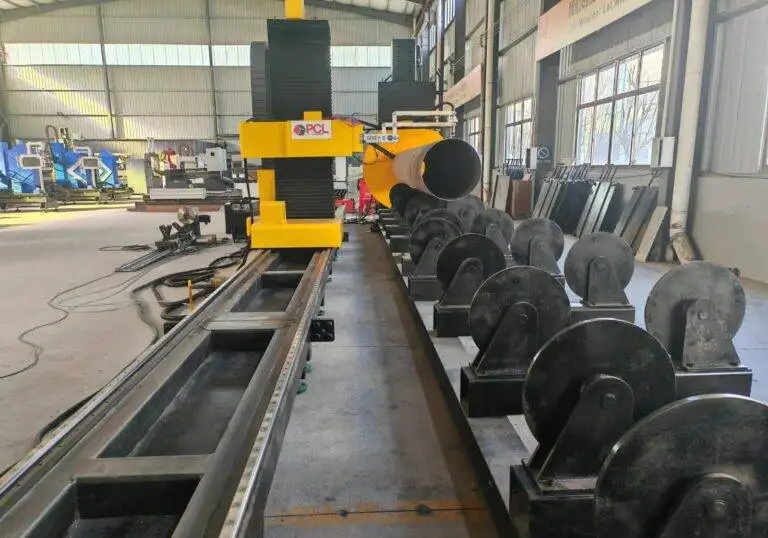
Beam Processing Center with Narrow Gap welding for for Shipbuilding

In this article
Strategic Integration of Plasma Cutting in Shipbuilding Beam Lines
In the domain of naval architecture and heavy structural fabrication, the transition toward Narrow Gap Welding (NGW) necessitates a fundamental shift in upstream processing. A Beam Processing Center (BPC) equipped with high-definition plasma cutting serves as the primary engine for this transition. Industrial engineering standards dictate that for NGW to be viable, the joint geometry must be executed with extreme precision. The traditional reliance on manual layout and mechanical sawing is no longer sufficient for the complex intersection geometries required in modern vessel hulls and offshore platforms.
The primary objective of a plasma-integrated BPC is to consolidate multiple fabrication steps—marking, cutting, and beveling—into a single automated cycle. By utilizing 6-axis robotic manipulators, these centers can process H-beams, bulb flats, and channel sections with a degree of intersection accuracy that ensures a consistent root gap. This consistency is the most critical variable in NGW, where the weld groove is significantly narrower than conventional V-grooves, often ranging from 5 to 9 millimeters in width regardless of plate thickness.
Achieving Micro-Tolerance Intersection Accuracy
In shipbuilding, structural beams rarely intersect at simple 90-degree angles. The curvature of the hull requires complex “cope” cuts and oblique intersections. Plasma cutting systems within a BPC utilize sophisticated CAD/CAM interfaces to translate three-dimensional ship models into precise torch paths. The accuracy of these intersections determines the success of the subsequent welding phase. If the plasma-cut edge deviates by more than 1.0mm, the narrow gap profile is compromised, leading to potential burn-through or lack of fusion.

High-definition plasma power sources employ oxygen-assisted or nitrogen-shielded arcs to produce a constricted, high-energy density plasma stream. This results in a narrow kerf and a perpendicularity that meets ISO 9013 Range 3 or 4 standards. For the industrial engineer, this means the “as-cut” surface requires zero to minimal secondary processing. The ability to maintain thermal stability across long H-beam sections ensures that longitudinal distortions are minimized, preserving the structural integrity of the member before it reaches the assembly platen.
Advanced Beveling for Narrow Gap Welding Preparation
Narrow Gap Welding is characterized by its high aspect ratio (depth to width). To facilitate this, the plasma torch must execute complex bevels—including Y-grooves, J-grooves, and K-grooves—on the flanges and webs of H-beams. A 6-axis robotic arm provides the necessary dexterity to change the torch angle dynamically during the cut. This capability is vital for creating the “land” or root face required to support the initial weld pass in an NGW setup.
The plasma process excels in this application because it can maintain a constant standoff distance via high-speed arc voltage sensing. Even if the H-beam exhibits mill-scale irregularities or slight flange warping, the robotic controller compensates in real-time. This ensures that the bevel angle remains constant throughout the length of the cut. for Shipbuilding, where thick-walled sections are common, the ability of plasma to penetrate up to 80mm or more with high travel speeds represents a significant throughput advantage over oxy-fuel systems, which are slower and introduce a much larger Heat Affected Zone (HAZ).
Metallurgical Integrity and the Heat Affected Zone
One of the primary concerns in shipyard fabrication is the impact of thermal cutting on the microstructure of high-tensile steels (such as DH36 or EH36). Modern plasma systems mitigate this through high-speed processing, which limits the duration of heat exposure. The resulting HAZ is narrow and manageable. Because NGW involves fewer weld passes and lower total heat input than traditional welding, it is imperative that the base metal preparation does not introduce pre-existing brittle zones. Plasma cutting provides a clean, oxide-free edge that is conducive to the high-quality metallurgical bonds required for maritime certification.
Operational Efficiency and Low Maintenance H-Beam Handling
From an operational expenditure (OPEX) perspective, the maintenance profile of a plasma-based BPC is a key differentiator. Unlike mechanical milling or complex optical cutting systems, plasma torches are ruggedized for the harsh environments of a shipyard. The consumable components—nozzles, electrodes, and swirl rings—are designed for rapid replacement, often featuring “plug-and-play” geometries that do not require tool-assisted calibration.
The mechanical handling of H-beams within the BPC is engineered for low maintenance. Robust conveyor systems and hydraulic clamping units are designed to withstand the vibration and dross associated with thermal cutting. Since plasma cutting is a non-contact process, there is no mechanical load placed on the robotic gantry, which reduces wear on the rack-and-pinion drives and linear bearings. This mechanical decoupling extends the calibration interval of the system, ensuring that intersection accuracy remains consistent over thousands of duty cycles.
Optimizing Consumable Life and Gas Management
To further drive down the cost per cut, industrial engineers focus on the gas management systems. Modern plasma centers utilize automatic gas consoles that mix gases based on the material type and thickness detected by the nesting software. This precision prevents excessive electrode wear caused by improper gas flows during arc ignition or ramp-down. The result is a beam processing center that maximizes uptime, a critical metric when shipbuilding schedules are compressed.
Data Integration and Digital Twin Alignment
The modern BPC functions as a node within the shipyard’s broader Digital Twin ecosystem. The plasma cutting parameters, including feed rates and arc currents, are logged for quality assurance purposes. When a beam is prepared for NGW, the system generates a digital record of the cut accuracy. This data is utilized by the robotic welding cells downstream to adjust their parameters based on the actual geometry of the cut, rather than a theoretical model. This closed-loop integration is the hallmark of Industry 4.0 in naval manufacturing.
Conclusion: The Role of Plasma in Future Ship Production
The reliance on plasma cutting for beam processing is not merely a matter of speed; it is a requirement for the technical realization of Narrow Gap Welding. By delivering superior intersection accuracy and versatile beveling capabilities, plasma systems allow shipbuilders to reduce weld volume and distortion. The low maintenance requirements of the H-beam handling systems and plasma components ensure that the production line remains fluid. As vessel designs become more complex, the precision of the thermal cut becomes the foundation upon which the structural integrity of the entire ship is built. Through rigorous process control and robotic automation, the industrial engineer can ensure that the BPC remains the most efficient stage in the shipbuilding lifecycle.