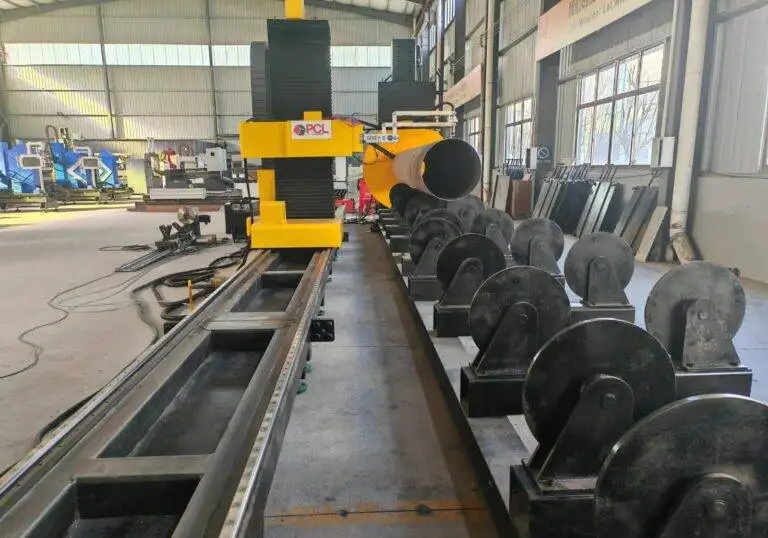
Beam Processing Center with Narrow Gap welding for for Pressure Vessels

In this article
Integration of Automated Plasma Profiling in Pressure Vessel Fabrication
In the demanding sector of pressure vessel manufacturing, the transition from manual preparation to automated Beam Processing Center technology is driven by the necessity for extreme volumetric precision. Pressure vessels, often operating under high-stress conditions, require structural integrity that begins at the raw material preparation stage. When preparing heavy-walled sections or structural support beams for these vessels, the precision of the initial cut dictates the success of subsequent joining processes.
High-definition plasma systems integrated into a multi-axis robotic or CNC framework allow for the processing of complex geometries that traditional mechanical methods cannot achieve. By utilizing high-energy density arcs, these systems maintain a stable kerf width even when traversing varying material thicknesses. This stability is paramount when the final objective is the application of advanced welding techniques that demand tight tolerances and minimal root gaps.
Optimizing Intersection Accuracy for Narrow Gap Welding
The implementation of Narrow Gap Welding (NGW) represents a significant shift in heavy-duty fabrication, offering a reduction in filler metal consumption by up to 70 percent compared to standard V-groove preparations. However, NGW is exceptionally sensitive to fit-up variations. Any deviation in the groove geometry can lead to side-wall fusion defects or slag entrapment. Consequently, the intersection accuracy provided by the beam processing center must be absolute.

Modern Plasma Cutting heads mounted on 5-axis or 6-axis kinematics use advanced algorithms to compensate for arc lead and taper. When cutting intersections for nozzles or structural skids, the software calculates the precise torch angle in real-time to ensure that the bevel angle remains consistent throughout the entire path. This level of accuracy ensures that the resulting “J” or “U” grooves provide the uniform side-wall profile required for the narrow gap process, effectively eliminating the need for manual touch-ups or corrective grinding.
Plasma Cutting Kinematics and Beveling Precision
The physics of Plasma Cutting involves a constricted ionized gas stream that reaches temperatures exceeding 20,000 degrees Celsius. In a beam processing center, the management of this thermal energy is critical to preventing material distortion. For pressure vessel components, where metallurgical properties are strictly regulated by codes such as ASME Section VIII, minimizing the Heat Affected Zone (HAZ) is a primary engineering objective.
Advanced plasma power sources now utilize oxygen-based or high-precision nitrogen-water injection techniques to produce a square cut edge or a precise bevel. The ability to perform multi-pass beveling or single-pass compound bevels allows for the creation of complex weld preparations directly on the processing line. This capability is particularly beneficial for saddle cuts and pipe-to-beam intersections, where the geometry changes continuously along the cut path. By automating this, engineers can guarantee a consistent bevel depth and angle, which is the cornerstone of high-quality NGW performance.
Mechanical Rigidity and H-Beam Low Maintenance Design
A critical aspect of machine longevity in heavy industrial environments is the structural design of the processing center itself. Utilizing an H-beam construction for the machine’s primary gantry and bed provides several mechanical advantages. First, the high moment of inertia inherent in H-beams minimizes vibration during high-speed torch movements. Vibration damping is essential for maintaining the surface finish of the plasma cut; any oscillation in the torch head translates to striations on the cut surface, which can compromise the vacuum-tight requirements of a pressure vessel weld.
From a maintenance perspective, H-beam-based frames offer superior resistance to thermal expansion and mechanical fatigue. Unlike lighter sheet-metal frames, the heavy structural steel foundation maintains alignment over decades of use. This leads to H-beam low maintenance profiles, as the guiding rails and rack-and-pinion systems remain perfectly parallel, reducing wear on bearings and drive motors. For a facility operating 24/7, this reliability translates directly into higher uptime and a lower total cost of ownership.
Eliminating Secondary Operations through Thermal Precision
Historically, plasma cutting was viewed as a “rough” process that required significant post-processing. However, the current generation of high-definition plasma has bridged the gap. By controlling the plasma gas flow and current ramp-up/down cycles, beam processing centers can produce dross-free cuts that are weld-ready. For NGW, where even minor surface irregularities can cause arc instability, the smooth finish provided by modern plasma is a prerequisite.
By integrating the beveling process into the primary cutting cycle, the manufacturing workflow is streamlined. The part moves from the beam processing center directly to the welding station. This “one-hit” manufacturing philosophy reduces material handling, which is one of the highest risks for safety incidents and part damage in a heavy fabrication shop. The precision of the CNC interface ensures that every part is a digital twin of the CAD model, facilitating a seamless assembly process.
Conclusion of Technical Parameters for High-Pressure Environments
The synergy between high-precision plasma profiling and Narrow Gap Welding is the future of pressure vessel structural fabrication. The ability of a beam processing center to deliver sub-millimeter intersection accuracy ensures that the narrow grooves required for high-efficiency welding are maintained throughout the production run. Furthermore, the adoption of rugged, H-beam based machine architectures ensures that this precision is not lost to mechanical wear or environmental stressors.
Engineers must prioritize the selection of plasma systems that offer sophisticated gas control and multi-axis dexterity. By doing so, they secure a production line capable of meeting the stringent safety and quality standards of the pressure vessel industry while significantly reducing the labor-intensive stages of weld preparation and machine maintenance.