Fiber Laser Cutting Machine with Narrow Gap welding for LNG Projects
In this article
Advanced Material Processing for LNG Infrastructure
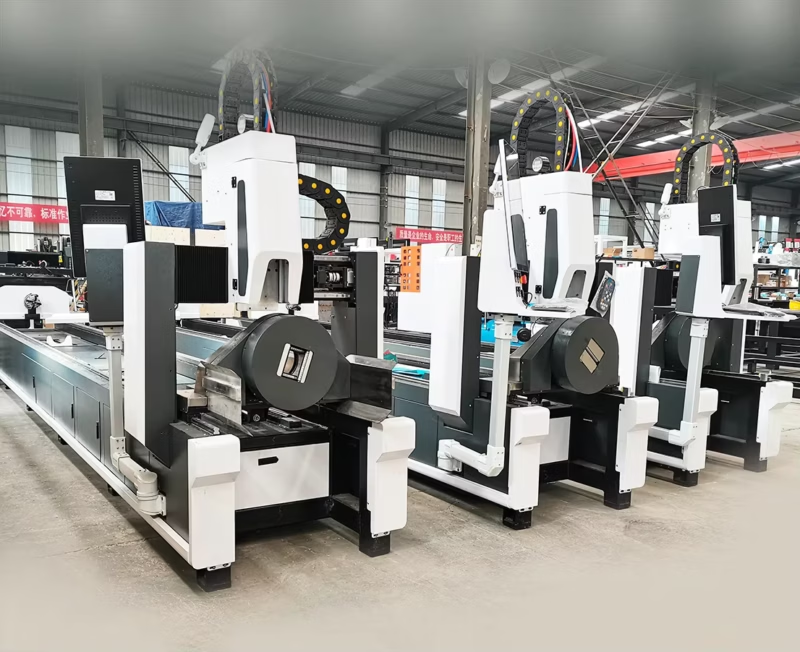
The manufacturing of Liquefied Natural Gas (LNG) storage tanks and transport vessels demands a level of precision that exceeds standard heavy-industry requirements. Given the cryogenic nature of LNG, typically stored at temperatures as low as -162 degrees Celsius, the materials used—primarily stainless steel and 9% nickel steel—must maintain high toughness and fatigue resistance. Fiber Laser Cutting has emerged as the critical process for achieving the geometric accuracy and edge quality necessary to support subsequent automated assembly phases. From an industrial engineering perspective, the transition to high-power fiber lasers represents a shift from subtractive, multi-step fabrication to a consolidated, high-throughput workflow.
The Role of High-Precision Edge Quality
In LNG project fabrication, the edge quality of a cut plate is not merely an aesthetic requirement but a functional one. Fiber laser systems, operating in the 12kW to 30kW range, utilize a concentrated photon beam to achieve a kerf width significantly narrower than traditional thermal cutting methods. This concentration results in a minimal Heat Affected Zone (HAZ). For 9% Nickel Steel, maintaining the metallurgical properties near the cut edge is vital; excessive heat input can lead to nickel segregation or grain growth, which compromises the material’s impact toughness at cryogenic temperatures. Because fiber laser cutting utilizes high-speed gas dynamics to eject molten material, the resulting edge is dross-free and requires no secondary grinding or mechanical edge cleaning before moving to the welding station.
Eliminating Secondary Processes: The No-Grinding Mandate
Industrial efficiency is measured by the reduction of non-value-added activities. Traditional cutting methods often necessitate manual grinding to remove oxide layers or slag, a process that introduces variability and increases labor costs. Fiber Laser Cutting Machines equipped with nitrogen or high-pressure air assist provide a bright, clean cut surface that is weld-ready. This is particularly critical for LNG tank shells, where thousands of linear meters of material must be processed. By eliminating the grinding phase, facilities reduce the risk of surface contamination and ensure that the plate dimensions remain within the strict +/- 0.1mm tolerance required for automated fit-up.
Integrated Punching and Marking Capabilities
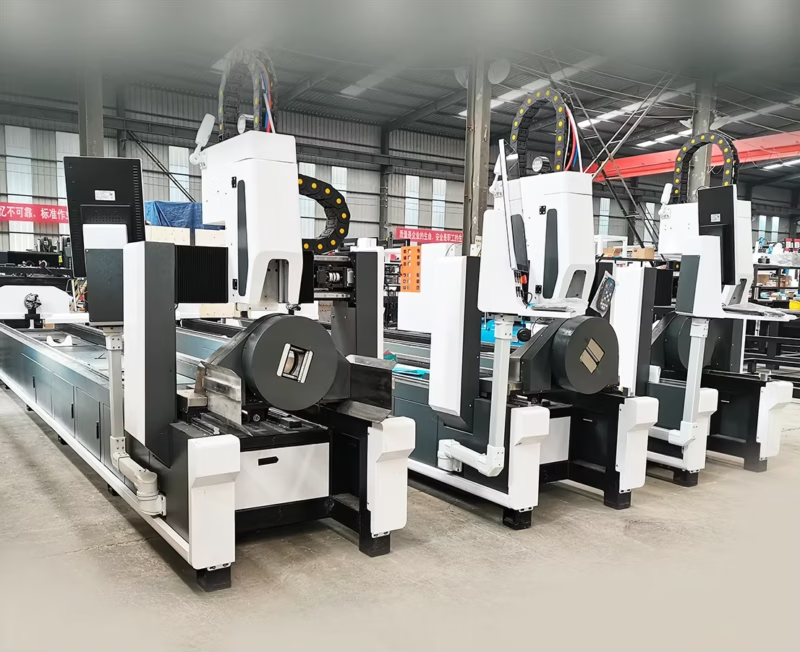
Modern fiber laser systems for LNG applications are not limited to simple profile cutting. The integration of Integrated Edge Preparation, marking, and punching into a single CNC program transforms the cutting bed into a multi-process center. Marking is essential for traceability in LNG projects, where every plate must be identified by heat number and orientation for quality assurance audits. High-speed laser marking creates permanent, legible identifiers without creating stress-concentration points that could lead to crack propagation. Furthermore, the ability to “punch” or pierce pilot holes with micron-level accuracy allows for the seamless installation of baffles, brackets, and internal tank instrumentation during the assembly phase.
Optimizing Geometry for Narrow Gap Welding
The primary driver for high-precision laser cutting in the LNG sector is the requirement for Narrow Gap Welding (NGW). Narrow gap techniques are employed to reduce the volume of weld metal required, thereby decreasing the total heat input into the joint and accelerating production timelines. However, NGW is highly sensitive to groove geometry. Even a slight deviation in the root face or the groove angle can lead to lack of fusion or slag inclusions. Fiber laser cutting machines featuring five-axis bevel heads can produce V, Y, X, and K-shaped bevels with absolute consistency. The laser’s ability to maintain a constant focal point throughout the beveling process ensures that the root face is perfectly uniform, a prerequisite for the stable arc dynamics required in narrow gap applications.
Thermal Distortion Control and Dimensional Stability
Large-format plates used in LNG tank construction are prone to thermal distortion during cutting. Industrial engineers mitigate this through strategic nesting and the inherent low-heat input of the fiber laser. Because the laser moves at significantly higher velocities than legacy systems, the thermal energy is dissipated quickly, preventing the plate from “walking” or warping. This dimensional stability is crucial when fabricating the large-radius segments of a spherical or cylindrical storage tank. If the segments do not match the theoretical radius perfectly, the resulting gaps will exceed the capabilities of automated welding systems, leading to costly manual repairs and project delays.
Throughput and Operational Efficiency Calculations
When analyzing the Total Cost of Ownership (TCO), fiber laser cutting offers a compelling ROI for LNG fabricators. While the initial capital expenditure for a 20kW+ system is substantial, the reduction in cost per meter is significant. The calculation includes:
– Reduction in gas consumption per cut meter compared to non-laser thermal methods.
– Elimination of abrasive consumables used in grinding.
– Significant reduction in man-hours for edge preparation.
– Increase in nesting density due to the small kerf, leading to 3-5% better material utilization.
In a sector where material costs for specialized nickel alloys are high, these percentage gains in yield translate directly to millions of dollars in project savings.
Automation and Industry 4.0 Integration
The latest generation of fiber laser machines is designed for integration into fully automated “Smart Factories.” for LNG Projects, this means the cutting schedule can be synced with the project management software. As the laser completes the integrated punching and marking of a plate, the data is fed back to the Narrow Gap Welding station, informing the welding robots of the exact plate thickness and bevel angle measured by the laser’s onboard sensors. This closed-loop communication minimizes the margin for human error and ensures that the structural integrity of the LNG containment system is verified at every stage of the manufacturing process.
Conclusion: The Engineering Standard for Cryogenic Fabrication
The shift toward fiber laser cutting is a response to the increasing complexity and safety requirements of the global energy infrastructure. By providing a high-precision, no-grinding solution that excels in the preparation of 9% nickel and stainless steels, fiber lasers have become the backbone of modern LNG fabrication. The ability to perform punch, mark, and cut operations in a single pass, combined with the geometric precision required for narrow gap welding, allows industrial engineers to achieve production benchmarks that were previously unattainable. As LNG demand grows, the reliance on this high-precision technology will only intensify, cementing fiber laser cutting as the industrial standard for cryogenic engineering.






