Optimizing Bridge Truss Fabrication with Magnetic Crawler Fillet Welding
In the domain of structural steelwork, bridge trusses represent one of the most demanding applications for weld integrity and consistency. The sheer volume of linear fillet welding required for chords, diagonals, and gusset plates necessitates a shift from manual arc welding to mechanized solutions. The primary tool for this transition is the Tank Fillet Welding Machine, specifically the magnetic crawler variant. This machine is designed to navigate the long, uninterrupted joints typical of bridge components while maintaining a constant contact angle and travel speed.
Mechanical Adhesion and the Magnetic Crawler Chassis
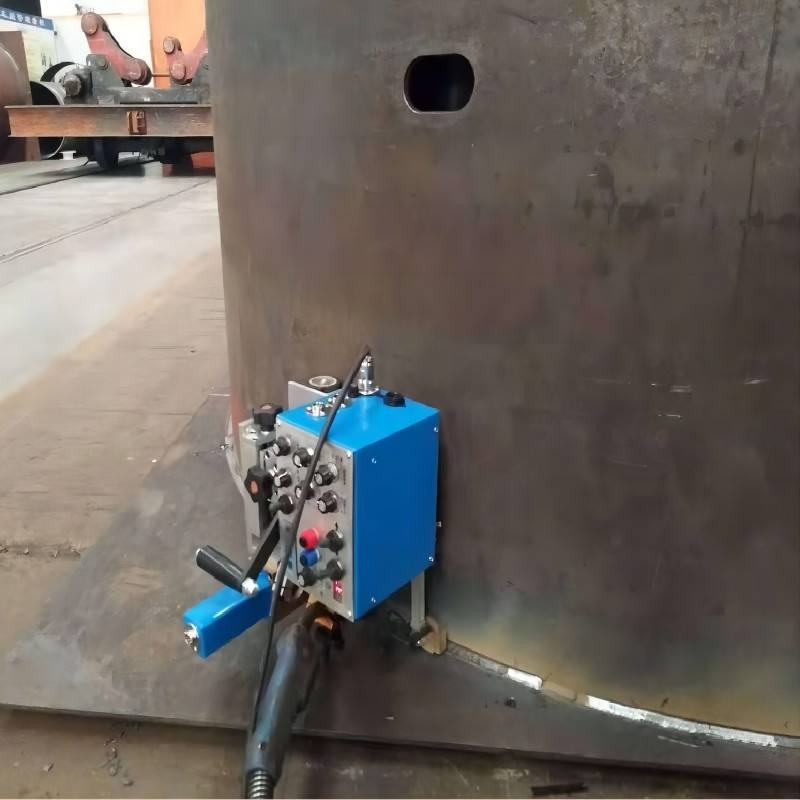
The core of the welding carriage is its drive system. Unlike rail-mounted systems that require the time-consuming installation of tracks, the magnetic crawler welding carriage utilizes high-strength permanent magnets or electromagnets integrated into its wheels or base plate. This allows the machine to adhere directly to the steel workpiece. In bridge truss construction, where beams are often positioned at various angles, the magnetic force ensures that the carriage remains pinned to the surface, counteracting gravity and the vibration generated by the welding process.
From an industrial engineering perspective, the elimination of external tracks reduces setup time by approximately 40%. The crawler’s ability to follow the joint geometry using guide rollers ensures that the torch remains centered in the root of the fillet. This mechanical tracking is vital for maintaining the effective throat thickness of the weld, which is the most critical dimension for calculating the load-bearing capacity of the truss.
The Mechanics of Zero-Tailing Technology
One of the historical limitations of mechanized welding carriages was the “tail” left at the start and end of a joint. Standard carriages often have a physical offset between the drive wheels and the torch position, preventing the machine from welding to the very edge of a plate or into a tight corner. Zero-tailing technology addresses this by optimizing the torch suspension and the carriage wheelbase.
The zero-tailing mechanism allows the torch to lead or trail in a way that the welding arc can reach the absolute start and finish points of the seam. In bridge trusses, where gusset plates meet chord members, ensuring a full-length weld without manual “touch-ups” at the ends is essential for fatigue resistance. Any crater or unfinished segment at the end of a fillet weld serves as a stress concentrator, potentially leading to crack initiation under cyclic loading. By utilizing zero-tailing logic, the machine completes the entire seam, ensuring uniform heat distribution from edge to edge.
Field Construction Stability and Environmental Resilience
Bridge construction sites are characterized by environmental variables that are absent in controlled shop environments. High winds, humidity, and the inherent vibrations of the construction site can disrupt the welding arc. The tank fillet welding machine is engineered for field construction stability through a low center of gravity and a ruggedized four-wheel drive system.
The stability of the carriage is further enhanced by its weight distribution. By placing the wire feeder and control unit directly over the magnetic wheels, the machine increases its “downforce,” which minimizes slippage on mill scale or slightly rusted surfaces. For the industrial engineer, this stability translates to a lower defect rate. Manual welding in the field often suffers from “stop-start” defects caused by welder fatigue or positioning changes; the crawler eliminates these variables by providing a continuous, steady-state welding operation for lengths exceeding 10 meters if necessary.
Consistency in Weld Bead Geometry
The quality of a fillet weld in a bridge truss is measured by its leg length, convexity, and penetration. Bridge truss fabrication standards require strict adherence to these parameters to meet safety codes. A magnetic crawler allows for the precise adjustment of travel speed (typically ranging from 150 to 1500 mm/min) and torch angle.
Once the parameters are locked into the carriage’s control panel, the machine delivers a uniform bead profile that manual operators cannot replicate over long durations. This uniformity reduces the volume of filler metal wasted on oversized welds and significantly lowers the time required for post-weld inspections. The use of flux-cored arc welding (FCAW) in conjunction with these carriages provides deep penetration and a slag blanket that protects the cooling weld metal, which is particularly useful in the outdoor conditions of a bridge site.
Operational Workflow and Labor Efficiency
Implementing tank fillet welding machines changes the labor dynamic on the job site. Instead of a single welder focusing on one joint, a single operator can oversee multiple crawlers. The workflow involves:
1. Surface Preparation
The steel surface is cleaned of moisture and loose scale to ensure maximum magnetic grip and arc stability. This is a standard prerequisite for any high-quality weld but is particularly important for the smooth travel of the crawler.
2. Carriage Alignment
The operator places the crawler at the start of the joint. The zero-tailing feature allows the torch to be positioned at the very beginning of the plate. The guide rollers are engaged against the vertical member of the truss to ensure the carriage follows the path without drifting.
3. Parameter Synchronization
The voltage, wire feed speed, and travel speed are synchronized. Modern units allow for “crater fill” settings where the machine slows down at the end of the run to fill the weld pool, preventing the formation of shrinkage cavities.
Economic Impact of Mechanization
The ROI for a magnetic crawler in bridge truss applications is realized through the reduction of rework. In manual welding, the probability of a defect requiring grinding and re-welding increases with the length of the seam. In contrast, the mechanized approach maintains a 98% first-pass success rate. Furthermore, the duty cycle of a machine is nearly 100%, whereas a manual welder’s duty cycle is often limited by ergonomic constraints and the need for frequent repositioning.
Conclusion
The integration of tank fillet welding machines with Zero-tailing technology represents a significant advancement in the efficiency of bridge truss fabrication. By focusing on mechanical stability and removing the human element from the travel speed and torch positioning equations, engineers can guarantee a level of structural integrity that meets the most stringent modern standards. The magnetic crawler is not merely a tool for speed; it is a system for precision, designed to withstand the rigors of field construction while delivering shop-quality results.
-


LT240S tube laser cutting machine
-
LT120S tube laser cutting machine
-
Sale

Tank Fillet Welding Machine
Original price was: $1,000.00.$900.00Current price is: $900.00. -
Sale

MAK100 tube laser cutting machine
Original price was: $5,500.00.$5,000.00Current price is: $5,000.00. -

portable plasma air cutting machine
$1,200.00 -

2in1 fiber laser cutting machine
-

Air cooling Laser welding machine
-

HF h beam laser cutting machine
-

LT240 laser cutting machine
-

Laser welding machine
-


Cobot Welding Station
-

Gantry welding robot solution
-

Tracked Wheeled AGV Welding robot
-

LFH6020 Fiber laser cutting machine
-
LFP6020
-

robotic welidng machine
Advanced Fiber Laser Tube Processing Technology
Our CNC Fiber Laser Tube Cutting systems revolutionize metal fabrication by integrating high-precision cutting, punching, and profiling into a single automated workflow. Designed for versatility, this technology handles a wide array of profiles including Round, Square, Rectangular, and Oval tubes, as well as complex L-shaped and U-shaped channels.
- Precision Punching: High-speed hole punching with micron-level accuracy, eliminating the need for mechanical drilling or die-stamping.
- Complex Profiling: Advanced 3D pathing allows for intricate interlocking joints and specialized notch cuts, ideal for structural frames.
- High Material Efficiency: Intelligent nesting software minimizes scrap, reducing raw material costs across large production runs.
- Clean Finish: Delivers oxide-free, burr-free edges that require zero secondary grinding before welding.

Seamlessly processing multiple profiles with consistent precision.
Global Delivery & Logistics



From our high-tech manufacturing facility directly to your global site. PCL WeldCut ensures secure packaging, professional handling, and reliable international logistics to safeguard your equipment throughout the entire journey.