Optimizing Fillet Welding Operations in Wind Tower Production
In the fabrication of wind turbine towers, the structural integrity of internal components—such as door frames, flange rings, and stiffener plates—relies heavily on the quality of fillet welds. For industrial engineers overseeing large-scale tank and tower production, the transition from manual welding to semi-automated systems is a prerequisite for meeting global demand. The primary challenge in field construction and shop-floor assembly of these massive structures is maintaining weld consistency over long, curved trajectories. Wind Tower Fabrication requires a balance of high deposition rates and precise penetration to ensure the longevity of the structure against cyclical aerodynamic loads.
The traditional approach of manual welding often leads to fatigue-induced defects and inconsistent bead profiles, which increase rework costs and extend lead times. By deploying a specialized Fillet Welding Automation system based on magnetic crawler technology, manufacturers can achieve a continuous duty cycle that far exceeds manual capabilities. These systems are designed to traverse the circumference or vertical seams of the tower sections, providing a stable platform for the welding torch while navigating the unique geometry of large-diameter tanks.
The Mechanics of Magnetic Crawler Systems for Field Stability
Field construction presents environmental variables that can disrupt standard automated welding setups. Wind tower sections, often exceeding 4 meters in diameter, require equipment that can adhere to the workpiece without the need for cumbersome external tracks or rails. The magnetic crawler utilizes high-strength permanent magnets or electromagnets integrated into its drive wheels. This creates a powerful clamping force that ensures the unit remains perpendicular to the weld joint, even when operating in vertical or overhead positions.
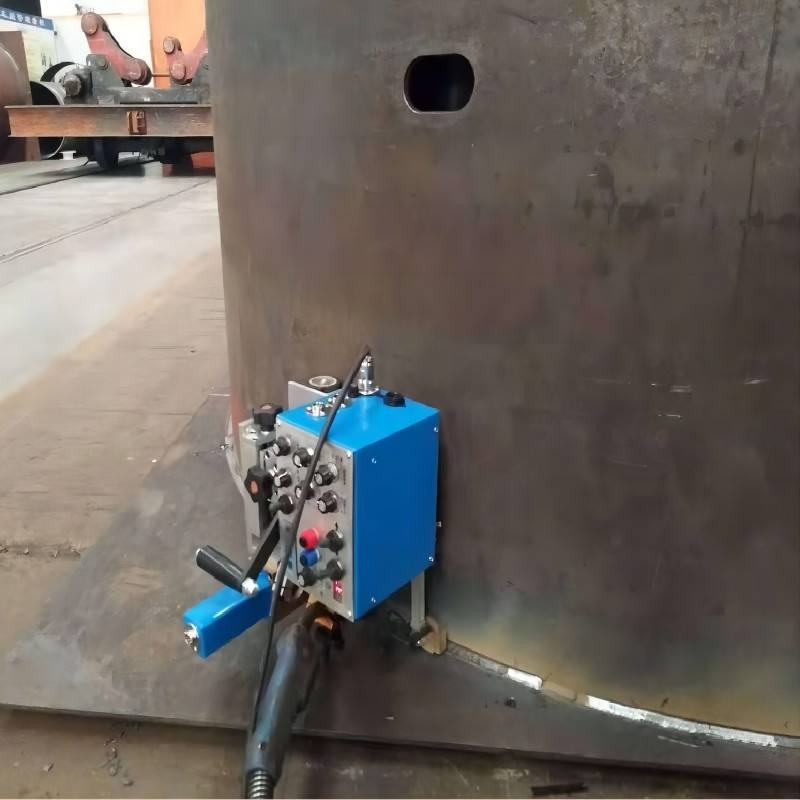
Stability is further enhanced by the crawler’s low center of gravity and high-torque drive motors. In tank fillet welding, the crawler tracks the joint using mechanical or electromechanical sensors, ensuring the torch remains in the root of the fillet. This mechanical adherence is critical for mitigating the effects of surface irregularities and slight deviations in plate fit-up. From an engineering perspective, the stability of the Magnetic Crawler minimizes vibration-induced arc instability, resulting in a uniform weld toe and consistent throat thickness across the entire length of the seam.
Integrating Offline Programming (OLP) for Non-Robotic Automation
While often associated with articulated arms, Offline Programming (OLP) is an essential tool for optimizing magnetic crawler paths in tower fabrication. OLP allows welding engineers to simulate the welding sequence and parameters in a virtual environment before the actual execution. This process involves importing the CAD data of the tower section and defining the weld path based on the specific geometry of the fillet joint. By calculating the optimal travel speed, wire feed rate, and torch angle offline, the setup time on the production floor is significantly reduced.
The OLP software generates a motion program that is uploaded to the crawler’s controller. This program accounts for the curvature of the tank, adjusting the drive speed to compensate for changes in position relative to gravity. This level of planning ensures that the heat input remains within the specified range of the Welding Procedure Specification (WPS). Furthermore, OLP enables the synchronization of multiple crawlers working on the same section, preventing thermal distortion by distributing the heat load across the circumference of the tower.
Enhancing Duty Cycle and Deposition Rates
The core objective of implementing automated fillet welding in wind tower production is the improvement of the “arc-on” time. Manual welders typically operate at a duty cycle of 20% to 30% due to the need for repositioning and rest. In contrast, a magnetic crawler system can maintain an arc-on time of over 70%. When combined with tandem-wire or high-capacity power sources, the deposition rate—the amount of weld metal added to the joint per hour—increases exponentially.
For thick-walled sections found at the base of wind towers, multi-pass fillet welds are often required. The precision of the programmed crawler allows for accurate bead placement in each successive pass, ensuring proper fusion between the weld metal and the base material. Industrial engineers can monitor these parameters in real-time, using data logging features to verify that every millimeter of the weld meets the required structural standards. This data-driven approach to fabrication reduces the reliance on post-weld ultrasonic or radiographic testing by ensuring quality at the point of deposition.
Thermal Management and Stress Mitigation
Fillet welding on large-diameter tanks introduces significant thermal stresses that can lead to buckling or dimensional inaccuracy if not managed properly. The automated nature of the crawler, guided by pre-programmed parameters, allows for a more controlled heat-affected zone (HAZ). Because the travel speed is constant, the energy input per unit length of the weld is uniform. This prevents localized overheating, which is a common cause of grain coarsening and reduced toughness in high-strength steels used for wind towers.
Moreover, the use of offline programming allows engineers to design “skip welding” sequences or balanced welding patterns that minimize residual stress. By coordinating the movement of the magnetic crawler, the fabrication team can ensure that the tower section remains within roundness tolerances. This is particularly vital when welding internal rings and flanges, where even a slight deformation can prevent the successful assembly of tower segments in the field.
Workflow Integration and Operator Safety
Transitioning to an automated magnetic crawler system also transforms the role of the welding operator. Instead of performing the weld manually in cramped or elevated positions, the operator becomes a system supervisor. This change significantly reduces exposure to welding fumes, UV radiation, and ergonomic strain. The control interface, often a ruggedized pendant or tablet, provides real-time feedback on the welding process, allowing for minor adjustments without interrupting the operation.
From a workflow perspective, the integration of these machines into the production line allows for better scheduling and resource allocation. Since the weld time is predictable and repeatable, the production of wind tower sections can be synchronized with subsequent stages such as blasting and coating. This level of predictability is the cornerstone of Lean Manufacturing in heavy industry, driving down the total cost of ownership while increasing the annual output of the fabrication facility.
Conclusion: The Future of Tower Fabrication Efficiency
The adoption of magnetic crawler-based welding systems with Offline Programming represents a significant leap forward for wind tower manufacturers. By focusing on the mechanical stability of magnetic adhesion and the precision of digital path planning, industrial engineers can overcome the limitations of manual field construction. This approach not only ensures the high-quality fillet welds necessary for structural safety but also provides the scalability required to meet the burgeoning global demand for renewable energy infrastructure. The synergy between robust mechanical design and intelligent programming defines the modern standard for heavy-duty tank and tower fabrication.
-


Cantilever Welding Robot solution
-


GF laser cutting machine
-

P3015 plasma cutting machine
-

LFP3015 Fiber Laser Cutter
-

pipe plasma cutting machine
-
LFH 4020 Fiber Laser Cutting Machine
-
LFP4020
-

gantry plasma air cutting machine
-

3D robot cutting machine
-

8 axis plasma cutting machine
-

5 axis plasma cutting machine
-

LT360 tube laser cutting machine
-

robot welding workstation
-

SF6060 fiber laser cutting machine
