Engineering Specifications for Tank Fillet Welding Automation
In the domain of large-scale steel structure fabrication, particularly for oil, gas, and water storage tanks, the execution of fillet welds at the junction of the tank shell and floor plates represents a critical path in construction. Industrial engineering standards demand a shift from manual stick welding to automated systems that can handle the rigorous demands of field environments. The magnetic crawler welding system has emerged as the primary solution for maintaining high duty cycles while ensuring the structural integrity of these massive installations. Unlike factory-bound systems, these units must operate in outdoor conditions where terrain and plate irregularities are common.
The primary engineering challenge in tank construction is the consistency of the fillet weld profile over hundreds of linear meters. Manual welding often results in variations in throat thickness and leg length due to operator fatigue and environmental factors. Automated magnetic crawlers address these variances by providing a constant travel speed and a stable torch position. The stability of the machine is derived from high-strength permanent magnets or electromagnets integrated into the drive chassis, allowing the unit to adhere to vertical or curved steel surfaces without the need for guide rails or complex rigging.
The Mechanics of Magnetic Crawler Stability in the Field
For a welding carriage to be effective in field construction, its traction system must overcome gravity and the friction of the welding lead umbilical. Field construction stability is achieved through a multi-point magnetic contact system. These crawlers utilize high-flux neodymium magnets that generate enough downward force to maintain a grip on carbon steel plates ranging from 6mm to over 40mm in thickness. The drive system usually consists of a four-wheel or tracked configuration powered by high-torque DC brushless motors, ensuring that the movement remains fluid even when encountering weld beads or surface rust.
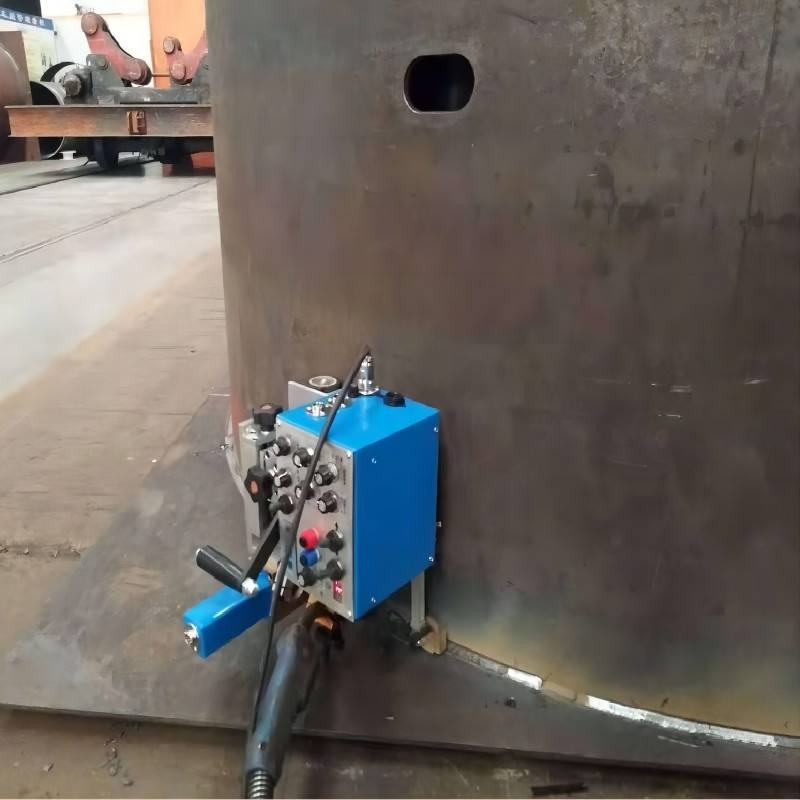
Engineers must calculate the “sliding force” versus the “pull-off force” of the magnetic base. In a vertical fillet welding scenario, the sliding force must exceed the combined weight of the carriage, the wire feeder (if mounted), and the drag of the gas hoses and power cables. By optimizing the center of gravity and the magnetic footprint, these machines can operate on the internal and external radii of storage tanks with a diameter as small as 10 meters, maintaining a precise arc gap throughout the rotation.
Implementing Offline Programming for Automated Tractors
While often associated with factory arms, offline programming integration is now a cornerstone of high-end welding tractors used in steel structures. In this context, offline programming (OLP) refers to the generation of welding paths and parameter sets within a digital environment before the machine is deployed to the tank site. By utilizing CAD models of the tank structure, engineers can simulate the crawler’s path along the floor-to-shell joint, identifying potential obstructions such as manways, nozzles, or existing vertical seams.
This data-driven approach allows for the pre-calculation of heat input and travel speeds. For instance, if the tank design specifies a 10mm fillet weld, the OLP software determines the exact wire feed speed, voltage, and oscillation width required to achieve that geometry in a single pass. This information is then uploaded to the crawler’s control unit via a ruggedized interface. Once on-site, the operator simply aligns the machine at the start point. The machine then executes the pre-programmed sequence, reducing the margin for human error and ensuring that the heat-affected zone (HAZ) remains within the engineering tolerances specified in the project’s Welding Procedure Specification (WPS).
Oscillation and Motion Control in Fillet Welding
The quality of a fillet weld in a heavy steel structure is largely dependent on the weave pattern or oscillation of the torch. Modern tank welding machines feature integrated motorized slides that allow for linear, circular, or “pendulum” oscillation. Through the offline programming interface, engineers can specify the dwell time at the toes of the weld to prevent undercut and ensure proper fusion into the thicker shell plate.
The control system monitors the back-EMF of the motors to detect any resistance that might indicate a slip or a physical obstruction. This closed-loop feedback is vital for automatic fillet welding because it ensures that the travel speed remains synchronized with the oscillation frequency. If the wind picks up or the cable snagging increases tension, the system compensates to maintain the programmed “centimeters per minute,” preserving the volumetric consistency of the weld metal deposit.
Enhancing Efficiency through Dual-Carriage Synchronization
To further compress construction timelines, industrial engineers often deploy multiple magnetic crawlers simultaneously. Using a centralized offline programming hub, a single technician can oversee three or four machines working on different segments of the tank perimeter. This systematic approach transforms the welding process from a craft-based activity into a repeatable industrial process. The data logs generated by these machines provide a “digital birth certificate” for each weld, recording the exact parameters used for every centimeter of the seam, which is invaluable for quality assurance and non-destructive testing (NDT) workflows.
Structural Integrity and Heat Input Management
One of the hidden benefits of using programmed magnetic crawlers is the management of thermal distortion. Large-diameter tanks are susceptible to “peaking” and “banding” if heat input is not controlled. Because the automated system moves at a precise, calculated speed determined during the offline programming phase, the total heat input per unit length is kept constant. This uniformity prevents the localized warping of thin-gauge floor plates and ensures that the shell remains perfectly cylindrical, which is essential for the proper operation of floating roofs in oil storage applications.
Conclusion: The Future of Field-Based Steel Fabrication
The integration of magnetic crawler technology with sophisticated offline programming marks a significant evolution in steel structure assembly. By prioritizing mechanical stability and data-led parameter control, industrial projects can achieve a level of precision previously reserved for controlled shop environments. As global demand for infrastructure increases, the reliance on these specialized automated tractors will grow, providing the safety, speed, and repeatability required for the next generation of massive storage and structural systems. The elimination of manual variability through these engineered solutions ensures that the final structure meets the most stringent safety and longevity standards in the industry.
-


Cantilever Welding Robot solution
-


GF laser cutting machine
-

P3015 plasma cutting machine
-

LFP3015 Fiber Laser Cutter
-

pipe plasma cutting machine
-
LFH 4020 Fiber Laser Cutting Machine
-
LFP4020
-

gantry plasma air cutting machine
-

3D robot cutting machine
-

8 axis plasma cutting machine
-

5 axis plasma cutting machine
-

LT360 tube laser cutting machine
-

robot welding workstation
-

SF6060 fiber laser cutting machine
