Optimization of Shipbuilding Productivity via Magnetic Crawler Systems
In the heavy industrial landscape of shipbuilding, the efficiency of tank construction is directly proportional to the speed and quality of Fillet Welding operations. Traditionally, the assembly of ballast tanks, fuel oil tanks, and cargo holds has relied heavily on manual labor, which introduces variables in weld consistency and operator fatigue. The introduction of the Tank Fillet Welding Machine represents a pivot toward mechanized precision tailored for the rugged conditions of a shipyard. Unlike stationary factory equipment, these systems must operate in situ, navigating the massive internal surfaces of ship hulls while maintaining the strict tolerances required by maritime classification societies.
The primary mechanical driver of these systems is the Magnetic Crawler. These units utilize high-strength permanent magnets or switchable electromagnets to adhere to vertical and overhead steel plates. From an industrial engineering perspective, the adhesion-to-weight ratio is the critical metric. A crawler must support the weight of the welding torch, wire feeder, and cable loom without slipping, even when encountering surface irregularities like mill scale or primer over-spray. This magnetic stability ensures that the welding arc remains positioned precisely in the root of the fillet joint, which is essential for achieving full penetration and avoiding undercut.
The Role of Offline Programming in Field Construction
While the mechanical crawler provides the physical platform, Offline Programming (OLP) serves as the digital architecture that maximizes its utility. In the context of tank welding, OLP allows engineers to utilize the vessel’s 3D CAD models to generate weld paths and parameter sets before the equipment ever reaches the shop floor. This approach minimizes “arc-off” time, as the operator does not need to manually program points on the workpiece. Instead, the crawler follows a pre-defined logic tailored to the specific geometry of the tank’s stiffeners and bulkheads.
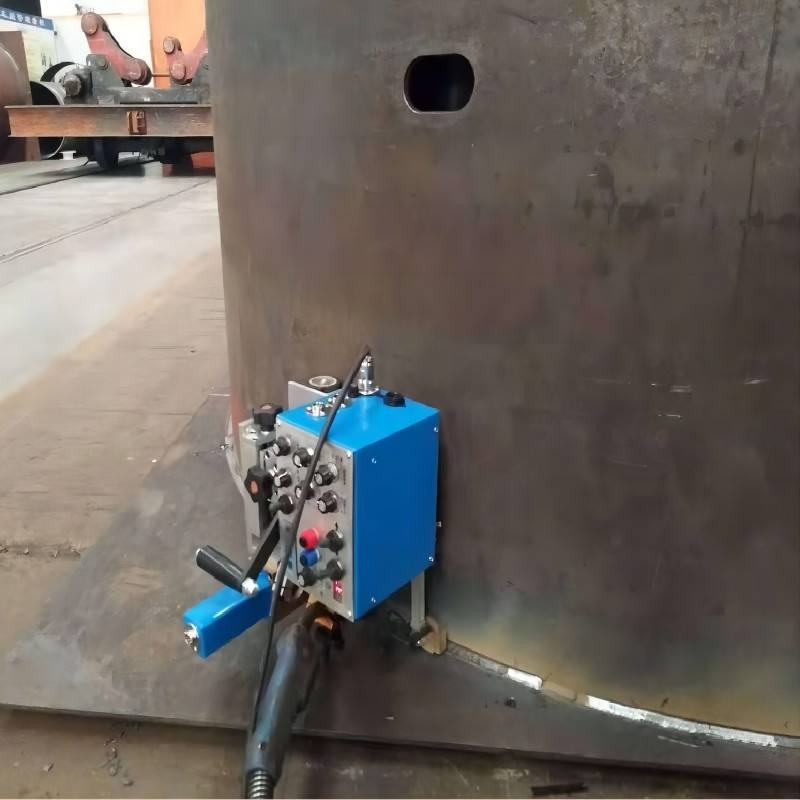
OLP systems for crawlers focus on three primary data points: travel speed, torch oscillation frequency, and dwell time. By simulating these variables in a virtual environment, engineers can predict the heat input and ensure it stays within the Qualified Welding Procedure Specification (WPS) limits. This pre-planning phase is vital for Shipbuilding Field Construction, where the environmental conditions—such as fluctuating temperatures and humidity—already pose challenges to metallurgy. Eliminating human error in pathing ensures that the fillet size remains uniform across kilometers of joints.
Mechanical Stability and Traction Control
Field construction stability is not merely about staying attached to the wall; it is about the vibration-free movement of the torch. A Tank Fillet Welding Machine must contend with the “slip-stick” phenomenon often found in gear-driven systems. To counteract this, industrial-grade crawlers utilize high-torque stepper motors coupled with precision gearboxes. The integration of four-wheel independent drive systems allows the crawler to negotiate the intersections of longitudinal and transverse stiffeners, which are common obstacles in tank internals.
Furthermore, the mechanical design incorporates a floating torch holder. Since shipyard steel plates are rarely perfectly flat, a rigid torch mount would result in inconsistent arc lengths. The floating mechanism, often tensioned by calibrated springs or pneumatic cylinders, ensures that the contact-to-work distance (CTWD) remains constant. This mechanical feedback loop is essential for maintaining a stable voltage and current, which directly impacts the throat thickness of the fillet weld.
Thermal Management and Duty Cycle Improvements
One of the significant advantages of transitioning from manual welding to a Magnetic Crawler system is the improvement in the duty cycle. A manual welder typically operates at a 30-40% duty cycle due to the need for repositioning, shielding gas checks, and physical breaks. In contrast, a mechanized crawler can achieve duty cycles exceeding 70%. To support this, the machine must be engineered for high thermal resistance. Heat shields and reflective coatings protect the internal electronics and the magnetic wheel assemblies from the intense radiant heat generated during continuous multi-pass welding.
Industrial engineers focus on the “meters per hour” metric when evaluating these machines. By utilizing large-diameter wire spools mounted directly on the crawler or fed via a high-tension conduit, the frequency of consumables replacement is reduced. When combined with the optimized paths provided by Offline Programming, the total time to complete a standard ballast tank section can be reduced by 25-30% compared to traditional semi-automatic methods.
Integration with Shipbuilding Workflow
The deployment of a Tank Fillet Welding Machine requires a shift in the traditional shipbuilding workflow. Integration begins in the design office, where weld symbols in the CAD model are mapped to OLP software. This digital thread ensures that the instructions sent to the Magnetic Crawler are identical to the engineering intent. On the shipyard floor, the focus shifts to “kit-based” deployment. Welders become system operators, responsible for the setup, monitoring, and quality assurance of multiple crawlers simultaneously.
This transition facilitates a more data-driven approach to quality control. Modern crawlers can log real-time data, including travel speed and heat input, for every centimeter of the weld. This data logging is a cornerstone of modern Shipbuilding Field Construction, providing a digital “birth certificate” for the vessel’s structural integrity. If a defect is later found during non-destructive testing (NDT), engineers can audit the logs to determine if the deviation was caused by a mechanical slip or a fluctuation in power supply.
Economic Impact and ROI Analysis
From a CAPEX perspective, the investment in a Tank Fillet Welding Machine and Offline Programming software is significant. However, the ROI is realized through three main channels: labor redistribution, reduction in filler metal waste, and minimized repair rates. Fillet welds in ships are often over-welded by manual operators to “be safe,” leading to excess weight and wasted consumables. Mechanized systems deposit the exact required volume of weld metal, leading to a measurable reduction in wire consumption per vessel.
Furthermore, the reduction in rework is the most substantial cost saver. Manual fillet welding in cramped tank environments often leads to porosity or slag inclusions due to poor torch angles. The Magnetic Crawler maintains the optimal 45-degree work angle consistently, regardless of the operator’s physical position. By lowering the reject rate from a typical shipyard average of 3-5% to under 1%, the system pays for itself within the construction cycle of two to three large commercial vessels.
Conclusion: The Future of Ship Tank Assembly
The synergy between Magnetic Crawler technology and Offline Programming represents the most pragmatic path forward for high-volume Shipbuilding Field Construction. By prioritizing mechanical stability and digital path planning, shipyards can overcome the limitations of manual welding without the complexity of fully autonomous robotics which often fail in the grit and grime of a drydock. The focus remains on the Tank Fillet Welding Machine as a robust, specialized tool designed for the specific rigors of maritime steel fabrication, ensuring that the hulls of tomorrow are built with unprecedented consistency and structural reliability.
-


Cantilever Welding Robot solution
-


GF laser cutting machine
-

P3015 plasma cutting machine
-

LFP3015 Fiber Laser Cutter
-

pipe plasma cutting machine
-
LFH 4020 Fiber Laser Cutting Machine
-
LFP4020
-

gantry plasma air cutting machine
-

3D robot cutting machine
-

8 axis plasma cutting machine
-

5 axis plasma cutting machine
-

LT360 tube laser cutting machine
-

robot welding workstation
-

SF6060 fiber laser cutting machine
