Advanced Fabrication Technologies in Shipbuilding: Tank Fillet Welding and Automated Systems
The shipbuilding industry is currently undergoing a significant technological shift as shipyards strive to meet increasing demands for structural integrity and production speed. Central to this evolution is the implementation of specialized welding and cutting automation designed to handle the massive scales and stringent safety requirements of marine vessels. Specifically, the deployment of Laser Seam Tracking in tank fillet welding has revolutionized the way large-diameter storage tanks and hull sections are joined, ensuring consistent bead quality in challenging field environments.
Tank Fillet Welding with Laser Seam Tracking
Fillet welding represents a substantial portion of the total weld volume in shipbuilding, particularly in the construction of fuel tanks, bulkheads, and water ballasts. Traditional manual welding in these areas is prone to fatigue-induced inconsistencies and difficulties in maintaining the correct torch angle over long distances. The introduction of the Tank Fillet Welding Machine, integrated with Laser Seam Tracking, addresses these challenges by providing real-time adjustments to the welding parameters.
The Role of Magnetic Crawler Technology
In field construction, stability is the primary concern for any automated welding system. Modern fillet welding machines utilize Magnetic Crawler Technology to adhere to the vertical and horizontal surfaces of large steel plates. Unlike rail-based systems that require extensive setup time, magnetic crawlers can be deployed directly onto the workpiece. These units use high-strength permanent magnets or electromagnets to maintain a constant distance from the seam, even when navigating the slight curvatures of large-diameter tanks. This stability is critical for maintaining the arc length and ensuring deep penetration in thick-plate fillet joints.
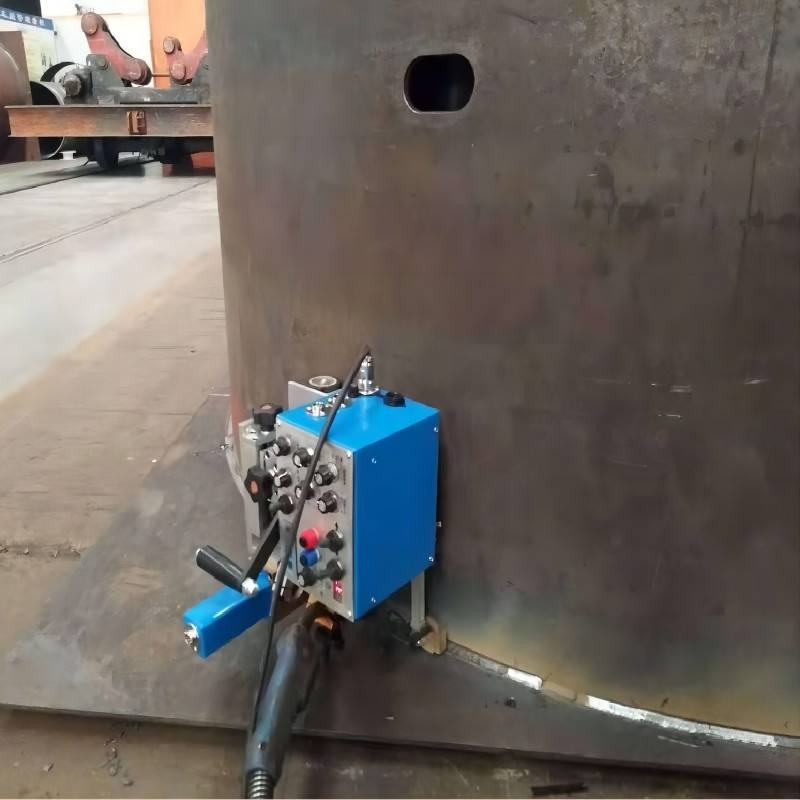
Stability in Large Diameter Tank Construction and Long Straight Seams
Large-diameter tanks and long straight seams in hull sections require continuous welding to minimize start-stop defects. Automated crawlers, guided by laser sensors, can follow a seam for several meters without intervention. The laser system scans the joint geometry ahead of the arc, compensating for any plate misalignment or thermal distortion that occurs during the welding process. This ensures that the weld metal is deposited precisely in the root of the joint, which is vital for the structural longevity of the vessel.
Comparative Analysis: Pipe Cutting Solutions in Shipbuilding
Beyond welding, the preparation of piping systems is a critical bottleneck in ship construction. Shipyards must choose between Tube Laser systems and Plasma cutting technologies, each offering distinct advantages depending on the material thickness and required throughput.
Tube Laser Precision and Surface Integrity
Tube Laser cutting is defined by its extreme precision and the high quality of the resulting edge. For shipyards, the primary benefit of the laser is the elimination of secondary processes. A Tube Laser produces a clean, burr-free cut that requires no grinding before welding. This precision (often within +/- 0.1mm) is essential for complex manifold systems where fit-up tolerances are tight. However, the capital investment for laser systems is higher, and they are typically optimized for thin to medium-walled pipes.
Plasma Cutting: One-Time Beveling and Material Savings
For heavy-wall pipe fabrication common in engine rooms and high-pressure lines, Plasma Beveling remains a dominant force. Plasma systems are capable of “one-time beveling,” where the machine cuts the pipe and creates the welding prep angle (V, Y, or K-cut) in a single pass. This significantly reduces labor hours compared to mechanical beveling. Furthermore, plasma systems are generally more forgiving of surface oxidation and scales common on shipyard raw materials. From a cost-benefit perspective, plasma offers a lower cost-per-cut on thicker sections, though it may require minor post-cut cleaning depending on the gas mixture used.
H-Beam Fabrication: Plasma vs. Laser
H-beams are the backbone of a ship’s internal structure. The choice between plasma and laser for H-beam processing involves a complex trade-off between initial cost and long-term operational efficiency.
Plasma Systems: Low Cost and Maintenance
Plasma H-beam cutting lines are the industry standard for shipyards focused on high-volume, heavy-duty structural components. The technology is robust, with relatively low maintenance requirements and a lower entry price point. For standard structural trimming and bolthole piercing, plasma provides a reliable ROI, especially in environments where the extreme precision of a laser is not strictly required by the design code.
Laser Systems: One-Step Punching, Marking, and Cutting
Conversely, Laser Cutting for H-beams represents the pinnacle of multi-functional fabrication. High-power fiber lasers can perform cutting, punching, and part marking in a single setup. This “all-in-one” approach eliminates the need to move heavy beams between different workcells, drastically reducing crane time and internal logistics costs. The ROI for laser systems is realized through the reduction of manual labor and the elimination of marking errors, which can be incredibly costly during the assembly phase of a ship.
ROI Analysis: Labor vs. Capital Investment
When analyzing the ROI of Laser vs. Plasma, shipyards must look beyond the sticker price. A laser system may cost 2-3 times more than a plasma system, but its ability to operate with minimal supervision and produce “weld-ready” parts can reduce total fabrication time by 40%. In regions with high labor costs, the laser’s higher efficiency often results in a shorter payback period despite the initial expenditure.
The Impact of Robotic Welding on Labor and Maintenance
The transition to Automated Robotic Welding is no longer optional for competitive shipyards. This shift is driven by a global shortage of high-skill welders and the need for higher “arc-on” time than a human operator can provide.
Technology and Labor Cost Reduction
A single robot welder can perform the work of three to four manual welders, particularly on repetitive tasks like stiffener-to-plate welding. By utilizing Automated Robotic Welding, shipyards can shift their skilled labor to more complex joinery that requires human intuition, while the robots handle the high-volume, straight-line, or circular welds. This not only reduces the direct labor cost per meter of weld but also improves safety by removing operators from environments with high fume concentrations and radiant heat.
Maintenance and System Reliability
The maintenance profile of a robotic welding cell is vastly different from manual equipment. While manual power sources are simple to repair, robotic systems require a structured preventative maintenance program focusing on the arm’s kinematics, cable management, and sensor calibration. However, the data generated by these systems allows for “predictive maintenance,” where the shipyard can identify potential failures before they result in downtime. In the long run, the consistency of a robot reduces the cost of rework and non-destructive testing (NDT) failures, which is often the most significant hidden cost in shipbuilding.
Conclusion
The integration of tank fillet welding machines with laser seam tracking, alongside the strategic use of laser and plasma cutting for pipes and beams, represents the future of naval architecture. By prioritizing Magnetic Crawler Technology for large-scale stability and choosing the appropriate cutting technology based on a rigorous ROI analysis, shipyards can significantly enhance their production throughput. As the industry moves toward further autonomy, the focus will remain on balancing high capital investment with the undeniable gains in precision, safety, and long-term operational efficiency.
-


LT240S tube laser cutting machine
-
LT120S tube laser cutting machine
-
Sale

Tank Fillet Welding Machine
Original price was: $1,000.00.$900.00Current price is: $900.00. -
Sale

MAK100 tube laser cutting machine
Original price was: $5,500.00.$5,000.00Current price is: $5,000.00. -

portable plasma air cutting machine
$1,200.00 -

2in1 fiber laser cutting machine
-

Air cooling Laser welding machine
-

HF h beam laser cutting machine
-

LT240 laser cutting machine
-

Laser welding machine
-


Cobot Welding Station
-

Gantry welding robot solution
-

Tracked Wheeled AGV Welding robot
-

LFH6020 Fiber laser cutting machine
-
LFP6020
-

robotic welidng machine
Advanced Fiber Laser Tube Processing Technology
Our CNC Fiber Laser Tube Cutting systems revolutionize metal fabrication by integrating high-precision cutting, punching, and profiling into a single automated workflow. Designed for versatility, this technology handles a wide array of profiles including Round, Square, Rectangular, and Oval tubes, as well as complex L-shaped and U-shaped channels.
- Precision Punching: High-speed hole punching with micron-level accuracy, eliminating the need for mechanical drilling or die-stamping.
- Complex Profiling: Advanced 3D pathing allows for intricate interlocking joints and specialized notch cuts, ideal for structural frames.
- High Material Efficiency: Intelligent nesting software minimizes scrap, reducing raw material costs across large production runs.
- Clean Finish: Delivers oxide-free, burr-free edges that require zero secondary grinding before welding.

Seamlessly processing multiple profiles with consistent precision.
Global Delivery & Logistics



From our high-tech manufacturing facility directly to your global site. PCL WeldCut ensures secure packaging, professional handling, and reliable international logistics to safeguard your equipment throughout the entire journey.