Advancing LNG Infrastructure via Robotic MAG Welding Systems
The construction of Liquefied Natural Gas (LNG) storage tanks and processing facilities represents one of the most demanding environments for structural integrity and welding precision. Traditional manual welding methods are increasingly insufficient to meet the aggressive timelines and stringent safety codes required by global energy firms. The industry is currently shifting toward the implementation of MAG welding optimization through the use of robotic magnetic crawlers. These systems allow for continuous, high-quality deposition on massive vertical and circumferential seams, effectively removing the physical constraints of human operators while maintaining the metallurgical standards required for cryogenic service.
Technical Specifications of MAG Integration in Crawler Units
Metal Active Gas (MAG) welding, a subset of Gas Metal Arc Welding (GMAW), is the preferred process for LNG Projects due to its high deposition efficiency and ability to produce clean, slag-free welds. In a robotic cell environment, the MAG process is fine-tuned for pulsed-spray transfer modes. This is critical for out-of-position welding, such as the vertical-up seams on 9% nickel steel tanks. By utilizing specialized shielding gas mixtures—typically Argon with CO2 concentrations—the robotic system can stabilize the arc and minimize spatter even at high wire-feed speeds.
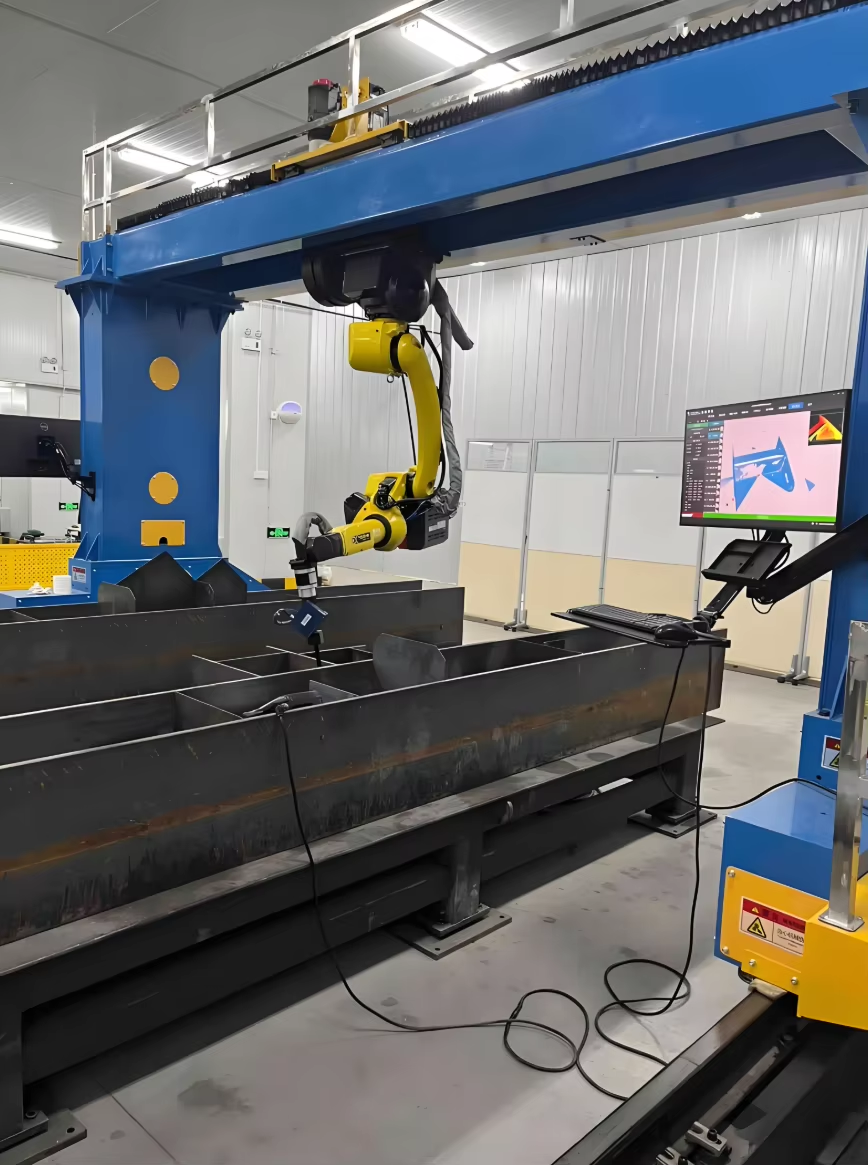
The integration of the welding power source with the robotic controller allows for real-time parameter adjustment. As the crawler moves along the substrate, the system monitors the arc voltage and current, adjusting the wire feed speed to compensate for slight variations in the root gap. This level of control ensures a uniform penetration profile, which is vital for the thermal cycling loads that LNG tanks endure during operation.
Engineering Dynamics of the Magnetic Crawler Platform
The primary challenge in LNG tank construction is the sheer scale of the workpiece. Fixed-base robots are impractical for welding structures that can exceed 80 meters in diameter. The magnetic crawler deployment solves this by utilizing high-intensity permanent magnets or electromagnets to adhere directly to the ferrous substrate. These crawlers are designed with independent drive motors that provide synchronized movement, allowing the welding torch to follow complex curvatures without the need for fixed tracks or heavy scaffolding.
Seam Tracking and Navigation
Robotic crawlers utilized in these cells are equipped with laser-vision sensors or through-the-arc sensing (TASC) technologies. These sensors allow the robot to detect the weld groove in real-time. In a high-production environment, the crawler must navigate around obstructions such as nozzles or stiffeners. The industrial engineer’s role is to program the path planning algorithms to ensure the torch maintains the correct work angle and travel angle, preventing defects like undercut or lack of fusion that are common in manual out-of-position MAG welding.
Maintenance Protocols for High-Duty Cycle Operations
To maintain the efficiency of a Robotic Welding Cell, a rigorous preventative maintenance schedule is mandatory. Unlike manual welding equipment, robotic systems are designed for duty cycles exceeding 80%. This places significant thermal and mechanical stress on the torch assembly and the crawler’s drive mechanism.
Torch and Consumable Management
The contact tip is the most frequently replaced component. In LNG infrastructure welding, even minor wear on the contact tip can lead to arc instability or “hunting,” which compromises weld quality. Automated torch cleaning stations are often integrated into the cell perimeter, where the robot can periodically dock to remove spatter, apply anti-spatter compounds, and check for tip concentricity. Additionally, the wire liners must be inspected for friction buildup, which can cause bird-nesting at the feeder, leading to costly downtime.
Crawler Drive and Magnet Integrity
The crawler’s locomotion system requires weekly inspection of the drive wheels and encoders. In an outdoor construction environment, grit and metallic dust can infiltrate the magnetic assemblies. Engineers must ensure the magnetic pull force remains within the safety factor limits to prevent the unit from detaching from the vertical wall. Motor brushes and gearboxes are monitored for thermal anomalies using infrared thermography during active welding cycles to predict failures before they occur.
Quantifying Labor ROI and Economic Impact
The transition to robotic welding is primarily driven by Robotic labor ROI calculations. The LNG sector faces a chronic shortage of certified high-pressure welders. A single robotic crawler operator can oversee two or three machines simultaneously, effectively tripling the output per man-hour.
In manual welding, the “arc-on” time—the actual time spent depositing metal—typically ranges from 20% to 30% due to welder fatigue, repositioning, and heat breaks. In contrast, a robotic magnetic crawler achieves arc-on times of 75% to 85%. When calculating the Return on Investment, engineers look at the “kilograms of weld metal deposited per hour.” A robotic MAG system can consistently deposit 4-6 kg/hr, whereas a manual welder may average 1.5-2 kg/hr in the same out-of-position conditions.
Reduction in Non-Destructive Testing (NDT) Failures
Beyond simple speed, the ROI is heavily influenced by the “repair rate.” In LNG projects, every weld is subjected to X-ray or Ultrasonic Testing (UT). Manual weld repair rates in vertical positions can fluctuate between 5% and 10%. Robotic systems, once calibrated, often bring this rate down to under 1%. Since the cost of gouging out and repairing a defective weld in a 30mm thick plate is roughly five times the cost of the initial weld, the reduction in rework provides a massive boost to the project’s bottom line.
Strategic Implementation for Site Managers
Deploying these cells requires more than just hardware acquisition. It involves a fundamental shift in site workflow. Pre-weld fit-up must be more precise; robots require consistent groove geometries to function at peak efficiency. Industrial engineers must optimize the workflow so that the crawler can move seamlessly from one seam to the next with minimal setup time. This “station-to-station” transit time is a key performance indicator (KPI) that determines the ultimate success of the automation strategy.
The use of magnetic crawlers also enhances site safety. By reducing the number of personnel working at height on scaffolding, the risk of falls and exposure to welding fumes is significantly mitigated. This reduction in insurance premiums and safety-related overhead further contributes to the overall ROI of the robotic investment.
Future Scalability in LNG Construction
As LNG projects move toward modular construction and larger storage capacities, the demand for mobile automation will only increase. The magnetic crawler platform provides a scalable solution that can be adapted to different plate thicknesses and metallurgical requirements simply by changing the welding wire and adjusting the software parameters. The integration of MAG welding within these mobile robotic units represents the current pinnacle of efficiency for large-scale energy infrastructure projects.
-


LT240S tube laser cutting machine
-
LT120S tube laser cutting machine
-
Sale

Tank Fillet Welding Machine
Original price was: $1,000.00.$900.00Current price is: $900.00. -
Sale

MAK100 tube laser cutting machine
Original price was: $5,500.00.$5,000.00Current price is: $5,000.00. -

portable plasma air cutting machine
$1,200.00 -

2in1 fiber laser cutting machine
-

Air cooling Laser welding machine
-

HF h beam laser cutting machine
-

LT240 laser cutting machine
-

Laser welding machine
-


Cobot Welding Station
-

Gantry welding robot solution
-

Tracked Wheeled AGV Welding robot
-

LFH6020 Fiber laser cutting machine
-
LFP6020
-

robotic welidng machine
Advanced Fiber Laser Tube Processing Technology
Our CNC Fiber Laser Tube Cutting systems revolutionize metal fabrication by integrating high-precision cutting, punching, and profiling into a single automated workflow. Designed for versatility, this technology handles a wide array of profiles including Round, Square, Rectangular, and Oval tubes, as well as complex L-shaped and U-shaped channels.
- Precision Punching: High-speed hole punching with micron-level accuracy, eliminating the need for mechanical drilling or die-stamping.
- Complex Profiling: Advanced 3D pathing allows for intricate interlocking joints and specialized notch cuts, ideal for structural frames.
- High Material Efficiency: Intelligent nesting software minimizes scrap, reducing raw material costs across large production runs.
- Clean Finish: Delivers oxide-free, burr-free edges that require zero secondary grinding before welding.

Seamlessly processing multiple profiles with consistent precision.
Global Delivery & Logistics



From our high-tech manufacturing facility directly to your global site. PCL WeldCut ensures secure packaging, professional handling, and reliable international logistics to safeguard your equipment throughout the entire journey.