Optimizing Wind Tower Fabrication via Robotic MAG Welding
The global demand for renewable energy infrastructure necessitates a radical shift in Wind Tower fabrication methodologies. Traditional manual welding methods are no longer viable for the scale and precision required by modern offshore and onshore turbine heights, which often exceed 100 meters. The core of this production evolution is the Robotic Welding Cell, a high-duty cycle environment designed to handle massive cylindrical sections with localized precision. Unlike standard automotive welding, wind tower production involves thick-plate steel (typically S355 or higher), requiring multi-pass sequences and high deposition rates that manual operators struggle to maintain over a 10-hour shift.
Technical Integration of Metal Active Gas Processes
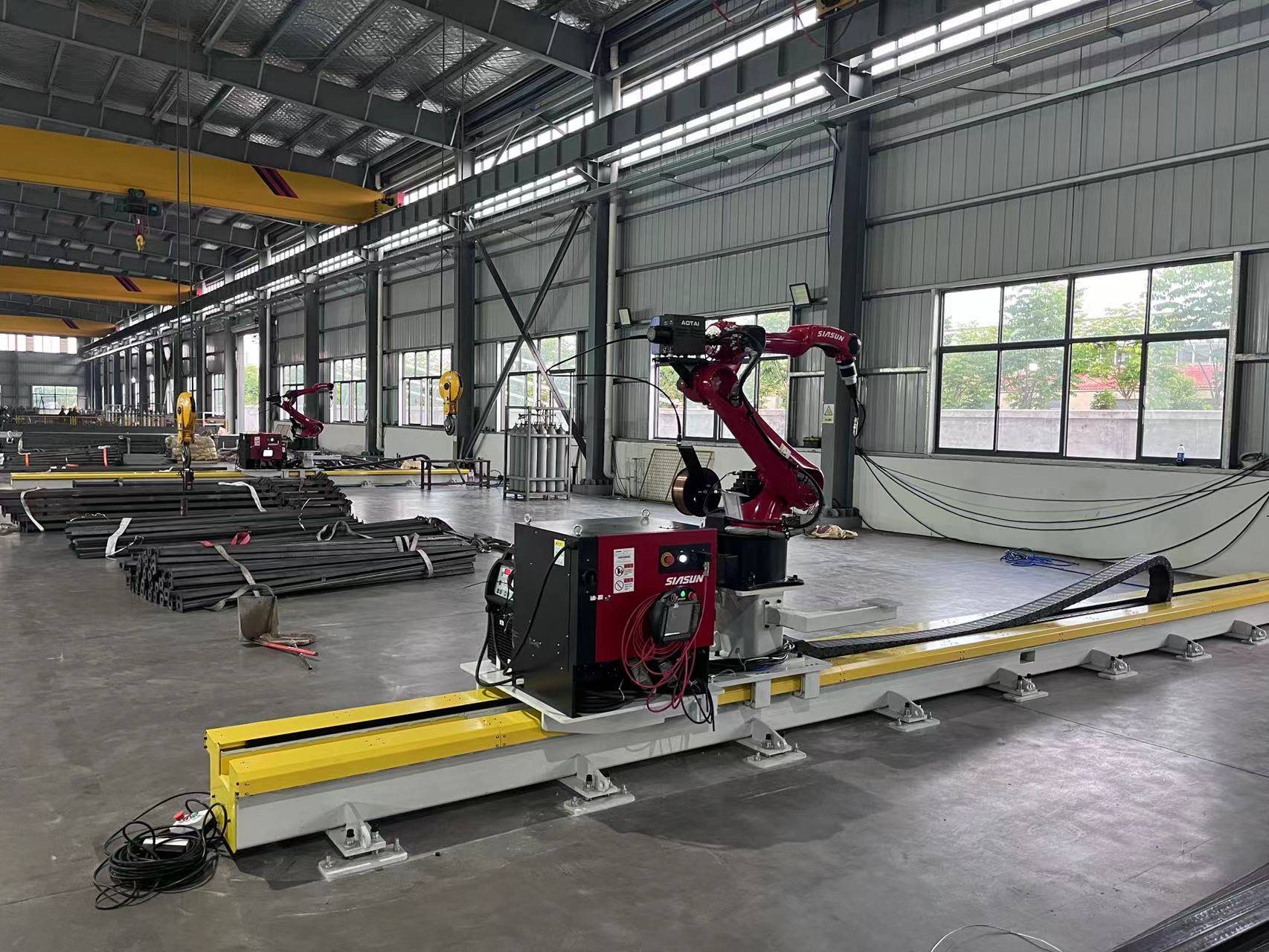
The primary process utilized within these cells is Metal Active Gas (MAG) welding. For wind tower sections, the focus is on maximizing the duty cycle while minimizing defects like slag inclusions or porosity. A high-performance robotic cell utilizes power sources capable of 500 to 600 amperes at 100% duty cycle. To achieve the required penetration in longitudinal seams, the system often employs tandem-wire or high-speed pulse MAG configurations.
Advanced Deposition Strategies
Industrial engineers prioritize the deposition rate (kg/h) as a key performance indicator (KPI). By utilizing 1.2mm or 1.6mm solid or metal-cored wires, a Robotic Welding Cell can achieve deposition rates far exceeding manual capabilities. The robot maintains a constant torch angle and contact-tip-to-work distance (CTWD), which is critical for stabilizing the arc and ensuring uniform heat input across the massive heat sink presented by the steel tower sections. This consistency reduces the Heat Affected Zone (HAZ) variability, ensuring the structural integrity of the tower under cyclic wind loads.
The Role of Laser Seam Tracking in Precision Control
One of the greatest challenges in welding large-scale wind tower components is fit-up variability. Even with precision rolling, the long seams often exhibit gaps, mismatches, or thermal distortion during the welding process. Laser Seam Tracking acts as the real-time “eyes” of the robot. This optical system scans the joint geometry millimeters ahead of the arc, providing instantaneous feedback to the robot controller.
Real-Time Path Correction
The sensor measures the gap width and the center of the groove. If the plate has warped due to previous passes or if the fit-up is inconsistent, the laser tracking system adjusts the robot’s path and parameters—such as travel speed and weave width—on the fly. This adaptive control is essential for multi-pass welding in deep V-grooves, where the robot must precisely position the root pass and then layer subsequent fill and cap passes without human intervention. By removing the need for constant manual monitoring, the system maintains a high arc-on time, directly impacting the facility’s throughput.
Maintenance Framework for Robotic Welding Cells
Reliability in a Wind Tower fabrication environment is dictated by the maintenance protocol of the welding periphery. Because these machines operate in high-heat, high-spatter environments, a reactive maintenance strategy is insufficient. Industrial engineers must implement a scheduled preventative maintenance (PM) program to ensure 98% uptime.
Periphery and Torch Maintenance
The automated torch cleaner (reamer station) is the most critical peripheral component. Every set number of cycles or minutes of arc time, the robot docks with the reamer to remove spatter from the nozzle and apply anti-spatter fluid. Furthermore, the contact tip, which is the primary wear part in Metal Active Gas (MAG) welding, must be replaced based on wire throughput (e.g., every 200kg of wire) rather than waiting for failure. Worn tips lead to arc instability and wire-feed issues, which can result in costly rework on a tower section that has already undergone hours of welding.
Calibration and Wire Delivery
Maintenance teams must also focus on the wire delivery system. For wind towers, wire is typically supplied in 250kg to 500kg drums. Ensuring that the conduits are free of kinks and that the feed rollers are correctly tensioned prevents bird-nesting and erratic feeding. Annual calibration of the robot’s TCP (Tool Center Point) ensures that the integration between the robot and the Laser Seam Tracking sensor remains accurate within sub-millimeter tolerances.
Labor ROI and Economic Analysis
From an industrial engineering perspective, the ROI of a robotic welding cell is not merely about replacing human labor; it is about scaling production capacity and reducing the Cost of Poor Quality (COPQ). The labor shift in a robotic cell moves from “welder” to “robot operator.”
Quantifying Labor Redistribution
A single robotic cell can often replace three to four manual welding stations. While the initial capital expenditure (CAPEX) for a gantry-mounted robotic system is significant, the operational expenditure (OPEX) is lower per meter of weld. A manual welder on a wind tower seam may spend only 30% of their shift with the arc actually on, due to fatigue, positioning, and setup. A robot can achieve an arc-on time of 75% to 85%.
Rework Reduction and Throughput
Rework on a wind tower is exponentially more expensive than the original weld. Excavating a defect in a 40mm thick plate requires hours of grinding and re-welding. By utilizing Laser Seam Tracking, the incidence of defects caused by human error—such as straying from the joint or incorrect travel speed—is virtually eliminated. If a robotic cell reduces the rework rate from 5% to less than 0.5%, the savings in gas, wire, and labor time typically pay for the robotic system within 18 to 24 months, depending on the volume of tower sections produced.
Process Standardization and Quality Assurance
Standardization is the bedrock of industrial efficiency. A robotic cell allows for the creation of digital Weld Procedure Specifications (WPS) that are locked into the system. Every tower section produced is a carbon copy of the previous one in terms of heat input and bead geometry. This level of traceability is vital for the insurance and certification of wind energy assets. Data logging features in modern controllers allow engineers to monitor voltage, current, and gas flow for every centimeter of the weld, providing a digital twin of the fabrication process that can be audited for quality assurance.
In conclusion, the deployment of a Robotic Welding Cell in wind tower production is a strategic necessity. By focusing on the technical refinement of the MAG process, leveraging the adaptive capabilities of Laser Seam Tracking, and adhering to rigorous maintenance standards, manufacturers can achieve a level of productivity and ROI that manual processes cannot replicate. The result is a more resilient supply chain and high-quality infrastructure capable of enduring the rigors of the global energy transition.
-


LT240S tube laser cutting machine
-
LT120S tube laser cutting machine
-
Sale

Tank Fillet Welding Machine
Original price was: $1,000.00.$900.00Current price is: $900.00. -
Sale

MAK100 tube laser cutting machine
Original price was: $5,500.00.$5,000.00Current price is: $5,000.00. -

portable plasma air cutting machine
$1,200.00 -

2in1 fiber laser cutting machine
-

Air cooling Laser welding machine
-

HF h beam laser cutting machine
-

LT240 laser cutting machine
-

Laser welding machine
-


Cobot Welding Station
-

Gantry welding robot solution
-

Tracked Wheeled AGV Welding robot
-

LFH6020 Fiber laser cutting machine
-
LFP6020
-

robotic welidng machine
Advanced Fiber Laser Tube Processing Technology
Our CNC Fiber Laser Tube Cutting systems revolutionize metal fabrication by integrating high-precision cutting, punching, and profiling into a single automated workflow. Designed for versatility, this technology handles a wide array of profiles including Round, Square, Rectangular, and Oval tubes, as well as complex L-shaped and U-shaped channels.
- Precision Punching: High-speed hole punching with micron-level accuracy, eliminating the need for mechanical drilling or die-stamping.
- Complex Profiling: Advanced 3D pathing allows for intricate interlocking joints and specialized notch cuts, ideal for structural frames.
- High Material Efficiency: Intelligent nesting software minimizes scrap, reducing raw material costs across large production runs.
- Clean Finish: Delivers oxide-free, burr-free edges that require zero secondary grinding before welding.

Seamlessly processing multiple profiles with consistent precision.
Global Delivery & Logistics



From our high-tech manufacturing facility directly to your global site. PCL WeldCut ensures secure packaging, professional handling, and reliable international logistics to safeguard your equipment throughout the entire journey.