Technical Integration of Robotic MAG Welding in LNG Fabrication
The construction of Liquefied Natural Gas (LNG) storage tanks, vaporizers, and distribution piping requires welding standards that exceed typical industrial benchmarks. The primary challenge involves managing high-strength alloys, such as 9% nickel steel, which are prone to magnetic arc blow and require precise heat input control to maintain cryogenic toughness. Implementing a Robotic MAG welding cell provides the necessary process stability to meet ASME Section IX and API 620 standards consistently.
Metal Active Gas (MAG) welding, when automated, allows for a significantly higher deposition rate compared to manual Shielded Metal Arc Welding (SMAW). In the context of LNG projects, where wall thicknesses are substantial, the transition to robotic cells facilitates multi-pass welding with optimized bead profiles. By leveraging pulsed-arc technology, engineers can minimize spatter and control the heat-affected zone (HAZ), which is critical for preventing grain growth that could compromise the integrity of the containment system at -162 degrees Celsius.
Precision Through Laser Seam Tracking Systems
While the robotic arm provides repeatability, the physical realities of large-scale LNG components involve fit-up tolerances and thermal distortion. This is where Laser Seam Tracking becomes an essential industrial engineering tool. The system utilizes a non-contact optical sensor mounted ahead of the welding torch. It projects a laser line across the joint, and a high-speed camera captures the profile data to identify the exact center and root of the seam in real-time.
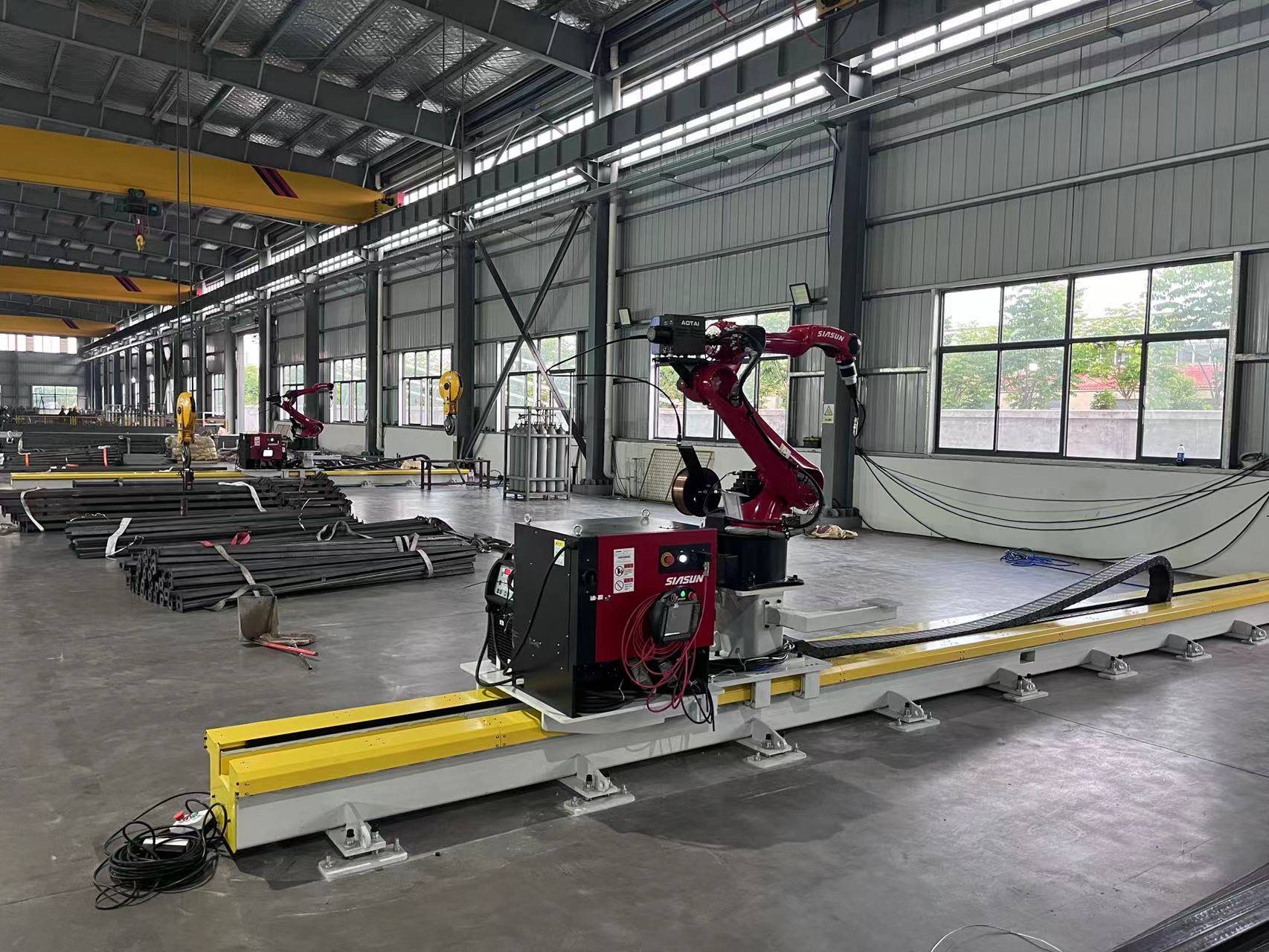
This real-time feedback loop allows the robot controller to adjust the torch position dynamically. For LNG longitudinal and circumferential seams, the tracker compensates for deviations caused by tack welds or plate misalignment. Without this technology, the robot would follow a programmed path that might drift relative to the actual joint, leading to lack of fusion or undercut. The integration of the tracker ensures that the arc remains perfectly centered, which is paramount when performing X-ray quality welds required for high-pressure cryogenic service.
Maintenance Protocols for High-Utilization Robotic Cells
To maintain the Arc-on time efficiency expected in industrial environments, a proactive maintenance strategy is required. Robotic Welding Cells in LNG yards often operate in harsh environments where dust and temperature fluctuations can impact sensitive electronics and mechanical components.
Torch and Consumable Management
The welding torch is the most critical point of failure. Automated Torch Service Centers (TSC) should be integrated into the cell to perform routine maintenance without operator intervention. This includes:
- Reaming the gas nozzle to remove accumulated spatter, ensuring laminar flow of shielding gas.
- Applying anti-spatter liquid to extend the life of the contact tip and shroud.
- Checking the wire cutter to ensure a clean end for consistent arc ignition.
In LNG applications using specialized nickel-based filler wires, contact tip wear is accelerated. Industrial engineers must implement a “cycle-count” based replacement strategy rather than a “fail-first” approach to prevent mid-weld interruptions that cause metallurgical discontinuities.
Sensor Calibration and Cleaning
The laser seam tracking hardware requires specific attention. The protective glass or “sacrificial window” on the sensor head must be checked daily. Any spatter or soot accumulation on the lens will degrade the sensor’s ability to resolve the joint geometry, leading to tracking errors. Compressed air knives are typically used to keep the optical path clear during the welding cycle, but manual inspection is still a vital component of the weekly maintenance checklist.
Labor ROI and Economic Impact in LNG Infrastructure
The shift from manual labor to Robotic MAG welding is often driven by the scarcity of highly skilled “Code Welders” capable of passing 6G position tests on exotic materials. The Return on Investment (ROI) for a robotic cell in an LNG project is calculated through three primary vectors: throughput, defect reduction, and labor utilization.
Comparative Throughput Analysis
Manual welding typically achieves an arc-on time of 20% to 30% due to operator fatigue, repositioning, and the need for frequent breaks. A robotic cell, conversely, can maintain an arc-on time of 75% to 85%. For an LNG tank project requiring miles of linear welding, this translates to a project timeline reduction of approximately 40%. The ability of the robot to weld continuously for long durations without stop-starts also reduces the number of potential defect sites, as most weld flaws occur at the initiation or termination of the arc.
Defect Rate and Rework Costs
In LNG fabrication, the cost of a single weld failure detected by Radiographic Testing (RT) or Ultrasonic Testing (UT) is exorbitant. Rework involves gouging out the defective area, re-prepping the joint, and re-welding—all while potentially damaging the surrounding base metal’s properties. Robotic cells with laser tracking typically reduce the repair rate from a manual average of 5-8% down to less than 1%. This reduction in rework alone can pay for the robotic system’s capital cost within the first 12 months of a major project.
Labor Optimization and Skill Transition
The ROI is also realized by transitioning expensive human capital from performing repetitive, hazardous tasks to high-value roles such as “Robotic Cell Technicians.” One technician can oversee two or three robotic cells, effectively tripling the output per man-hour. This does not eliminate the need for welding expertise; rather, it shifts the focus to process optimization and quality oversight, which are more sustainable roles in the long-term industrial landscape.
Operational Specifications and Gas Management
Optimizing the MAG process for LNG infrastructure fabrication requires precise shielding gas mixtures. For stainless steel components, a mixture of Argon and CO2 (typically 98/2 or 97/3) is used to stabilize the arc while preventing excessive carbon pick-up. The robotic system allows for digital gas flow control, ensuring that the envelope of protection remains constant even as the robot moves through complex geometries. This level of control is virtually impossible to maintain manually over an eight-hour shift, further cementing the case for automation in high-stakes energy projects.
Conclusion for Industrial Implementation
For industrial engineers overseeing LNG projects, the deployment of a robotic welding cell is not merely a technological upgrade but a strategic necessity. The synergy between MAG welding and laser seam tracking addresses the core requirements of the industry: metallurgical integrity, extreme precision, and aggressive production schedules. By focusing on rigorous maintenance and understanding the quantitative ROI of labor transition, firms can secure a competitive advantage in the global energy infrastructure market.
-


LT240S tube laser cutting machine
-
LT120S tube laser cutting machine
-
Sale

Tank Fillet Welding Machine
Original price was: $1,000.00.$900.00Current price is: $900.00. -
Sale

MAK100 tube laser cutting machine
Original price was: $5,500.00.$5,000.00Current price is: $5,000.00. -

portable plasma air cutting machine
$1,200.00 -

2in1 fiber laser cutting machine
-

Air cooling Laser welding machine
-

HF h beam laser cutting machine
-

LT240 laser cutting machine
-

Laser welding machine
-


Cobot Welding Station
-

Gantry welding robot solution
-

Tracked Wheeled AGV Welding robot
-

LFH6020 Fiber laser cutting machine
-
LFP6020
-

robotic welidng machine
Advanced Fiber Laser Tube Processing Technology
Our CNC Fiber Laser Tube Cutting systems revolutionize metal fabrication by integrating high-precision cutting, punching, and profiling into a single automated workflow. Designed for versatility, this technology handles a wide array of profiles including Round, Square, Rectangular, and Oval tubes, as well as complex L-shaped and U-shaped channels.
- Precision Punching: High-speed hole punching with micron-level accuracy, eliminating the need for mechanical drilling or die-stamping.
- Complex Profiling: Advanced 3D pathing allows for intricate interlocking joints and specialized notch cuts, ideal for structural frames.
- High Material Efficiency: Intelligent nesting software minimizes scrap, reducing raw material costs across large production runs.
- Clean Finish: Delivers oxide-free, burr-free edges that require zero secondary grinding before welding.

Seamlessly processing multiple profiles with consistent precision.
Global Delivery & Logistics



From our high-tech manufacturing facility directly to your global site. PCL WeldCut ensures secure packaging, professional handling, and reliable international logistics to safeguard your equipment throughout the entire journey.