Technical Integration of Robotic MAG Welding in Infrastructure
The fabrication of bridge trusses involves massive structural components, typically using A709 or A572 grade steel. These materials require deep penetration and high-volume filler metal deposition. Traditional manual welding in this sector is plagued by low duty cycles and ergonomic strain. Transitioning to a Robotic MAG welding system allows for a continuous arc-on time that far exceeds human capabilities. In a standard bridge truss application, the robot utilizes a Gas Metal Arc Welding (GMAW) process, often with metal-cored wires to maximize travel speeds while minimizing spatter.
The primary challenge in bridge truss assembly is the scale. Beams and gusset plates are often several meters long, and even with precise tacking, thermal expansion during the welding process causes the joint to shift. Without adaptive control, a fixed-path robot would miss the seam, leading to structural failure or expensive rework. By utilizing a high-speed MAG process paired with a heavy-duty industrial arm, fabricators can achieve a deposition rate of 12 to 15 pounds per hour, compared to the 3 to 5 pounds per hour typical of manual operations.
Precision Through Laser Seam Tracking
The implementation of Laser seam tracking is the critical technological enabler for automating bridge components. This system uses a laser triangulation sensor mounted ahead of the welding torch. The sensor projects a laser line across the joint, capturing the geometry in real-time. The feedback loop allows the robot controller to adjust the torch position (X, Y, and Z axes) and orientation (torch angle) dynamically.
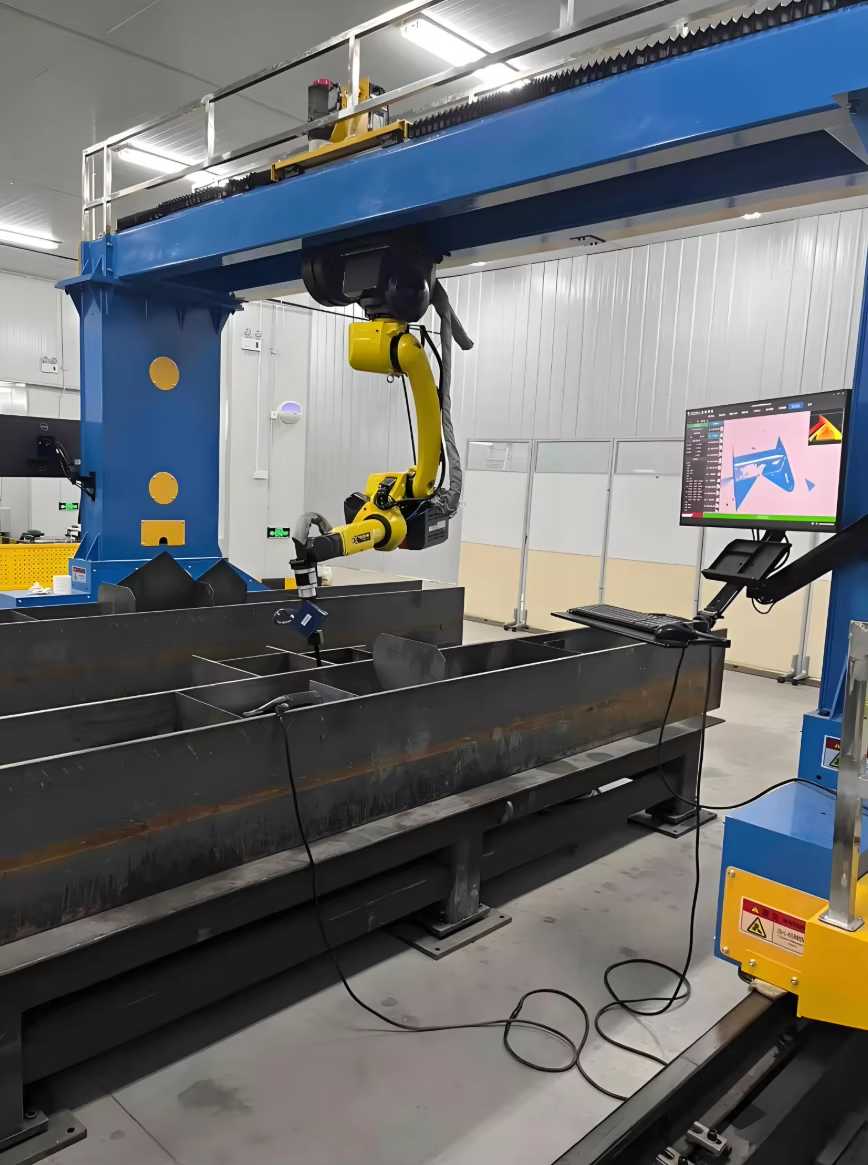
In bridge trusses, fit-up tolerances are often loose due to the size of the components. A laser sensor can identify the center of a V-groove or a fillet joint even if the part has moved several millimeters from its programmed position. Furthermore, the system can adjust the welding parameters—such as wire feed speed or travel speed—based on the measured gap width. This ensures that the root pass always achieves full penetration, which is a non-negotiable requirement for fracture-critical bridge members.
Optimizing Deposition Rates and Metallurgical Integrity
Maximizing the Deposition rate is central to the industrial engineering objective of reducing cycle times. for Bridge Trusses, this often involves using pulsed MAG welding. Pulsed waveforms allow for spray transfer at lower average heat inputs, which reduces the width of the heat-affected zone (HAZ). Maintaining a narrow HAZ is vital for ensuring the fatigue resistance of the bridge structure.
Industrial engineers must calibrate the shielding gas mixture—typically a blend of Argon and CO2—to balance penetration depth with surface finish. The robotic system’s ability to maintain a constant stick-out distance ensures a stable arc, which results in a uniform bead profile. This uniformity is not merely aesthetic; it reduces stress concentrations at the toe of the weld, extending the service life of the truss under cyclical loading.
Maintenance Protocols for High-Uptime Cells
Robotic cells in heavy fabrication environments operate under harsh conditions. To maintain a high OEE (Overall Equipment Effectiveness), a rigorous preventative maintenance schedule is required. The most critical components are the torch consumables and the laser sensor optics.
1. Torch Maintenance: Automated torch cleaning stations (reamers) should be programmed to trigger every 30 to 60 minutes of arc-on time. These stations remove spatter from the nozzle and apply anti-spatter fluid, ensuring consistent shielding gas flow.
2. Liner and Contact Tips: In high-volume MAG welding, the contact tip is a wear item. Using high-quality chrome-zirconium copper tips is recommended to withstand the heat. Liners must be blown out or replaced periodically to prevent wire feed oscillations.
3. Sensor Protection: The laser seam tracker is protected by a sacrificial clear lens or an air knife. Monitoring the clarity of this lens is essential, as smoke or spatter buildup will degrade the sensor’s ability to “see” the joint, leading to tracking errors.
Labor ROI and Economic Impact Analysis
The Labor ROI for Robotic Welding in the bridge industry is calculated through three primary vectors: throughput increase, rework reduction, and labor grade shifting. Manual welding of a large truss might require four welders working simultaneously. A single robotic cell, managed by one operator, can often match or exceed that output while providing superior consistency.
In terms of direct labor costs, the robot eliminates the non-value-added time associated with welder fatigue, breaks, and the need for frequent repositioning. While the initial capital expenditure (CAPEX) for a robotic cell with laser tracking is significant—often ranging from $250,000 to $600,000 depending on the reach and payload—the payback period is typically 18 to 24 months in a two-shift operation.
Rework is perhaps the most overlooked cost in bridge fabrication. A single failed ultrasonic test (UT) on a critical weld can cost thousands of dollars in grinding, re-welding, and re-inspection. Robots do not suffer from the “Friday afternoon” effect; provided the parameters are set correctly, the weld quality remains identical from the first inch to the thousandth. This reliability shifts the labor force from manual execution to higher-value roles, such as weld programming and quality assurance.
Implementation Considerations for Structural Steel
When integrating these cells, industrial engineers must consider the floor layout and material flow. Bridge trusses require large work envelopes. Often, the robot is mounted on a gantry or a track system to cover the entire length of the component. Specialized heavy-duty positioners are used to rotate the truss, ensuring that the robot can always weld in the flat or horizontal position (1F/2F), which are the most efficient positions for high-deposition MAG.
Data logging is the final layer of the robotic advantage. Modern controllers can record every parameter for every weld—voltage, current, gas flow, and travel speed. This digital birth certificate for each bridge truss provides unparalleled traceability, satisfying the stringent requirements of Department of Transportation (DOT) audits and ensuring long-term structural accountability.


















One thought on “Robotic Welding Cell with Laser Seam Tracking for for Bridge Trusses”
The customer support for the LT120S was very helpful during installation.