Robotic MIG/MAG Welding Robot – Indiana, USA
In this article
- Field Report: Implementing Automated MIG/MAG Welding Robot for Galvanized Pipe Fabrication
- 1. Project Scope and Indiana Site Conditions
- 2. The Synergy of the MIG/MAG Welding Robot and Advanced Arc Welding…
- 3. Overcoming the Challenges of Galvanized Pipe Welding
- 4. Technical Specification of the Robotic Cell
- 5. Lessons Learned and Field Observations
- 6. Quantitative Results
- 7. Conclusion
Field Report: Implementing Automated MIG/MAG Welding Robot for Galvanized Pipe Fabrication
1. Project Scope and Indiana Site Conditions
This report details the commissioning and optimization of a high-speed MIG/MAG Welding Robot cell at a Tier-1 infrastructure component facility in Indiana, USA. The facility specializes in large-scale HVAC and structural supports, where Galvanized Pipe welding represents 85% of total production volume. The primary objective was to replace manual GMAW stations with automated Arc Welding Solutions to address rising labor costs and inconsistent weld quality caused by zinc-related defects.
Operating in the Indiana climate presents unique challenges. The high humidity during the summer months in the Midwest can lead to moisture ingress in the shielding gas lines if not properly managed, exacerbating hydrogen-induced cracking risks. Furthermore, the local power grid stability in rural manufacturing hubs required the installation of dedicated line conditioners to ensure the MIG/MAG Welding Robot maintained consistent arc voltage—a critical factor when dealing with the volatile nature of galvanized coatings.
2. The Synergy of the MIG/MAG Welding Robot and Advanced Arc Welding Solutions
The core of this installation is the integration of a six-axis MIG/MAG Welding Robot with a digital power source capable of running sophisticated Arc Welding Solutions. In a standard setup, a robot is merely a motion controller. However, for Galvanized Pipe welding, the motion must be perfectly synchronized with the arc’s electrical characteristics.
The “synergy” here refers to the communication speed between the robot’s CPU and the welding inverter. We implemented a fieldbus interface that allowed the Arc Welding Solutions to adjust parameters in real-time (sub-millisecond) based on the torch’s position. This is vital when the MIG/MAG Welding Robot navigates the circumference of a pipe, where gravity affects the weld pool differently at the 12 o’clock versus the 6 o’clock position. Without this high-level integration, the zinc vapor would routinely destabilize the arc, leading to excessive spatter and rework.
3. Overcoming the Challenges of Galvanized Pipe Welding
Galvanized Pipe welding is notoriously difficult due to the low boiling point of zinc (906°C) compared to the melting point of steel (approx. 1500°C). When the arc hits the pipe, the zinc coating vaporizes instantly. If the weld pool solidifies too quickly, these vapors are trapped, creating porosity (blowholes). In our Indiana workshop, the initial scrap rate for manual welding was nearly 12%.
3.1. Waveform Manipulation
By utilizing specialized Arc Welding Solutions, specifically a modified pulse-on-pulse waveform, we were able to create a “stirring” effect in the weld pool. The MIG/MAG Welding Robot was programmed to maintain a specific travel speed that allowed the zinc gas to escape ahead of the solidification front. We moved away from standard spray transfer to a regulated short-circuit process which reduced the heat input, thereby minimizing the volume of zinc vaporized while still ensuring deep penetration into the base carbon steel.
3.2. Shielding Gas Optimization
In the Indiana field test, we experimented with several gas blends. While a standard 75/25 Ar/CO2 mix is common, it proved insufficient for the MIG/MAG Welding Robot at high speeds. We transitioned to a 90/10 Ar/CO2 mix with a trace amount of Oxygen. This increased the fluidity of the puddle, allowing for better out-gassing during Galvanized Pipe welding and significantly reducing the “volcano” effect typically seen in robotic cells.
4. Technical Specification of the Robotic Cell
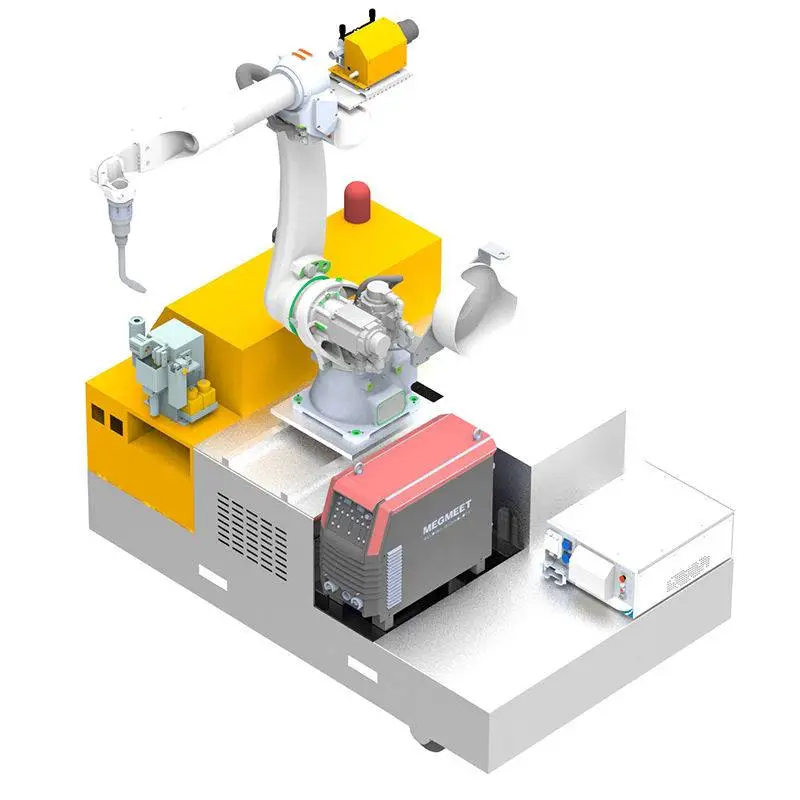
The cell footprint was designed for high-volume throughput typical of Indiana’s heavy manufacturing sector. The MIG/MAG Welding Robot was mounted on a riser to extend its reach across two independent workstations, allowing a “load-while-weld” configuration.
- Robot Model: High-speed 6-axis articulated arm with 20kg payload.
- Power Source: 400A Digital Inverter with integrated Arc Welding Solutions software suite.
- Torch Geometry: 45-degree neck with high-flow fume extraction nozzles.
- Wire Feed: Direct-drive four-roll system to prevent slippage with silicon bronze or mild steel wires.
4.1. Fume Extraction Integration
Given the toxicity of zinc oxide fumes, the MIG/MAG Welding Robot was equipped with a torch-mounted extraction system. A “Lesson Learned” here was the impact of extraction suction on gas coverage. If the suction is too high, it pulls the shielding gas away from the arc, causing porosity. We calibrated the Arc Welding Solutions to compensate for this, ensuring the gas shroud remained intact even at high vacuum pressures.
5. Lessons Learned and Field Observations
After six months of operation in the Indiana facility, several key engineering takeaways emerged regarding the use of the MIG/MAG Welding Robot in Galvanized Pipe welding environments.
5.1. Contact Tip Longevity
Zinc spatter is more tenacious than standard steel spatter. It tends to “plate” onto the contact tip. We found that standard copper tips failed within 4 hours of continuous operation. Switching to heavy-duty Chrome-Zirconium-Copper (CrZrCu) tips, combined with an automated reaming station that the MIG/MAG Welding Robot visits every 10 cycles, extended tip life to a full 10-hour shift. This is a critical adjustment for any Arc Welding Solutions package aimed at high-uptime environments.
5.2. Grounding Issues
Galvanized coatings act as an insulator. In the Indiana shop, we initially faced arc starting issues. The MIG/MAG Welding Robot would attempt to strike an arc, but the coating prevented a clean circuit. We solved this by implementing a dual-grounding strategy on the pipe rotators and using a “pre-flow” arc strike routine within the Arc Welding Solutions software that uses a high-frequency burst to pierce the zinc layer.
5.3. Material Consistency
Not all galvanized pipe is created equal. We observed that pipes sourced from different mills had varying thicknesses of zinc coating (G60 vs. G90). The MIG/MAG Welding Robot requires consistency. We had to implement a “Material Selection” menu on the HMI, allowing the operator to toggle between different Arc Welding Solutions profiles depending on the batch of pipe being loaded. This flexibility is what separates successful automation from failed deployments.
6. Quantitative Results
The transition to the MIG/MAG Welding Robot yielded the following improvements over the previous Indiana-based manual production baseline:
- Cycle Time Reduction: 45% decrease in floor-to-floor time per pipe assembly.
- Defect Rate: Porosity and slag inclusions dropped from 12% to under 0.5%.
- Consumable Savings: 20% reduction in shielding gas waste due to optimized flow-control within the Arc Welding Solutions.
- Rework: Post-weld grinding of spatter was nearly eliminated, saving approximately 15 man-hours per week.
7. Conclusion
The deployment of the MIG/MAG Welding Robot at the Indiana site demonstrates that Galvanized Pipe welding can be successfully automated when the right Arc Welding Solutions are applied. The key is not just the robot’s movement, but the intelligent control of the welding arc to manage the metallurgical challenges of zinc volatilization. For senior engineers looking to replicate these results, the focus must remain on the synergy between the power source’s waveform and the robot’s path precision. Future iterations will look into integrating AI-driven vision systems to further adjust for seam tracking variances in real-time, pushing the boundaries of what automated Arc Welding Solutions can achieve in the Midwest manufacturing landscape.







