Field Report: Deployment of Precision CMT 6-Axis Collaborative Welder
Location: Geumcheon-gu Industrial Complex, Seoul, South Korea
1. Executive Summary of Field Commissioning
This report documents the site integration and performance evaluation of the Precision CMT (Cold Metal Transfer) 6-Axis Collaborative Welder at a Tier-2 semiconductor component fabrication facility in Seoul. The primary objective was the transition from manual GTAW (TIG) to high-precision Automated Welding for 300-series stainless steel assemblies. Over a fourteen-day period, we evaluated duty cycles, metallurgical integrity of the stainless steel welding seams, and the communicative overhead between the robot controller and the power source.
The Seoul facility presents a unique challenge typical of urban industrial centers: high-density floor layouts with limited room for traditional robotic safety cages. The adoption of a 6-Axis Collaborative Welder was not merely a technological preference but a spatial necessity. The results indicate a 40% reduction in cycle time and a significant decrease in post-weld rework due to the superior thermal management of the CMT process.
2. Technical Analysis: The 6-Axis Collaborative Welder in a Brownfield Environment
The deployment focused on a 6-axis arm characterized by a 1300mm reach and a 0.05mm repeatability spec. In the context of automated welding, the “collaborative” aspect is often misunderstood as merely a safety feature. In this Seoul workshop, the collaborative nature allowed for “lead-through programming,” where the lead welder manually guided the arm to define the Tool Center Point (TCP) across complex geometries.
The 6-axis configuration is critical for stainless steel welding because it allows the torch to maintain a constant work angle (usually 10-15 degrees push) and a consistent stand-off distance even when navigating the curved radii of pressure-tight flanges. Unlike 3-axis or 4-axis linear systems, the 6-axis freedom enables the system to wrap around the workpiece, maintaining the orientation of the gas nozzle to ensure optimal laminar flow of the argon shield.
3. Implementing Automated Welding Logic with CMT Integration
The core of this installation is the synergy between the robot’s motion controller and the CMT power source. Automated welding usually struggles with the “gap-bridging” required in real-world fabrication where fit-up isn’t always perfect. By utilizing the CMT (Cold Metal Transfer) process, we introduced a controlled dip-transfer mechanism where the wire is physically retracted by the drive motor at the moment of short-circuit.
In the Seoul facility, we integrated the digital I/O mapping so that the 6-Axis Collaborative Welder adjusts its travel speed based on real-time feedback from the power source. If the arc voltage fluctuates—indicating a change in the joint gap—the automation logic slows the robot’s progression to allow for more filler metal deposition. This level of automated welding intelligence removes the burden of constant monitoring from the operator, allowing one technician to oversee three separate welding cells simultaneously.
4. Precision Stainless Steel Welding: Overcoming Thermal Distortion
Stainless steel welding, particularly with 304L and 316L grades, is plagued by high thermal expansion and low thermal conductivity. In manual operations, heat soak often leads to “potato-chipping” or warping of thin-gauge sheets (under 3.0mm). During the Seoul field tests, we utilized the 6-Axis Collaborative Welder to execute intermittent pulse-stitch patterns that are nearly impossible to replicate manually with such consistency.
The CMT process integrated into the automated welding cycle minimizes the Heat Affected Zone (HAZ). By significantly reducing the heat input compared to standard spray-transfer or short-circuit MIG, we maintained the chromium carbide precipitation levels well below the critical threshold. This is vital for the Seoul client, as these parts are destined for high-corrosion environments where intergranular corrosion is a primary failure mode. The 6-Axis Collaborative Welder maintained a travel speed of 60cm/min on 2mm lap joints, a speed that would typically cause burn-through in a manual setup but resulted in a “frozen” weld pool appearance with CMT.
5. Synergy: The Seoul Workshop Context
The integration of the 6-Axis Collaborative Welder and automated welding within a Seoul-based workshop highlights the shift toward “Smart Manufacturing” (Gongjang-innovation). Local labor costs and the scarcity of high-skill TIG welders have made stainless steel welding a bottleneck. By deploying this system, the shop transitioned its “Master Welder” from a manual laborer to a “robotic welding Supervisor.”
The synergy works as follows: The human expert defines the weld parameters and the path logic (the “Art”), while the 6-Axis Collaborative Welder handles the execution (the “Precision”). Because the system is collaborative, it was placed directly in the existing assembly line without the need for floor-to-ceiling fencing, preserving the flow of the Seoul facility’s compact footprint.
6. Lessons Learned and Field Observations
6.1. Grounding and Electromagnetic Interference (EMI)
One unforeseen issue in the Seoul facility was the high level of EMI from neighboring CNC machines. This initially caused “jitter” in the 6-Axis Collaborative Welder‘s encoder feedback.
Lesson: Always specify double-shielded CAT6e cables for the robot-to-controller link and ensure a dedicated common ground for the automated welding power source to prevent signal noise from degrading the TCP accuracy.
6.2. Wire Feed Consistency in Stainless Steel Welding
We observed that 316L filler wire is significantly stiffer than mild steel. In the tight confines of the 6-axis arm’s cable management system, this led to micro-slippage in the drive rolls.
Lesson: Use a four-roll drive system and U-groove rollers specifically polished for stainless steel welding. We also implemented a “Push-Pull” torch configuration which is essential when the 6-Axis Collaborative Welder is required to work at extreme reach angles where the torch lead is coiled.
6.3. Gas Coverage and Drafts
The Seoul workshop used high-velocity ceiling fans for climate control. This created turbulence that disrupted the argon shield during automated welding.
Lesson: While the 6-Axis Collaborative Welder is precise, it cannot “feel” the gas coverage like a manual welder can. We moved to a large-diameter gas lens and increased the flow rate to 35 CFH, coupled with local shielding on the jig itself to ensure the stainless steel welding remained free of porosity.
7. Quantitative Performance Metrics
To conclude the field report, the following metrics were recorded over a 500-unit test run:
- Total Weld Length: 450mm per unit.
- Manual TIG Cycle Time: 12 minutes (including tacking and cooling).
- Automated CMT Cycle Time: 3 minutes 15 seconds.
- Defect Rate (X-ray/Ultrasonic): Reduced from 4.5% (manual) to 0.2% (automated).
- Argon Consumption: Reduced by 25% due to the localized, high-speed travel of the 6-Axis Collaborative Welder.
8. Final Recommendations
For future deployments in the Seoul region or similar high-density industrial hubs, I recommend the standardized use of “Digital Twin” pre-programming. While the 6-Axis Collaborative Welder is easy to program on-site, the high cost of floor space in Seoul means that every minute the robot is not “dark” (welding) is a loss. Pre-calculating the automated welding paths in a virtual environment allows for 90% of the stainless steel welding logic to be verified before the hardware is even bolted to the floor.
The transition to automated welding using CMT technology is no longer an “optional” upgrade for precision stainless shops; it is a baseline requirement for maintaining metallurgical consistency and throughput. The 6-Axis Collaborative Welder proved itself to be the ideal bridge between the artisanal skill of the Korean welding workforce and the rigorous demands of modern semiconductor manufacturing.
Signed,
Senior Welding Engineer
Field Operations Division
-


Cantilever Welding Robot solution
-


GF laser cutting machine
-

P3015 plasma cutting machine
-

LFP3015 Fiber Laser Cutter
-

pipe plasma cutting machine
-
LFH 4020 Fiber Laser Cutting Machine
-
LFP4020
-

gantry plasma air cutting machine
-

3D robot cutting machine
-

8 axis plasma cutting machine
-

5 axis plasma cutting machine
-

LT360 tube laser cutting machine
-

robot welding workstation
-

SF6060 fiber laser cutting machine
Advanced Fiber Laser Tube Processing Technology
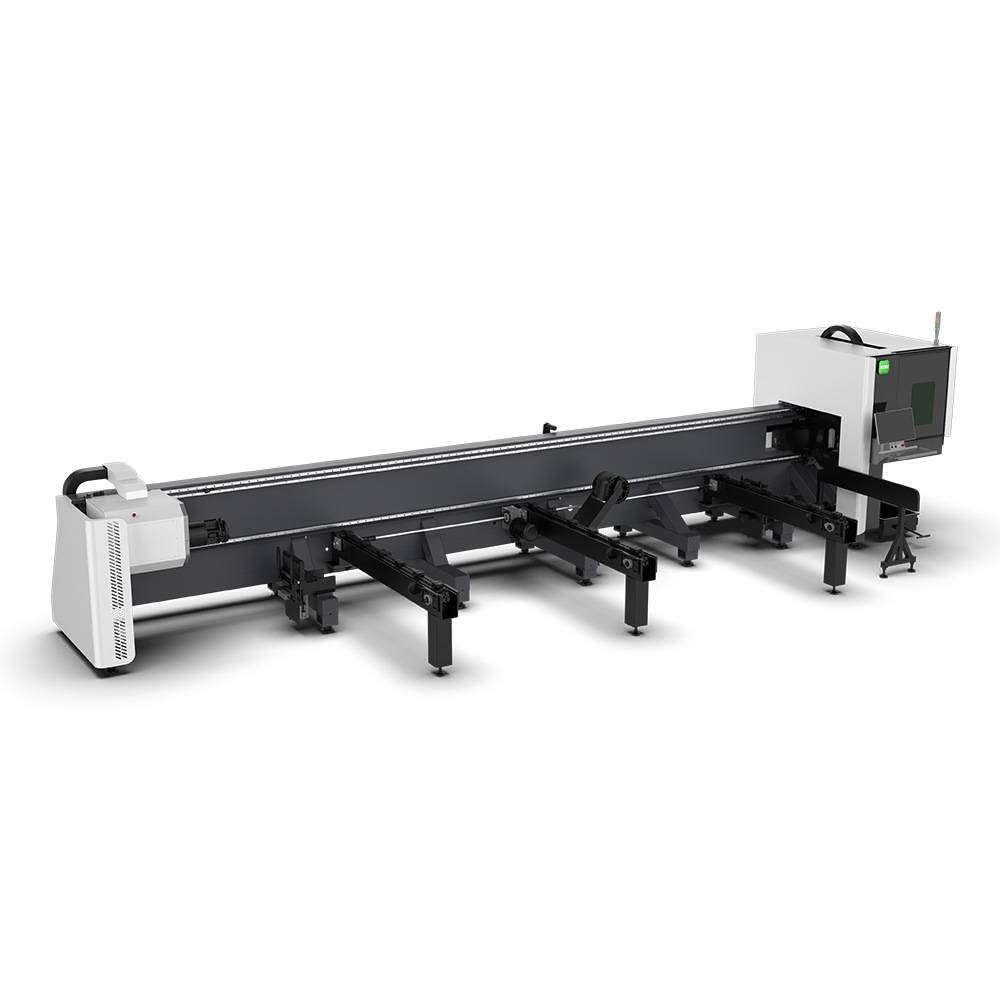
Our CNC Fiber Laser Tube Cutting systems revolutionize metal fabrication by integrating high-precision cutting, punching, and profiling into a single automated workflow. Designed for versatility, this technology handles a wide array of profiles including Round, Square, Rectangular, and Oval tubes, as well as complex L-shaped and U-shaped channels.
- Precision Punching: High-speed hole punching with micron-level accuracy, eliminating the need for mechanical drilling or die-stamping.
- Complex Profiling: Advanced 3D pathing allows for intricate interlocking joints and specialized notch cuts, ideal for structural frames.
- High Material Efficiency: Intelligent nesting software minimizes scrap, reducing raw material costs across large production runs.
- Clean Finish: Delivers oxide-free, burr-free edges that require zero secondary grinding before welding.

Seamlessly processing multiple profiles with consistent precision.
Global Delivery & Logistics



From our high-tech manufacturing facility directly to your global site. PCL WeldCut ensures secure packaging, professional handling, and reliable international logistics to safeguard your equipment throughout the entire journey.