Optimizing Maritime Fabrication: Plasma Cutting and Offline Programming
In the heavy industry of shipbuilding, the transition from manual layout to automated plasma cutting systems represents a critical shift in production efficiency. Unlike light-duty manufacturing, shipyards demand high duty cycles and the ability to process massive steel plates and structural profiles under rigorous tolerances. The implementation of high-definition plasma, synchronized with sophisticated offline programming (OLP), addresses the core challenges of geometric complexity and structural integrity required by international maritime classifications.
The Precision of Intersection Accuracy in Structural Assemblies
Ship hulls and internal frameworks consist of thousands of intersecting points where plates meet stiffeners, and pipes penetrate bulkheads. Achieving intersection accuracy is the primary metric for reducing “gap-up” time during the assembly phase. When plasma systems utilize 5-axis or 6-axis robotic or gantry heads, the machine can calculate the precise path for complex apertures.
The accuracy is not merely a function of the torch movement but a result of dynamic kerf compensation. As the torch tilts to accommodate a curved surface or an oblique intersection, the effective width of the plasma arc changes. Industrial-grade CNC controllers adjust the feed rate and gas pressure in real-time to maintain a constant kerf width. This ensures that when two components are brought together on the slipway, the fit-up is within the 1mm to 2mm tolerance range, drastically reducing the need for manual grinding or excessive filler material.
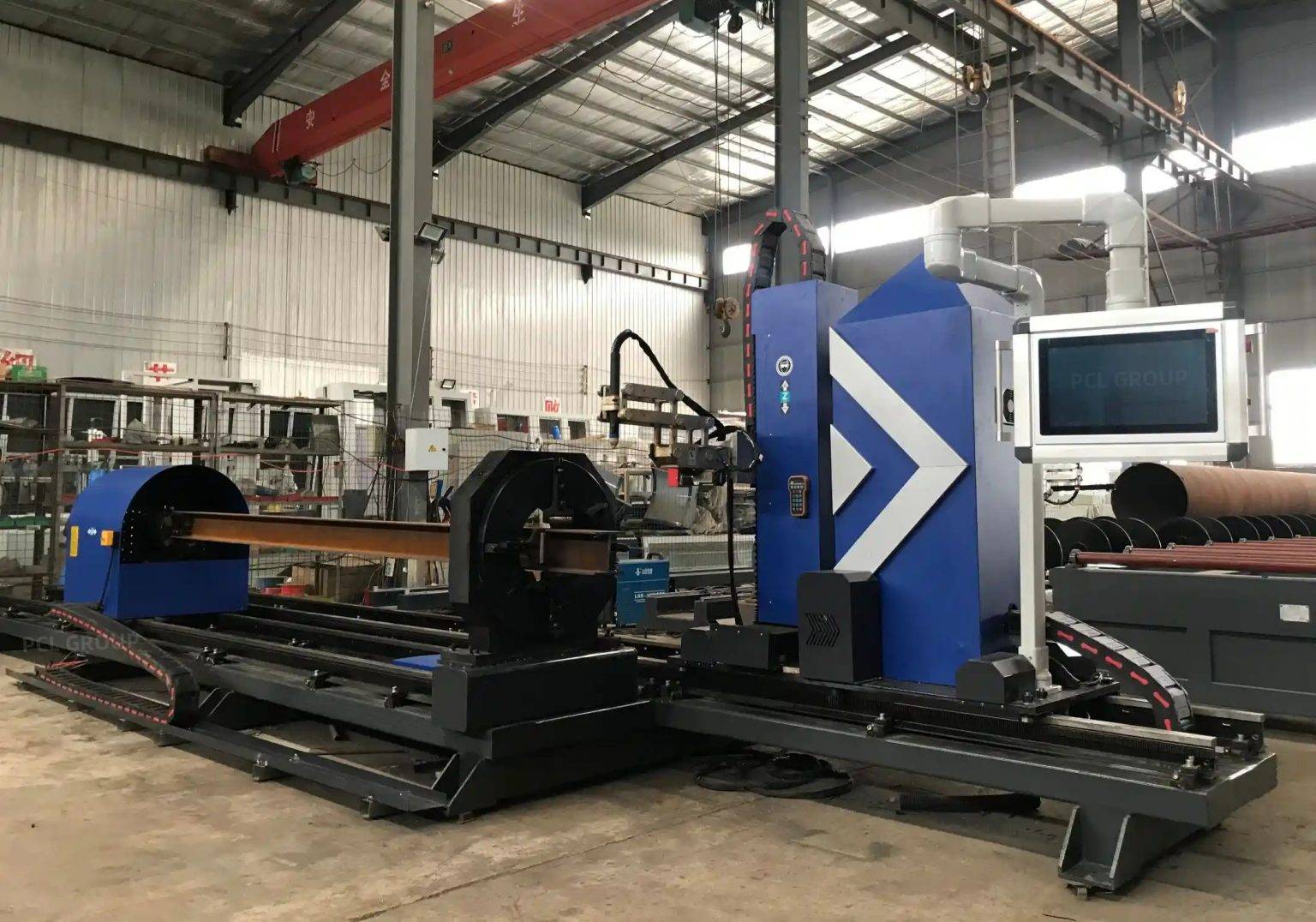
Low Maintenance H-Beam Processing: A Mechanical Advantage
Marine structures rely heavily on H-beams and I-beams for deck support and longitudinal strength. Traditionally, these profiles were processed using mechanical saws and drills—systems prone to high wear, fluid contamination, and frequent tool changes. Plasma cutting offers a “non-contact” alternative that significantly lowers the Total Cost of Ownership (TCO).
By utilizing a robotic plasma arm for H-beam processing, shipyards eliminate the need for expensive drill bits and cooling lubricants. The plasma arc handles web and flange penetrations, coping, and trimming in a single pass. From a maintenance perspective, the primary wear components are limited to electrodes and nozzles. This reduces the Mean Time To Repair (MTTR) and increases machine uptime. In a 24/7 shipyard environment, the absence of mechanical shear forces on the machine frame ensures long-term alignment stability, which is often compromised in mechanical punching or sawing stations.
Advanced Beveling for Weld Preparation
Heavy plate fabrication in shipbuilding requires specific edge geometries for submerged arc welding and other high-volume joining processes. Plasma beveling heads allow for the creation of V, Y, K, and X-joints directly on the cutting table. This integration removes a secondary stage of production where plates would otherwise be moved to a dedicated milling or grinding station.
The technical challenge in plasma beveling lies in the management of the Heat Affected Zone (HAZ). Modern high-definition plasma systems use precise gas mixing (O2, N2, and H35) to produce a narrow HAZ, ensuring that the metallurgical properties of the marine-grade steel remain intact. By programming the bevel angle into the OLP environment, the system automatically adjusts the torch height and tilt to compensate for the “arc wander” that occurs at extreme angles, maintaining a clean, dross-free edge that is ready for immediate assembly.
The Role of Offline Programming (OLP) in Throughput Optimization
The efficiency of a plasma machine is often bottlenecked by its programming speed. Offline Programming (OLP) decouples the creative and logical task of path planning from the physical machine. By importing 3D CAD data (from platforms like ShipConstructor or AVEVA Marine), OLP software generates the CNC code without interrupting the active cutting cycle.
Key Benefits of OLP for Shipyards:
- Collision Avoidance: OLP simulates the torch movement across the entire nested plate, identifying potential collisions with tipped parts or slag buildup before the code reaches the floor.
- Nesting Efficiency: Advanced algorithms optimize the layout of parts on a 12-meter plate, reducing scrap rates by 15% compared to manual nesting.
- Lead-in/Lead-out Management: Proper placement of pierce points is vital for maintaining the structural integrity of the part. OLP allows engineers to customize lead-ins based on material thickness and part geometry.
- Bridge Cutting: To minimize pierces (which extends consumable life), OLP can create a continuous path between multiple parts, effectively “chaining” the cut.
Technical Comparison: Mechanical vs. Plasma Profile Processing
To understand the industrial shift toward plasma for H-beam and structural work, we must analyze the operational metrics. The following table highlights why plasma is the preferred choice for high-volume ship component fabrication.
| Feature | Mechanical Sawing/Drilling | Robotic Plasma Cutting |
|---|---|---|
| Tooling Cost | High (Drills, Blades, Coolant) | Low (Nozzles, Electrodes) |
| Geometry Capability | Straight cuts, circular holes only | Complex shapes, bevels, notches |
| Maintenance Frequency | Weekly (Mechanical wear) | Monthly (Filter/Consumable check) |
| Setup Time | High (Manual alignment) | Low (Automated sensing) |
| Intersection Accuracy | Moderate (Tolerance stack-up) | High (Direct 3D pathing) |
Integration with Material Handling Systems
An industrial-grade plasma cutting solution is only as effective as the material flow surrounding it. In shipbuilding, where plates can weigh several tons, the plasma gantry is often integrated with automated conveyor systems or magnetic lifters. The offline programming system communicates with the shipyard’s ERP to track material heat numbers and plate remnants. This traceability is essential for compliance with maritime safety standards, ensuring that every structural member can be traced back to its original mill certificate.
Conclusion for Industrial Implementation
For the industrial engineer, the decision to deploy a plasma cutting system with OLP is driven by the need for repeatable precision and reduced secondary operations. By focusing on intersection accuracy, the shipyard ensures that the massive puzzle of ship construction fits together seamlessly. The low maintenance requirements of plasma-based H-beam processing provide a resilient solution to the harsh environment of steel fabrication. Ultimately, the synergy between high-definition plasma hardware and robust offline software creates a production line capable of meeting the rigorous timelines and safety standards of modern naval architecture.
Technical Specifications and Standards Compliance
All plasma cutting operations must adhere to ISO 9013 standards for thermal cutting quality. The use of OLP ensures that the “Range 2” or “Range 3” perpendicularity and angularity tolerances are met consistently, regardless of operator skill level. This standardization is the cornerstone of modern, high-throughput ship manufacturing.
-


LT240S tube laser cutting machine
-
LT120S tube laser cutting machine
-
Sale

Tank Fillet Welding Machine
Original price was: $1,000.00.$900.00Current price is: $900.00. -
Sale

MAK100 tube laser cutting machine
Original price was: $5,500.00.$5,000.00Current price is: $5,000.00. -

portable plasma air cutting machine
$1,200.00 -

2in1 fiber laser cutting machine
-

Air cooling Laser welding machine
-

HF h beam laser cutting machine
-

LT240 laser cutting machine
-

Laser welding machine
-


Cobot Welding Station
-

Gantry welding robot solution
-

Tracked Wheeled AGV Welding robot
-

LFH6020 Fiber laser cutting machine
-
LFP6020
-

robotic welidng machine
Advanced Fiber Laser Tube Processing Technology
Our CNC Fiber Laser Tube Cutting systems revolutionize metal fabrication by integrating high-precision cutting, punching, and profiling into a single automated workflow. Designed for versatility, this technology handles a wide array of profiles including Round, Square, Rectangular, and Oval tubes, as well as complex L-shaped and U-shaped channels.
- Precision Punching: High-speed hole punching with micron-level accuracy, eliminating the need for mechanical drilling or die-stamping.
- Complex Profiling: Advanced 3D pathing allows for intricate interlocking joints and specialized notch cuts, ideal for structural frames.
- High Material Efficiency: Intelligent nesting software minimizes scrap, reducing raw material costs across large production runs.
- Clean Finish: Delivers oxide-free, burr-free edges that require zero secondary grinding before welding.

Seamlessly processing multiple profiles with consistent precision.
Global Delivery & Logistics



From our high-tech manufacturing facility directly to your global site. PCL WeldCut ensures secure packaging, professional handling, and reliable international logistics to safeguard your equipment throughout the entire journey.