Optimizing Heavy Machinery Fabrication with Advanced Plasma Systems
In the production of construction machinery, such as excavators, cranes, and earth-moving equipment, the demand for structural integrity and dimensional repeatability is absolute. The transition toward high-definition Plasma Cutting technology has redefined how heavy-duty steel plates and profiles are processed. Unlike traditional mechanical methods, modern plasma systems provide a balance of speed, thickness capacity, and edge quality that is essential for the high-tensile steels used in the industry. By focusing on the synergy between robust hardware and sophisticated software, industrial engineers can achieve significant throughput gains while maintaining rigorous tolerance standards.
The Role of Offline Programming in Maximizing Machine Duty Cycles
One of the primary bottlenecks in heavy fabrication is machine idle time during manual data entry or at-machine nesting. Implementing offline programming software (OLP) allows engineers to bridge the gap between CAD design and CNC execution without halting the production line. OLP environments simulate the entire cutting process, accounting for plate orientation, torch lead-ins, and potential collisions. for Construction Machinery manufacturers, this means that while the plasma gantry is cutting 25mm thick chassis plates, the programming department is already optimizing the next nest for H-beam reinforcements.
This decoupling of programming from the machine tool ensures that the “arc-on” time is maximized. Advanced algorithms within the OLP suite handle automatic kerf compensation and path optimization, which are critical for maintaining the tight tolerances required for assembly. Furthermore, the ability to import native 3D models from platforms like Tekla or SolidWorks ensures that metadata regarding material grades and part identifiers remains intact throughout the lifecycle of the component.
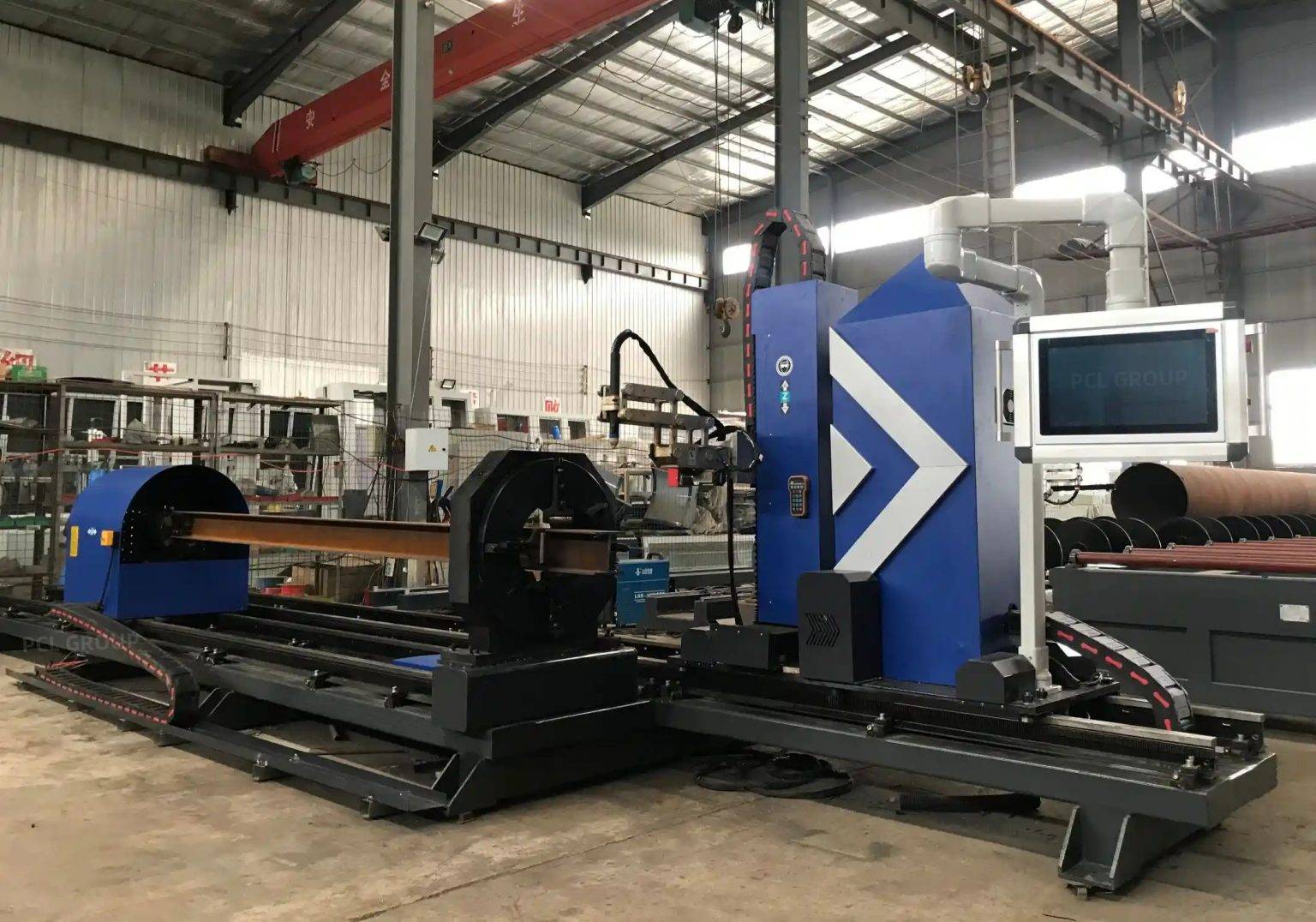
Achieving Superior Intersection Accuracy in Structural Assemblies
Construction machinery relies heavily on complex junctions where tubes, channels, and plates meet at varying angles. Achieving high intersection accuracy is vital for the load-bearing performance of these joints. Plasma systems equipped with multi-axis capabilities can execute intricate contours that allow for a “hand-in-glove” fit between components. This precision is particularly relevant for telescopic crane booms and chassis frames where the stress distribution depends on the exactness of the mating surfaces.
Modern plasma controllers utilize advanced motion control cards that synchronize the movement of the gantry with the rotation of the torch head. This synchronization ensures that the arc remains perpendicular to the theoretical cut path, even during rapid direction changes. By minimizing the gap between intersecting parts, manufacturers reduce the volume of filler material required in subsequent stages and ensure that the structural geometry aligns perfectly with the original engineering specifications.
H-Beam Processing: Efficiency and Low Maintenance Requirements
H-beams and I-beams form the backbone of many heavy equipment frames. Processing these profiles typically involves drilling, sawing, and coping. However, integrating a plasma-based H-beam structural processing line offers a distinct advantage in terms of maintenance and versatility. Mechanical systems with high-speed spindles require frequent lubrication, tool sharpening, and part replacement. In contrast, a plasma system has fewer moving mechanical contact points, significantly reducing the wear and tear associated with heavy-duty profile fabrication.
The maintenance profile of a plasma beam line is primarily centered on consumables—nozzles, electrodes, and shields—which are easily replaceable and predictable in their wear patterns. This predictability allows maintenance managers to schedule downtime during non-peak hours. Additionally, a single plasma torch can perform bolt hole cutting, coping, and flange thinning in a single pass, eliminating the need for multiple machines and the associated material handling risks.
Precision Beveling for Weld Preparation
Weld preparation is perhaps the most labor-intensive aspect of heavy machinery fabrication. For parts thicker than 12mm, a straight 90-degree cut is rarely sufficient. Plasma beveling heads, capable of A, V, X, and Y-cuts, allow the machine to create the necessary edge geometry during the initial cutting phase. This eliminates the need for secondary grinding or milling operations, which are both time-consuming and ergonomically hazardous for operators.
High-definition plasma power sources now offer sophisticated “true hole” and “true bevel” technologies. These features automatically adjust gas pressures, torch height, and feed rates based on the specific bevel angle being executed. When integrated with Offline Programming, the software can automatically calculate the necessary offsets for the bevel angle, ensuring that the top and bottom dimensions of the part remain within a 0.5mm tolerance range. This level of precision is essential for automated assembly cells where consistent fit-up is a prerequisite for operational success.
Technical Integration and Material Handling
Beyond the cutting process itself, the layout of a plasma cutting cell for construction machinery must consider the massive weight and scale of the raw materials. Heavy-duty water tables or downdraft tables are necessary to manage the thermal energy and dust generated during the process. For H-beams, conveyorized systems integrated with the CNC controller allow for seamless feeding of 12-meter profiles.
The data flow from the engineering office to the shop floor must be robust. Industrial engineers should prioritize systems that support Industry 4.0 standards, enabling real-time monitoring of consumable life and power consumption. By analyzing the data provided by the offline programming suite and the machine’s internal sensors, plants can implement predictive maintenance strategies that further enhance the reliability of the plasma cutting operation.
Conclusion: The Industrial Engineering Perspective on ROI
Investing in a high-definition Plasma Cutting Machine with integrated offline programming is a strategic move for any construction machinery manufacturer. The return on investment is found not just in the speed of the cut, but in the reduction of secondary processes, the minimization of scrap through better nesting, and the drastic decrease in machine idle time. By focusing on intersection accuracy and the low-maintenance benefits of plasma for structural profiles, manufacturers can ensure a resilient production environment capable of meeting the rigorous demands of the global construction market.
-


Cantilever Welding Robot solution
-


GF laser cutting machine
-

P3015 plasma cutting machine
-

LFP3015 Fiber Laser Cutter
-

pipe plasma cutting machine
-
LFH 4020 Fiber Laser Cutting Machine
-
LFP4020
-

gantry plasma air cutting machine
-

3D robot cutting machine
-

8 axis plasma cutting machine
-

5 axis plasma cutting machine
-

LT360 tube laser cutting machine
-

robot welding workstation
-

SF6060 fiber laser cutting machine
Advanced Fiber Laser Tube Processing Technology
Our CNC Fiber Laser Tube Cutting systems revolutionize metal fabrication by integrating high-precision cutting, punching, and profiling into a single automated workflow. Designed for versatility, this technology handles a wide array of profiles including Round, Square, Rectangular, and Oval tubes, as well as complex L-shaped and U-shaped channels.
- Precision Punching: High-speed hole punching with micron-level accuracy, eliminating the need for mechanical drilling or die-stamping.
- Complex Profiling: Advanced 3D pathing allows for intricate interlocking joints and specialized notch cuts, ideal for structural frames.
- High Material Efficiency: Intelligent nesting software minimizes scrap, reducing raw material costs across large production runs.
- Clean Finish: Delivers oxide-free, burr-free edges that require zero secondary grinding before welding.

Seamlessly processing multiple profiles with consistent precision.
Global Delivery & Logistics



From our high-tech manufacturing facility directly to your global site. PCL WeldCut ensures secure packaging, professional handling, and reliable international logistics to safeguard your equipment throughout the entire journey.