Optimizing Shipbuilding Throughput with Advanced Plasma Systems
In the heavy industry sector, particularly within maritime construction, the demand for high-volume, high-precision steel fabrication is absolute. The Plasma Cutting Machine remains the workhorse of the shipyard due to its ability to process thick carbon steel and aluminum plates with significant speed and cost-effectiveness. However, as vessels grow in complexity, the tolerance for error at structural intersections has narrowed. This necessitates the integration of laser seam tracking technology to bridge the gap between digital designs and physical material realities.
Shipbuilding involves the assembly of massive components where fit-up accuracy is the primary driver of labor costs. When structural members do not align perfectly due to cutting deviations, manual grinding and gap-filling become necessary, stalling the production line. Industrial engineers are now prioritizing automated tracking systems that allow the plasma torch to adapt to the material’s surface in real-time, ensuring that every cut profile matches the 3D model regardless of plate deformation or positioning errors.
The Critical Role of Intersection Accuracy
The structural integrity of a ship’s hull and internal bulkheads depends on the precision of intersections. Whether it is a longitudinal stiffener passing through a transverse web frame or a complex pipe-to-plate junction, the intersection accuracy of the plasma cut determines the quality of the subsequent assembly. In traditional plasma cutting, thermal expansion during the process can cause the plate to move or warp, leading to dimensional drift.
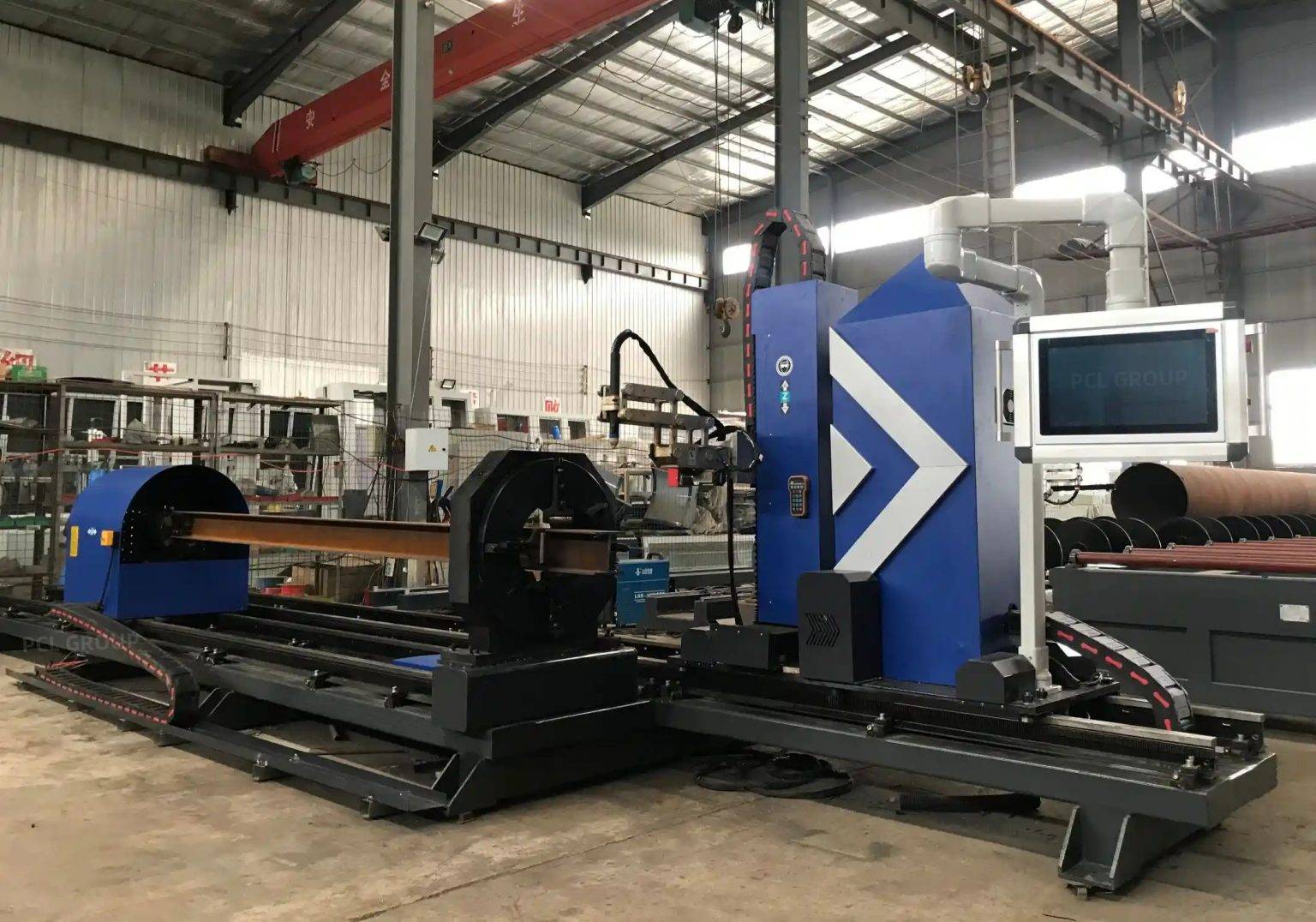
Laser seam tracking mitigates this by utilizing a non-contact triangulation sensor that scans the path ahead of the plasma arc. The system identifies the exact position of the material surface and any pre-cut edges or grooves. By feeding this data back to the CNC controller with millisecond latency, the machine adjusts the torch height and lateral position. This ensures that complex geometries—such as scallops, manholes, and interlocking slots—are executed with sub-millimeter precision. This level of accuracy is vital for modular construction, where sections fabricated in different areas of the yard must be joined with perfect alignment.
H-Beam Processing and Low Maintenance Operations
Beyond flat plate processing, shipyards utilize vast quantities of structural profiles, particularly H-beams and I-beams, for deck supports and engine room frames. The transition to automated 3D plasma cutting for these profiles has drastically reduced the time required for layout and manual cutting. A key advantage of using plasma for H-beam processing in a shipyard environment is the system’s resilience and low maintenance requirements.
Unlike other thermal cutting processes that are highly sensitive to dust, scale, and surface contaminants common in shipyards, plasma systems are inherently robust. The high-velocity ionized gas stream clears the kerf efficiently. From an industrial engineering perspective, the “low maintenance” aspect of plasma H-beam lines stems from the simplified torch design and the durability of consumables. Modern plasma power sources are designed for 100% duty cycles, and when paired with laser tracking, the risk of “torch crashes” is nearly eliminated. The sensors detect flange height variations or beam camber, moving the torch safely around the workpiece. This reduces downtime associated with broken nozzles or damaged shields, ensuring that the profile line remains operational across multiple shifts.
Thermal Distortion Management in Structural Steel
One of the primary challenges in plasma cutting large maritime components is managing the heat-affected zone (HAZ) and the resulting thermal distortion. As the plasma arc introduces localized heat, the internal stresses of the steel are released, causing the material to bow or “oil-can.” Without tracking, the torch-to-workpiece distance would vary, leading to inconsistent kerf widths and poor edge quality.
The integration of laser sensors allows for dynamic “surface following.” As the plate lifts or sinks due to heat, the laser maintains the optimal focal point of the plasma jet. This consistency is essential for maintaining a square cut edge, which is a prerequisite for high-quality intersections. By stabilizing the arc voltage through precise physical positioning, the system maximizes the life of the electrode and nozzle, further contributing to the low-maintenance profile of the machinery.
Multi-Axis Beveling for Weld Preparation
Shipbuilding requires extensive beveling to prepare edges for full-penetration structural bonds. V-grooves, Y-grooves, and K-cuts are standard requirements for hull plating. Utilizing a 5-axis plasma head equipped with laser tracking allows these complex bevels to be cut in a single pass, eliminating the need for secondary edge processing.
The complexity of beveling is compounded when the plate is not perfectly flat. A fixed-height bevel cut on a warped plate will result in a wandering land dimension (the vertical portion of the bevel), which is unacceptable for automated welding processes. The laser tracking system compensates for this by calculating the actual slope of the plate and tilting the plasma torch accordingly. This ensures the bevel angle remains constant relative to the plate surface, regardless of any undulations. This capability is particularly useful for curved hull sections where the geometry is constantly changing in three dimensions.
Standardizing Consumable Life and Predictable Costs
From a lean manufacturing standpoint, predictability is as important as speed. The use of high-definition plasma systems in shipbuilding allows for highly predictable consumable life cycles. Because the laser tracking prevents the torch from dipping into the molten dross or colliding with tipped parts, the internal components of the torch are protected from premature failure.
Engineers can schedule maintenance intervals based on “arc-on” time with high confidence. This predictability allows for better resource allocation and prevents the “stop-start” inefficiency that plagues less automated cutting operations. In an environment where thousands of meters of steel are processed weekly, the cumulative effect of reducing unplanned maintenance by even 5% results in significant annual savings and increased vessel delivery capacity.
Data Integration and the Digital Twin
Modern plasma machines equipped with laser tracking also serve as data collection points. The sensors can verify the dimensions of a raw H-beam or plate before the cut begins, comparing the physical part to the CAD model. If a beam is out of tolerance from the mill, the software can adjust the nesting or the cut path to compensate, ensuring the final part meets the required specifications. This digital feedback loop is essential for modern shipyards moving toward Industry 4.0 standards, where every component’s “as-built” data is tracked against its “as-designed” parameters.
Conclusion: The Strategic Advantage of Plasma in Maritime Engineering
The combination of a robust plasma cutting machine and precision laser seam tracking provides shipbuilders with a decisive technical advantage. By focusing on the mechanical reliability of the plasma arc and the intelligent guidance of laser sensors, yards can achieve superior intersection accuracy and master the complexities of H-beam processing without the burden of high-maintenance overhead. As the industry continues to evolve toward more complex vessel designs and tighter production schedules, the ability to produce perfect bevels and accurate structural components in a single, automated step is not just an efficiency gain—it is a requirement for global competitiveness.
By investing in these high-precision thermal cutting solutions, industrial engineers ensure that the foundation of the ship—its steel skeleton—is built with the highest possible integrity, setting the stage for streamlined assembly and long-term structural reliability at sea.
-


LT240S tube laser cutting machine
-
LT120S tube laser cutting machine
-
Sale

Tank Fillet Welding Machine
Original price was: $1,000.00.$900.00Current price is: $900.00. -
Sale

MAK100 tube laser cutting machine
Original price was: $5,500.00.$5,000.00Current price is: $5,000.00. -

portable plasma air cutting machine
$1,200.00 -

2in1 fiber laser cutting machine
-

Air cooling Laser welding machine
-

HF h beam laser cutting machine
-

LT240 laser cutting machine
-

Laser welding machine
-


Cobot Welding Station
-

Gantry welding robot solution
-

Tracked Wheeled AGV Welding robot
-

LFH6020 Fiber laser cutting machine
-
LFP6020
-

robotic welidng machine
Advanced Fiber Laser Tube Processing Technology
Our CNC Fiber Laser Tube Cutting systems revolutionize metal fabrication by integrating high-precision cutting, punching, and profiling into a single automated workflow. Designed for versatility, this technology handles a wide array of profiles including Round, Square, Rectangular, and Oval tubes, as well as complex L-shaped and U-shaped channels.
- Precision Punching: High-speed hole punching with micron-level accuracy, eliminating the need for mechanical drilling or die-stamping.
- Complex Profiling: Advanced 3D pathing allows for intricate interlocking joints and specialized notch cuts, ideal for structural frames.
- High Material Efficiency: Intelligent nesting software minimizes scrap, reducing raw material costs across large production runs.
- Clean Finish: Delivers oxide-free, burr-free edges that require zero secondary grinding before welding.

Seamlessly processing multiple profiles with consistent precision.
Global Delivery & Logistics



From our high-tech manufacturing facility directly to your global site. PCL WeldCut ensures secure packaging, professional handling, and reliable international logistics to safeguard your equipment throughout the entire journey.