Optimizing Structural Fabrication with Plasma Cutting and Arc Voltage Control
In the field of heavy steel construction, the Plasma Cutting Machine remains a cornerstone technology for processing thick-section materials with high throughput. Unlike thin-gauge applications, structural steel requires the management of large-scale components such as H-beams, channels, and heavy plates where material flatness is rarely perfect. To address these geometric inconsistencies while maintaining high precision, the integration of arc voltage control (AVC) is a technical necessity. This system functions as a real-time feedback loop, measuring the voltage between the plasma electrode and the workpiece to regulate the torch height. By maintaining a constant standoff distance, the system ensures that the plasma arc remains stable, which is critical for achieving consistent kerf width and angularity across long-span beams.
The Mechanics of Arc Voltage Control in Thick Plate Processing
The principle of AVC relies on the linear relationship between the arc length and the electrical voltage. During the cutting process, as the distance between the torch nozzle and the steel plate increases, the electrical resistance of the arc increases, leading to a rise in voltage. Conversely, a decrease in distance results in lower voltage. The CNC controller monitors these fluctuations at millisecond intervals. For structural steel fabricators, this means that even if a 20-meter H-beam exhibits slight longitudinal warping, the plasma torch will dynamically adjust its vertical position (Z-axis). This prevents the torch from colliding with the material or moving too far away, which would otherwise result in excessive dross or a lost arc.
Achieving Superior Intersection Accuracy
Intersection accuracy is a primary metric in the assembly of complex steel structures, particularly in tube-to-beam or beam-to-beam connections. When cutting holes for bolted connections or coping beams for interlocking joints, the intersection accuracy determines the ease of fit-up during site erection. High-definition plasma systems utilize sophisticated nesting software that calculates the exact toolpath required for these intersections. However, software precision is lost without mechanical height consistency. AVC ensures that the focal point of the plasma jet is always at the optimal depth relative to the material surface. This eliminates deviations in the cut profile, ensuring that when two structural members meet, the gap remains within the tight tolerances required for structural integrity and load-bearing performance.
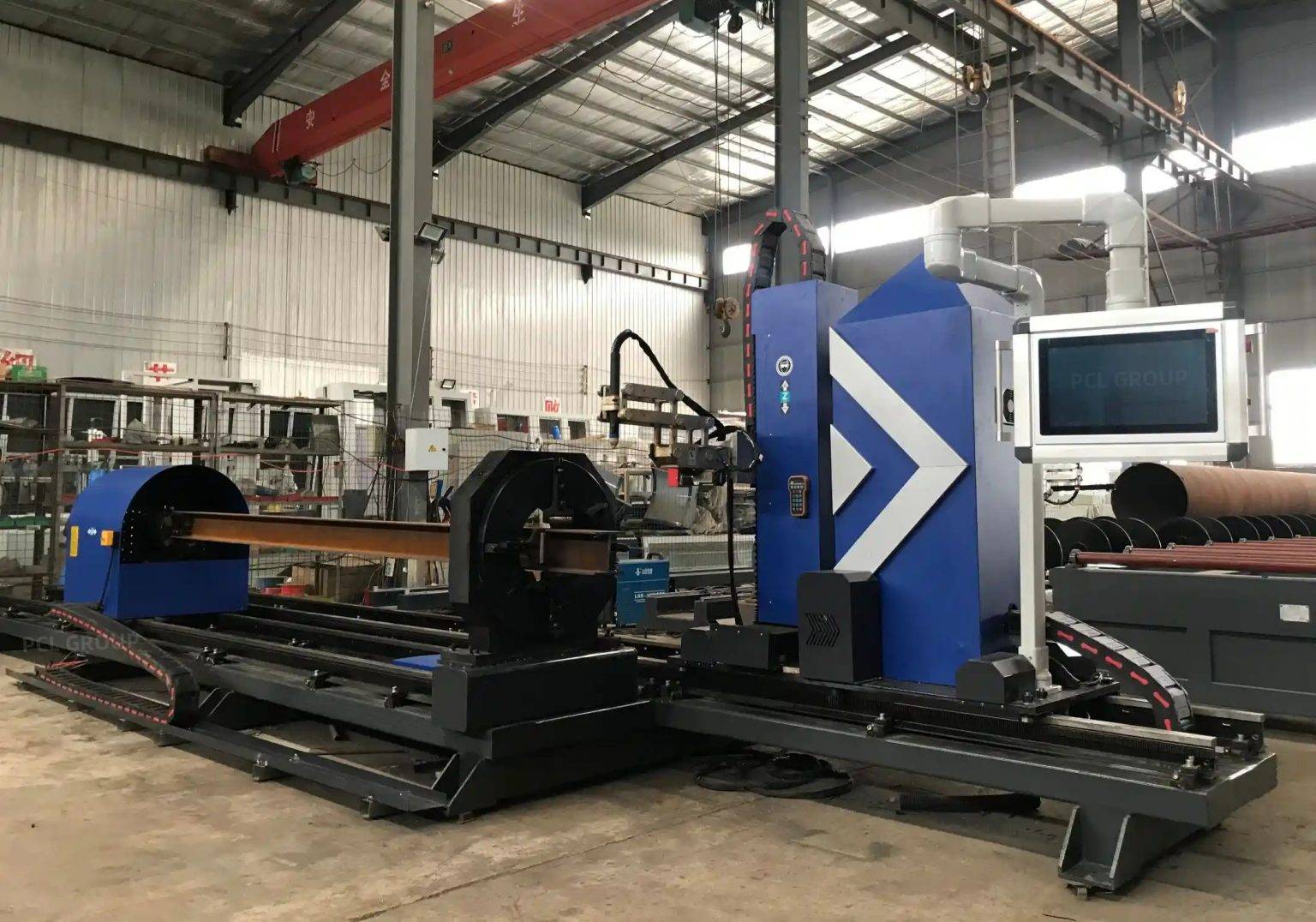
Advanced Processing for H-Beams and Structural Profiles
The processing of H-beams presents unique challenges due to the internal corners and the thickness transitions between the web and the flanges. Modern steel structure fabrication lines often employ multi-axis robotic arms or specialized gantry systems to navigate these profiles. A plasma torch mounted on a 5-axis or 6-axis head can reach into the internal sections of an H-beam to perform coping, slotting, and bolt-hole piercing in a single pass. This eliminates the need for manual layout and drilling, which are labor-intensive and prone to human error. The ability of the plasma arc to penetrate through varying thicknesses without stopping allows for continuous processing, significantly reducing the cycle time per ton of steel.
Robotic Beveling for Weld Preparation
Weld preparation is perhaps the most critical secondary process in structural steel fabrication. To meet building codes, many joints require specific bevel angles (V, Y, X, or K cuts). Plasma cutting machines equipped with a tilt-and-rotate torch head can perform these bevels during the initial cutting phase. This integration removes the requirement for secondary edge grinding. By utilizing the AVC system during a bevel cut, the machine compensates for the increased path length as the torch tilts. This ensures that the root face and the bevel angle remain uniform throughout the length of the cut, which is vital for achieving full-penetration welds in heavy structural nodes.
Low Maintenance Requirements and Operational Longevity
From an industrial engineering perspective, the low maintenance profile of plasma systems is a significant advantage in harsh fabrication environments. Unlike other high-energy cutting methods that require clean-room conditions or sensitive optics, plasma systems are robust. The primary wear components—nozzles, electrodes, and swirl rings—are designed for rapid replacement. Advanced plasma power sources now include “long-life” technology that modulates the ramp-up and ramp-down of gas flow and current to minimize electrode erosion. Furthermore, the absence of complex beam-delivery optics means that the machine is less susceptible to the dust and vibrations common in structural steel shops. A scheduled maintenance program focusing on gas filtration and rail lubrication is generally sufficient to maintain 95% uptime.
Enhancing Production Throughput and Kerf Management
Efficiency in a structural shop is measured by the “arc-on” time. Plasma systems are optimized for high-speed cutting on thicknesses ranging from 10mm to 50mm, which covers the majority of structural steel requirements. Effective kerf management is handled by the CNC, which applies offsets based on the specific consumable set and material thickness. Because the AVC keeps the torch at a precise height, the kerf stays predictable. This predictability allows for tighter nesting of parts, reducing material scrap rates. In the context of large-scale projects like stadiums or high-rise bridges, even a 2% saving in material waste through better nesting and precise cutting translates into significant cost reductions.
Integration with Building Information Modeling (BIM)
Modern plasma cutting workflows are increasingly integrated with BIM software. Standard file formats such as DSTV or STEP can be imported directly into the machine’s programming environment. The plasma system reads the geometric data for every flange hole, web notch, and bevel requirement. This digital-to-physical workflow ensures that the physical component matches the structural engineer’s model exactly. The combination of AVC-regulated cutting and digital integration minimizes the “re-work” rate, which is often the largest hidden cost in steel fabrication. By ensuring that every part is cut correctly the first time, fabricators can maintain strict delivery schedules and avoid costly site-fit issues.
Technical Conclusion for Industrial Application
The implementation of a plasma cutting machine with Arc Voltage Control represents a strategic investment for any steel structure manufacturer. The technology directly addresses the core variables of structural fabrication: material irregularity, geometric complexity, and the need for weld-ready edges. By focusing on intersection accuracy and leveraging the low-maintenance nature of the hardware, facilities can achieve a higher output per square meter of shop floor. As the industry moves toward more complex architectural designs and stricter safety regulations, the precision offered by AVC-equipped plasma systems will remain the standard for heavy-duty structural processing.
-


LT240S tube laser cutting machine
-
LT120S tube laser cutting machine
-
Sale

Tank Fillet Welding Machine
Original price was: $1,000.00.$900.00Current price is: $900.00. -
Sale

MAK100 tube laser cutting machine
Original price was: $5,500.00.$5,000.00Current price is: $5,000.00. -

portable plasma air cutting machine
$1,200.00 -

2in1 fiber laser cutting machine
-

Air cooling Laser welding machine
-

HF h beam laser cutting machine
-

LT240 laser cutting machine
-

Laser welding machine
-


Cobot Welding Station
-

Gantry welding robot solution
-

Tracked Wheeled AGV Welding robot
-

LFH6020 Fiber laser cutting machine
-
LFP6020
-

robotic welidng machine
Advanced Fiber Laser Tube Processing Technology
Our CNC Fiber Laser Tube Cutting systems revolutionize metal fabrication by integrating high-precision cutting, punching, and profiling into a single automated workflow. Designed for versatility, this technology handles a wide array of profiles including Round, Square, Rectangular, and Oval tubes, as well as complex L-shaped and U-shaped channels.
- Precision Punching: High-speed hole punching with micron-level accuracy, eliminating the need for mechanical drilling or die-stamping.
- Complex Profiling: Advanced 3D pathing allows for intricate interlocking joints and specialized notch cuts, ideal for structural frames.
- High Material Efficiency: Intelligent nesting software minimizes scrap, reducing raw material costs across large production runs.
- Clean Finish: Delivers oxide-free, burr-free edges that require zero secondary grinding before welding.

Seamlessly processing multiple profiles with consistent precision.
Global Delivery & Logistics



From our high-tech manufacturing facility directly to your global site. PCL WeldCut ensures secure packaging, professional handling, and reliable international logistics to safeguard your equipment throughout the entire journey.