Optimizing Wind Tower Production via 5-Axis Plasma Technology
In the production of utility-scale wind towers, the primary engineering challenge lies in the preparation of thick-walled steel plates and tubular sections. The transition from traditional straight-cut methodologies to advanced 5-axis plasma beveling has become a prerequisite for meeting global structural standards. This shift is driven by the need for precise weld geometry, which directly impacts the fatigue life of the tower. High-definition plasma systems are now engineered to handle the extreme dimensions of tower segments while maintaining the tight tolerances required for automated longitudinal and circumferential assembly.
The Mechanics of 5-Axis Beveling in Heavy Plate Processing
The 5-axis plasma head is a sophisticated kinematic assembly designed to provide rotational and tilt movements (typically A and B axes) in addition to the standard X, Y, and Z linear movements. In wind tower fabrication, this allows for the creation of complex bevel profiles—including V, X, Y, and K cuts—in a single pass. Unlike 3-axis systems that require secondary grinding or machining to create weld preps, 5-axis systems execute these geometries during the initial cutting phase.
From an industrial engineering perspective, the ability to control the torch angle dynamically compensates for kerf width variations. This ensures that the root face and bevel angle remain consistent even when traversing non-linear paths. For wind tower sections where plate thickness can exceed 50mm, the precision of the bevel determines the volume of weld metal required, directly influencing the total manufacturing cycle time and consumable expenditure.
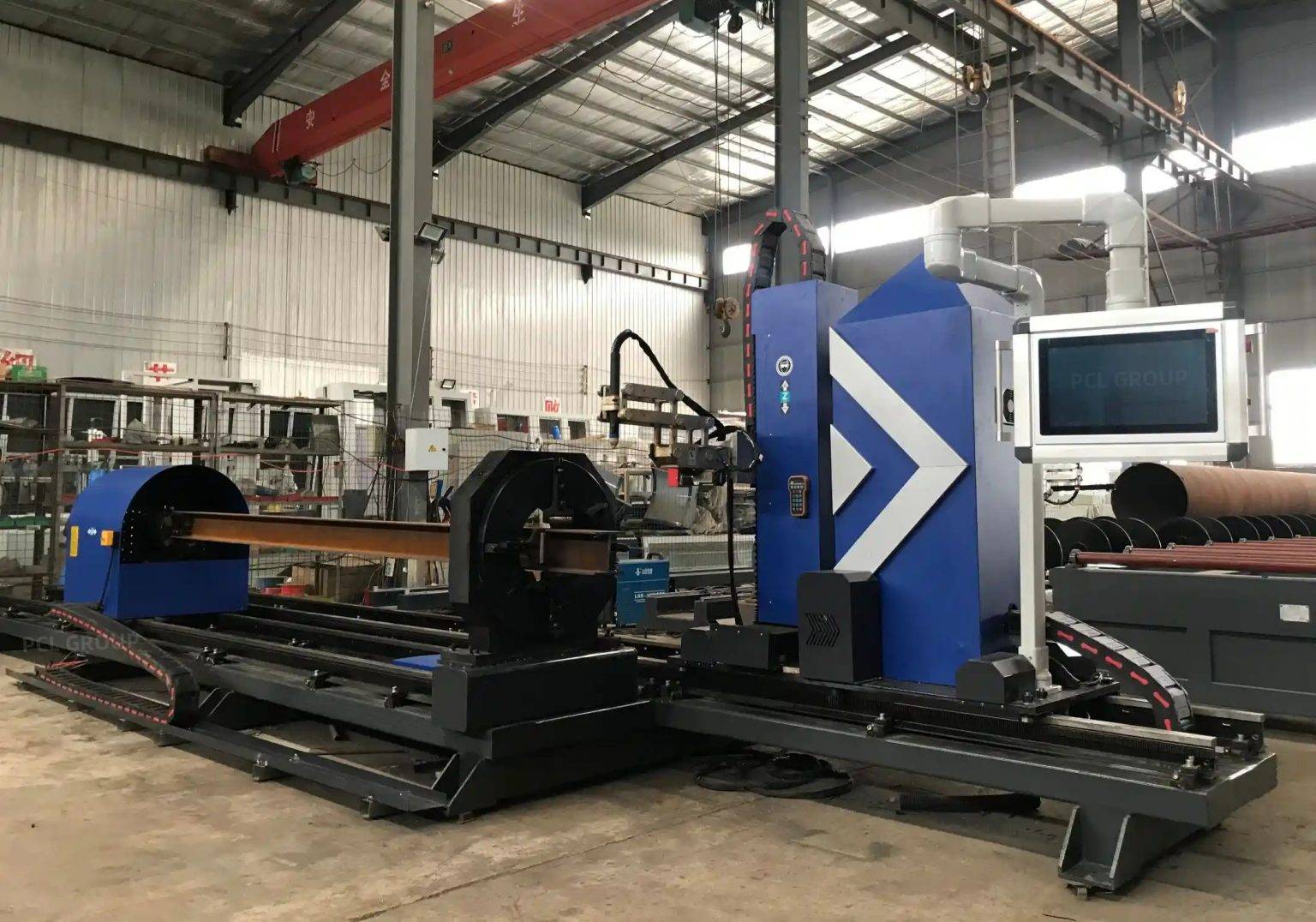
Critical Importance of Intersection Accuracy
Wind towers are not simple cylinders; they include various structural apertures for door frames, cable entries, and ventilation ports. These openings require high-precision intersection accuracy to ensure a flush fit with mating components. When cutting a hole into a curved surface, the plasma torch must continuously adjust its tilt and height to maintain a perpendicular or specific beveled relationship with the material surface.
Advanced CNC controllers utilize mathematical algorithms to calculate the “unrolled” geometry of these intersections. The 5-axis head follows a synchronized path that accounts for the curvature of the tower segment. Poor intersection accuracy leads to excessive gaps, which necessitate manual fill-work or cause structural weaknesses. By leveraging high-definition plasma, engineers can achieve tolerances within ±0.5mm on large-diameter cuts, ensuring that the tower maintains its aerodynamic and structural integrity under high stress.
Mechanical Stability through H-Beam Gantry Designs
The operational environment of a wind tower production line is rigorous. The machinery must support large-span operations, often exceeding 4 to 6 meters in width. To maintain accuracy over such distances, Plasma Cutting Machine manufacturers utilize heavy-duty H-beam gantry structures. These H-beams provide the necessary torsional rigidity to prevent vibration and deflection during high-speed traverses.
A robust gantry design is essential for the 5-axis head’s performance. Since the beveling head adds significant weight and creates dynamic forces during rapid direction changes, the H-beam serves as a stabilized platform. This rigidity is the cornerstone of long-term mechanical reliability. In industrial settings, a rigid gantry reduces the frequency of recalibration and ensures that the machine’s “squareness” is preserved despite the thermal fluctuations common in large-scale fabrication shops.
Low Maintenance Requirements of Plasma Systems
Operational uptime is a key metric in wind tower fabrication. Compared to alternative thermal cutting processes, modern high-definition plasma systems are engineered for low maintenance and high availability. The primary maintenance focus is centered on the torch consumables and the gantry’s motion components. However, when compared to mechanical edge milling or older oxy-fuel systems, plasma offers a significantly more streamlined maintenance profile.
- Self-aligning torch components reduce human error during changeovers.
- Automated gas consoles monitor flow rates and pressures, preventing torch damage.
- Rack-and-pinion drives on H-beam gantries are designed for easy cleaning and lubrication, resisting the dust and debris typical of heavy plate shops.
- Long-life electrodes and nozzles minimize the downtime required for consumable replacement.
Thermal Management and Material Integrity
While plasma is a thermal process, industrial-grade systems minimize the Heat Affected Zone (HAZ) through high-speed cutting and optimized power delivery. For wind tower steel, maintaining the metallurgical properties of the base metal is vital. The 5-axis head allows for rapid travel speeds, which limits the duration of thermal exposure. This precision prevents edge hardening that could lead to cracking during the rolling process or under the cyclic loading of the wind turbine’s operation.
Software Integration and Nesting Efficiency
The efficiency of a 5-axis plasma machine is also a product of its software ecosystem. Industrial engineers utilize nesting software that specifically handles bevel parameters. This software accounts for the “over-travel” required by a tilted torch to ensure that the bottom of the bevel matches the programmed dimensions. By accurately simulating the 5-axis movement, manufacturers can minimize plate scrap—a critical factor when dealing with expensive, high-tensile strength steel. The integration of CAD/CAM directly with the gantry’s CNC allows for a seamless transition from design to cut, reducing the lead time for custom tower configurations.
Conclusion of Engineering Value
The implementation of 5-axis plasma cutting technology represents a significant advancement in the scalability of wind energy infrastructure. By focusing on the mechanical advantages of beveling precision and the structural reliability of H-beam gantry systems, fabricators can achieve higher throughput with lower secondary processing costs. The ability to maintain high intersection accuracy on massive cylindrical sections ensures that every tower meets the stringent safety and performance standards required for both onshore and offshore environments. In the competitive landscape of renewable energy, the transition to automated, high-precision plasma cutting is not merely an upgrade but a strategic necessity for operational excellence.
-


LT240S tube laser cutting machine
-
LT120S tube laser cutting machine
-
Sale

Tank Fillet Welding Machine
Original price was: $1,000.00.$900.00Current price is: $900.00. -
Sale

MAK100 tube laser cutting machine
Original price was: $5,500.00.$5,000.00Current price is: $5,000.00. -

portable plasma air cutting machine
$1,200.00 -

2in1 fiber laser cutting machine
-

Air cooling Laser welding machine
-

HF h beam laser cutting machine
-

LT240 laser cutting machine
-

Laser welding machine
-


Cobot Welding Station
-

Gantry welding robot solution
-

Tracked Wheeled AGV Welding robot
-

LFH6020 Fiber laser cutting machine
-
LFP6020
-

robotic welidng machine
Advanced Fiber Laser Tube Processing Technology
Our CNC Fiber Laser Tube Cutting systems revolutionize metal fabrication by integrating high-precision cutting, punching, and profiling into a single automated workflow. Designed for versatility, this technology handles a wide array of profiles including Round, Square, Rectangular, and Oval tubes, as well as complex L-shaped and U-shaped channels.
- Precision Punching: High-speed hole punching with micron-level accuracy, eliminating the need for mechanical drilling or die-stamping.
- Complex Profiling: Advanced 3D pathing allows for intricate interlocking joints and specialized notch cuts, ideal for structural frames.
- High Material Efficiency: Intelligent nesting software minimizes scrap, reducing raw material costs across large production runs.
- Clean Finish: Delivers oxide-free, burr-free edges that require zero secondary grinding before welding.

Seamlessly processing multiple profiles with consistent precision.
Global Delivery & Logistics



From our high-tech manufacturing facility directly to your global site. PCL WeldCut ensures secure packaging, professional handling, and reliable international logistics to safeguard your equipment throughout the entire journey.