Advanced Plasma Cutting Systems for Heavy Structural Fabrication
In the field of industrial steel fabrication, the shift toward 5-axis plasma cutting systems represents a significant leap in processing efficiency. Unlike traditional 2D cutting, 5-axis technology introduces rotational and tilt axes, allowing for complex geometries to be executed in a single pass. For structural engineers and facility managers, the primary objective is to maximize structural steel fabrication throughput while maintaining tight tolerances required for complex assemblies. Plasma technology remains the industrial standard for this application due to its ability to penetrate thick-gauge carbon steel with high velocity and minimal thermal distortion.
The mechanical architecture of a 5-axis plasma gantry is designed to handle the rigorous demands of H-beam, I-beam, and channel processing. By utilizing a high-definition plasma power source, these machines achieve a constricted arc that increases energy density. This results in cleaner cuts and a narrower kerf, which is essential when preparing joints for deep-penetration welding.
The Mechanics of 5-Axis Beveling and Geometric Precision
The introduction of the 5th axis—typically involving a tilt (A-axis) and a rotation (C-axis)—enables the plasma torch to maintain a perpendicular or angled orientation relative to the workpiece surface. In structural steel, 5-axis plasma beveling is critical for creating V, Y, X, and K-type bevels. These profiles are necessary for ensuring that structural joints meet the American Welding Society (AWS) standards for full-penetration welds.
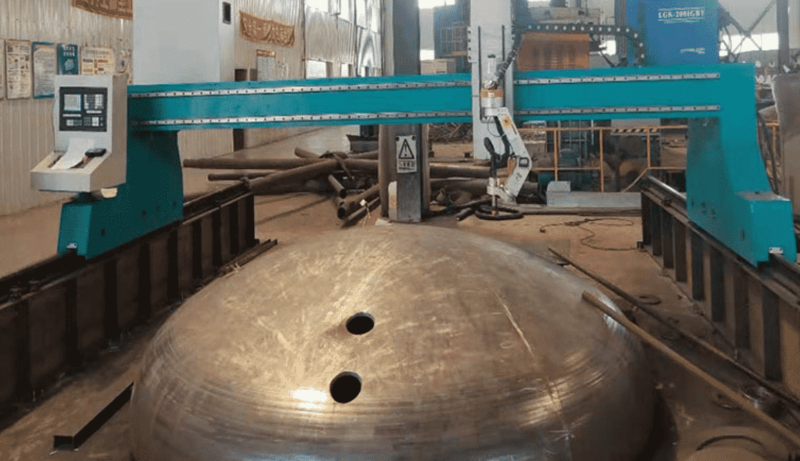
Precision in beveling is not merely about the angle of the cut; it involves complex software algorithms that compensate for the plasma arc’s natural taper. As the torch tilts, the focal point of the arc shifts. Advanced CNC controllers calculate these offsets in real-time, ensuring that the land thickness and the bevel angle remain consistent across the entire length of the H-beam or plate. This eliminates the need for manual grinding or secondary edge preparation, directly reducing labor costs per ton of steel processed.
Optimizing Intersection Accuracy in H-Beam Processing
One of the most challenging aspects of structural engineering is the precise fitment of intersecting members. Whether it is a pipe-to-beam connection or a complex miter cut on a heavy-duty H-section, intersection accuracy determines the ease of assembly on-site. Plasma machines equipped with 5-axis heads utilize sophisticated sensing technologies, such as initial height sensing (IHS) and continuous torch height control (THC), to adapt to material irregularities.
H-beams often possess inherent mill tolerances, including slight bows or flanges that are not perfectly square. A 5-axis plasma system uses touch-probing or laser scanning to map the actual surface of the beam before the cut begins. The CNC then adjusts the toolpath to match the real-world geometry of the steel. This level of precision ensures that when components arrive at the construction site, the gaps between members are within the specified 1-2mm tolerance, facilitating faster fit-up and reducing the volume of filler metal required.
Low Maintenance Requirements for Industrial Durability
From an operational maintenance perspective, plasma systems are favored for their robustness in dusty, high-vibration industrial environments. Unlike optical-based cutting systems, plasma torches are relatively simple mechanical devices. The primary maintenance concerns are consumables—nozzles, electrodes, and swirl rings—which can be replaced in minutes by a machine operator without specialized technical training.
For H-beam processing lines, low maintenance is a key performance indicator. Plasma systems are less sensitive to the oils, rust, and mill scale commonly found on structural steel. The gantry and drive systems are engineered to withstand the grit of a fabrication shop. Modern plasma power supplies also feature self-diagnostic tools that monitor gas pressure, coolant flow, and arc stability, allowing for predictive maintenance schedules that prevent unplanned downtime during critical production cycles.
Thermal Management and the Heat Affected Zone
A common concern in thermal cutting is the Heat Affected Zone (HAZ). Industrial engineers must balance cutting speed with the metallurgical integrity of the steel. High-definition plasma systems utilize oxygen or nitrogen as plasma gases to narrow the arc and increase the cutting speed. Faster travel speeds result in less total heat input into the base material, which narrows the HAZ and prevents excessive hardening of the cut edge.
By optimizing the gas flow and current settings, the 5-axis system ensures that the chemical properties of the structural steel remain within design specifications. This is particularly important for high-strength low-alloy (HSLA) steels used in bridge construction and high-rise frameworks, where edge ductility is paramount for fatigue resistance.
Integration with Building Information Modeling (BIM)
The modern plasma cutting workflow begins long before the torch is ignited. Structural steel fabricators utilize BIM software to generate 3D models of the entire structure. These models are exported as DSTV or STEP files, which the plasma machine’s CAM software converts into 5-axis toolpaths. This digital integration ensures that every bolt hole, cope, and bevel is executed exactly as designed.
The automation of these complex cuts reduces the margin for human error. In a traditional shop, layout marks are made by hand, leading to cumulative errors. In a 5-axis plasma environment, the machine handles the layout, marking, and cutting in a single synchronized operation. This “one-touch” processing philosophy is the cornerstone of lean manufacturing in the structural steel industry.
Conclusion: Maximizing ROI in Steel Fabrication
Investing in a 5-axis Plasma Cutting Machine is a strategic decision for any structural steel enterprise looking to scale production. The combination of beveling capabilities, high intersection accuracy, and a low-maintenance profile creates a versatile tool capable of handling the heaviest sections of steel. By automating the most labor-intensive parts of the fabrication process—specifically joint preparation and complex geometry cutting—engineers can ensure consistent quality while significantly reducing the time-to-market for large-scale infrastructure projects.
As the industry moves toward more complex architectural designs, the flexibility of 5-axis plasma technology will remain a critical asset. Its ability to provide precise, weld-ready edges on heavy H-beams ensures that it remains the backbone of modern structural fabrication facilities worldwide.
-


LT240S tube laser cutting machine
-
LT120S tube laser cutting machine
-
Sale

Tank Fillet Welding Machine
Original price was: $1,000.00.$900.00Current price is: $900.00. -
Sale

MAK100 tube laser cutting machine
Original price was: $5,500.00.$5,000.00Current price is: $5,000.00. -

portable plasma air cutting machine
$1,200.00 -

2in1 fiber laser cutting machine
-

Air cooling Laser welding machine
-

HF h beam laser cutting machine
-

LT240 laser cutting machine
-

Laser welding machine
-


Cobot Welding Station
-

Gantry welding robot solution
-

Tracked Wheeled AGV Welding robot
-

LFH6020 Fiber laser cutting machine
-
LFP6020
-

robotic welidng machine
Advanced Fiber Laser Tube Processing Technology
Our CNC Fiber Laser Tube Cutting systems revolutionize metal fabrication by integrating high-precision cutting, punching, and profiling into a single automated workflow. Designed for versatility, this technology handles a wide array of profiles including Round, Square, Rectangular, and Oval tubes, as well as complex L-shaped and U-shaped channels.
- Precision Punching: High-speed hole punching with micron-level accuracy, eliminating the need for mechanical drilling or die-stamping.
- Complex Profiling: Advanced 3D pathing allows for intricate interlocking joints and specialized notch cuts, ideal for structural frames.
- High Material Efficiency: Intelligent nesting software minimizes scrap, reducing raw material costs across large production runs.
- Clean Finish: Delivers oxide-free, burr-free edges that require zero secondary grinding before welding.

Seamlessly processing multiple profiles with consistent precision.
Global Delivery & Logistics



From our high-tech manufacturing facility directly to your global site. PCL WeldCut ensures secure packaging, professional handling, and reliable international logistics to safeguard your equipment throughout the entire journey.