Optimizing Structural Steel Fabrication via 5-Axis Plasma Kinematics
The transition from traditional 2D cutting to multi-axis automated systems represents a critical shift in structural engineering throughput. In the context of heavy steel fabrication—specifically for H-beams, I-beams, and large-scale plate components—the application of Plasma Cutting technology serves as the primary driver for operational efficiency. Industrial engineers focus on these systems not merely for their speed, but for their ability to execute complex geometries that eliminate the need for downstream manual prep work.
The 5-axis configuration allows the torch head to tilt and rotate simultaneously, providing the necessary degrees of freedom to follow the contours of structural members. This capability is essential when dealing with non-linear intersections and the varying flange thicknesses inherent in hot-rolled steel. By automating the beveling process, facilities move away from the high-labor costs associated with handheld grinders and manual oxy-fuel torches.
Advanced 5-Axis Beveling and Weld Preparation
For structural integrity, weld preparation must meet stringent AWS or Eurocode standards. 5-axis beveling facilitates the creation of V, Y, X, and K-cuts directly on the cutting table or beam line. Unlike 3-axis systems that only allow for vertical cuts, the 5-axis plasma head utilizes sophisticated motion control algorithms to maintain a constant focal point (TCP – Tool Center Point) even as the torch angle deviates up to 45 or 50 degrees.
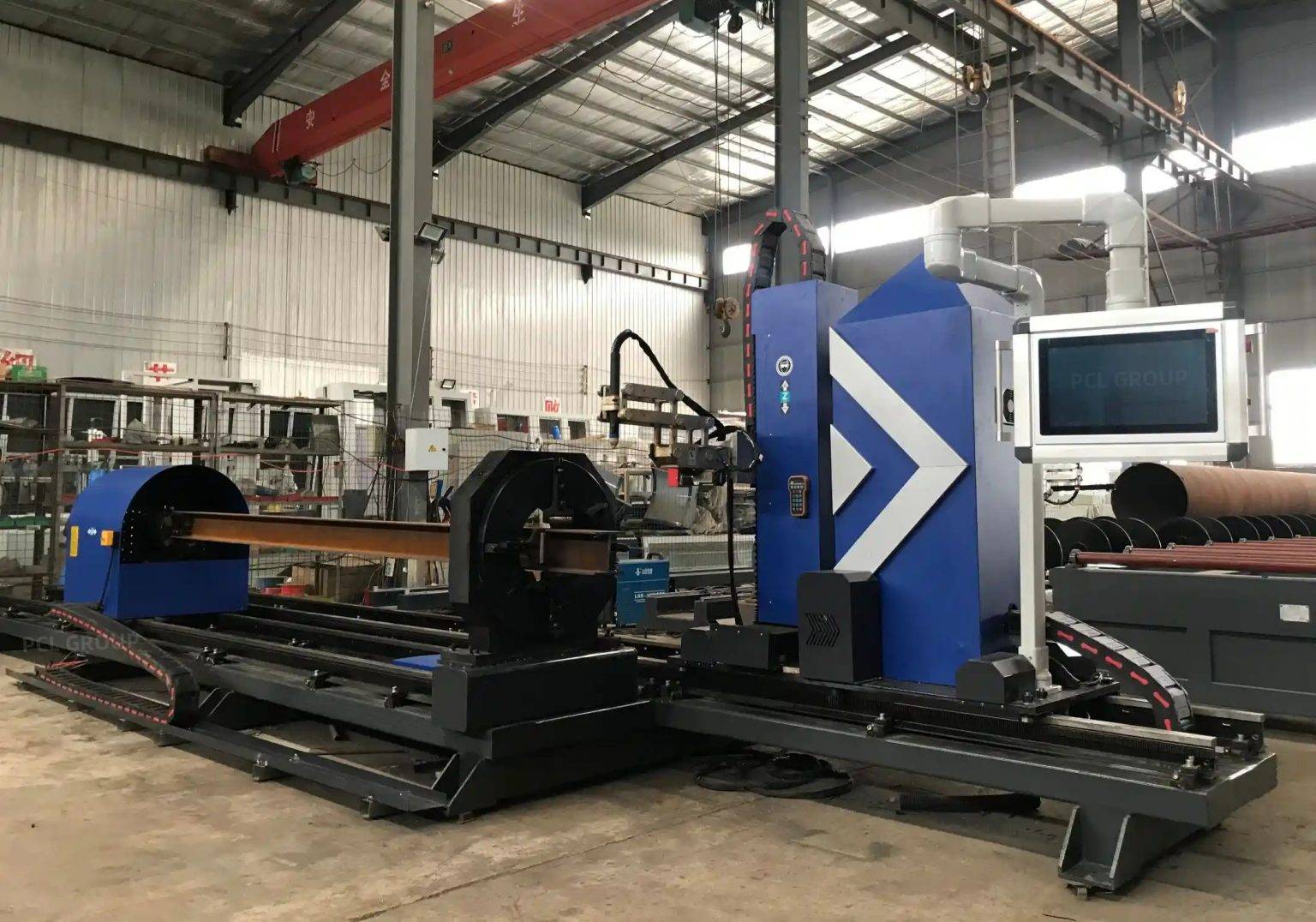
This angular flexibility is vital for the preparation of H-beam webs and flanges. When a beam is intended for a moment connection, the bevel angle must be precise to ensure full penetration. High-definition plasma systems now incorporate gas-mixing consoles that automatically adjust the shield gas composition based on the angle of the cut. This ensures that the bevel face remains free of dross and heavy oxidation, which are primary causes of porosity in structural joints.
Precision in Intersection Accuracy and Coping
One of the most complex tasks in steel structure engineering is the execution of beam-to-beam intersections. Intersection accuracy is the metric that determines the success of a “bolt-up” assembly in the field. When coping the end of an H-beam to fit into the web of another, the plasma system must account for the radius of the root of the beam. 5-axis plasma machines utilize laser scanning or mechanical probing to map the actual dimensions of the steel, compensating for mill tolerances and beam twist.
This data-driven approach ensures that the “cope” or “notch” fits with a tolerance of +/- 1mm. High-definition plasma also employs specialized hole-cutting protocols. By modulating the plasma arc’s intensity and the feed rate as the torch completes the circumference of a bolt hole, the system eliminates the “taper” typically associated with older plasma units. This results in cylindrical holes that meet the AISC requirements for structural bolting without the need for reaming.
H-Beam Processing and Low Maintenance Requirements
From an OEE (Overall Equipment Effectiveness) perspective, the maintenance profile of a machine is as important as its cutting speed. Structural steel environments are inherently harsh, characterized by heavy dust, vibration, and temperature fluctuations. Plasma cutting systems are engineered for this environment, offering a significantly lower maintenance burden than mechanical processing centers that rely on complex drilling spindles and hydraulic fluid systems.
The primary wear components in a plasma system are the consumables—nozzles, electrodes, and swirl rings. Modern CNC controllers track the number of “pierces” and “arc-on time,” allowing maintenance teams to perform predictive replacements rather than reactive repairs. Furthermore, because plasma is a non-contact cutting process, there is no tool pressure exerted on the machine frame. This absence of mechanical force extends the life of the rack-and-pinion drives and linear bearings, ensuring long-term repeatability without the frequent recalibration required by mechanical drills or saws.
Thermal Management and Kerf Compensation
In structural steel, heat-affected zones (HAZ) are a concern for metallurgists. However, modern high-speed plasma cutting minimizes the duration of heat exposure. By maintaining high travel speeds and utilizing narrow-kerf technology, the energy is concentrated in a very localized area. The 5-axis head further assists by adjusting the kerf compensation in real-time. As the torch tilts for a bevel cut, the effective width of the plasma arc changes; the CNC software must calculate this trigonometric shift to ensure the final part dimensions are accurate.
This level of precision is critical when fabricating trusses or bridge components where cumulative error can lead to significant alignment issues during site erection. By integrating the 5-axis beveling directly into the primary cutting cycle, the industrial engineer eliminates the “stacking” of tolerances that occurs when a part is moved from a cutting station to a separate manual beveling station.
Operational Efficiency and Cost Per Cut
Analyzing the cost-benefit of 5-axis plasma reveals significant savings in the “cost-per-foot” of processed steel. While the initial capital expenditure for a 5-axis system is higher than a standard 3-axis unit, the reduction in labor hours is the primary ROI driver. A single operator can manage the loading, cutting, and unloading of a multi-ton beam, with the machine performing the work that would previously have required a team of fitters and grinders.
The elimination of secondary processing is not just about labor; it also reduces the footprint of the fabrication shop. By consolidating cutting, beveling, and hole-drilling (via plasma) into a single workstation, the flow of material is streamlined. In lean manufacturing terms, this reduces “Work in Progress” (WIP) and minimizes the risks associated with material handling—a major factor in industrial safety and insurance costs.
Future-Proofing Structural Fabrication
As structural designs become more architecturally complex, the demand for non-standard geometries increases. 5-axis plasma machines are uniquely suited for this trend. Whether it is preparing a complex miter cut on a hollow structural section (HSS) or creating slotted holes in a heavy base plate, the versatility of the plasma arc remains unmatched in heavy-duty applications. The focus on intersection accuracy ensures that as the industry moves toward more prefabricated and modular construction, the components produced will meet the high-tolerance demands of off-site assembly.
In conclusion, the strategic implementation of 5-axis plasma cutting systems addresses the three core pillars of industrial engineering in steel fabrication: precision, reliability, and cost-efficiency. By leveraging advanced kinematics and automated kerf management, fabricators can produce high-quality structural components that facilitate seamless field assembly and long-term structural integrity.
-


Cantilever Welding Robot solution
-


GF laser cutting machine
-

P3015 plasma cutting machine
-

LFP3015 Fiber Laser Cutter
-

pipe plasma cutting machine
-
LFH 4020 Fiber Laser Cutting Machine
-
LFP4020
-

gantry plasma air cutting machine
-

3D robot cutting machine
-

8 axis plasma cutting machine
-

5 axis plasma cutting machine
-

LT360 tube laser cutting machine
-

robot welding workstation
-

SF6060 fiber laser cutting machine
Advanced Fiber Laser Tube Processing Technology
Our CNC Fiber Laser Tube Cutting systems revolutionize metal fabrication by integrating high-precision cutting, punching, and profiling into a single automated workflow. Designed for versatility, this technology handles a wide array of profiles including Round, Square, Rectangular, and Oval tubes, as well as complex L-shaped and U-shaped channels.
- Precision Punching: High-speed hole punching with micron-level accuracy, eliminating the need for mechanical drilling or die-stamping.
- Complex Profiling: Advanced 3D pathing allows for intricate interlocking joints and specialized notch cuts, ideal for structural frames.
- High Material Efficiency: Intelligent nesting software minimizes scrap, reducing raw material costs across large production runs.
- Clean Finish: Delivers oxide-free, burr-free edges that require zero secondary grinding before welding.

Seamlessly processing multiple profiles with consistent precision.
Global Delivery & Logistics



From our high-tech manufacturing facility directly to your global site. PCL WeldCut ensures secure packaging, professional handling, and reliable international logistics to safeguard your equipment throughout the entire journey.