Engineering Precision in Maritime Fabrication: The Role of 5-Axis Plasma Systems
In the heavy-duty environment of a shipyard, the demand for structural integrity and high-volume throughput necessitates cutting solutions that transcend basic 2D profiling. The transition to 5-axis plasma beveling represents a fundamental shift in how marine engineers approach the fabrication of hulls, bulkheads, and complex piping systems. Unlike standard 3-axis machines, a 5-axis system introduces rotational and tilt axes, allowing the plasma torch to maintain a perpendicular or angled orientation relative to the material surface, even on curved profiles. This capability is not merely a convenience; it is a technical requirement for achieving the complex geometries required in modern naval architecture.
The primary advantage of high-definition Plasma Cutting in this sector is its ability to process thick carbon steel plates—the backbone of shipbuilding—with a high degree of thermal efficiency. While mechanical shearing or traditional oxy-fuel methods may suffice for simple cuts, they fail to provide the edge quality and angle precision necessary for automated assembly. By integrating 5-axis motion, the machine can execute V, X, Y, and K bevels in a single pass, ensuring that the part is ready for the next stage of production without the need for manual edge dressing.
Intersection Accuracy and Geometric Integrity
Defining Volumetric Accuracy in Complex Profiles
Shipbuilding involves the convergence of multiple structural members, such as pipes, H-beams, and bulbs, often meeting at skewed angles. Achieving intersection accuracy is the most significant challenge in these assemblies. When two cylindrical sections or a pipe and a flat plate intersect, the resulting cut path is a complex 3D curve. A 5-axis plasma machine utilizes advanced CNC algorithms to calculate the torch angle dynamically throughout the cut, ensuring that the fit-up gap remains uniform across the entire circumference of the joint.
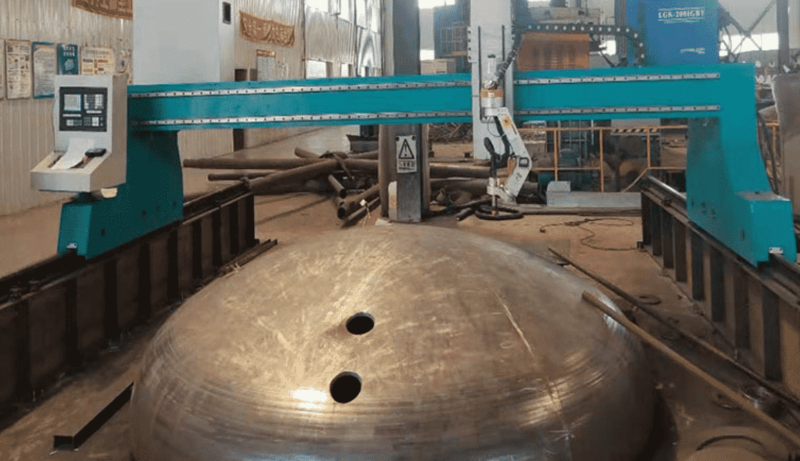
From an industrial engineering perspective, the reduction of the root gap variance is critical. If the intersection accuracy is low, the resulting gaps require excessive filler material during the joining process, leading to increased thermal distortion and potential structural weaknesses. The CNC plasma motion control system compensates for the plasma arc’s natural taper, ensuring that the programmed angle matches the physical cut. This level of precision is achieved through real-time height control and torch pivot point compensation, which maintains the focal point of the arc at the exact coordinate required by the CAD model.
Optimizing the Plasma Arc for Beveling
The physics of the plasma arc during a beveled cut differ significantly from a vertical cut. As the torch tilts, the thickness of the material the arc must penetrate increases. Industrial-grade plasma power supplies must adjust gas flow and amperage dynamically to maintain edge quality and dross-free results. High-performance 5-axis heads are engineered to minimize torch lead-out and lead-in errors, which are often the primary causes of rework in shipyard environments. By maintaining a constant standoff distance via ultra-responsive voltage sensors, the system ensures that the bevel angle remains consistent even if the plate has slight undulations.
Industrial Efficiency: H-Beam and Profile Processing
Low Maintenance Requirements for Continuous Operation
One of the most compelling arguments for adopting plasma technology in H-beam and structural steel processing is its low maintenance overhead. In the heavy-duty cycle of a shipyard, equipment is subjected to dust, metallic particles, and extreme temperature fluctuations. Plasma systems are inherently robust, with fewer sensitive optical components compared to other high-energy beam technologies. The consumables—nozzles, electrodes, and swirls—are designed for rapid replacement, ensuring that machine downtime is measured in minutes rather than hours.
For H-beam processing, 5-axis plasma machines often utilize a “coping” configuration where the torch can reach all sides of the beam. This eliminates the need to flip the workpiece, a process that is both time-consuming and hazardous. The mechanical reliability of plasma torches allows for 24/7 operation with minimal intervention. Engineers favor this technology because the mean time between failures (MTBF) is high, and the spare parts inventory is manageable and cost-effective, which is vital for maintaining tight production schedules in large-scale maritime projects.
Automating the Web and Flange Cuts
The structural rigidity of a ship relies on the precise fitment of longitudinal and transverse stiffeners. 5-axis plasma systems excel at creating “rat holes” or complex notches in H-beams where they pass through other structural members. By utilizing integrated CAD/CAM workflows, the machine can interpret complex nested designs and execute cuts on the web and flanges of the beam with high repeatability. This automation reduces the reliance on manual layout and hand-torching, which are prone to human error and inconsistent tolerances.
Advanced Weld Preparation and Beveling Techniques
Standardizing the Weld Joint
Effective weld preparation is the precursor to a high-quality joint. In shipbuilding, where ultrasonic and X-ray testing of joints is standard, the bevel must be flawless. The 5-axis plasma machine allows for precise land thickness and bevel angles, which are essential for achieving full penetration in thick-walled sections. By automating this process, the shipyard ensures that every joint meets the stringent requirements of maritime classification societies (such as DNV or ABS).
Single-Pass Multi-Beveling
The ability to perform multi-pass beveling or complex K-cuts in a single setup is a major throughput driver. In traditional setups, a plate would be cut to size and then moved to a secondary station for beveling. A 5-axis plasma system combines these steps. The industrial engineering impact is a significant reduction in material handling and a decrease in the “work-in-progress” (WIP) inventory. The elimination of secondary grinding not only saves labor costs but also improves the shop floor environment by reducing noise and airborne dust.
Software Integration and Digital Twin Simulation
The modern 5-axis plasma machine does not operate in isolation. It is part of a digital manufacturing ecosystem. Before the first arc is struck, the entire cutting sequence is simulated in a virtual environment to check for collisions and optimize the cutting path. This simulation is crucial for 5-axis work because the torch’s range of motion is extensive, and the risk of interference with the workpiece or machine bed must be mitigated. This “right-first-time” approach is essential for high-value materials used in specialized vessels like LNG carriers or naval destroyers.
Conclusion: The Strategic Impact on Shipyard Productivity
The implementation of a 5-axis Plasma Cutting Machine is a strategic investment in operational excellence. For shipyards, the benefits are measured in the reduction of man-hours per ton of steel processed and the enhancement of structural reliability. By focusing on intersection accuracy and leveraging the low maintenance nature of plasma technology, engineers can create a highly efficient production line that meets the rigorous demands of the global maritime industry. As vessel designs become more complex and material specifications more demanding, the versatility and precision of 5-axis plasma beveling will remain a cornerstone of modern ship fabrication.
-


LT240S tube laser cutting machine
-
LT120S tube laser cutting machine
-
Sale

Tank Fillet Welding Machine
Original price was: $1,000.00.$900.00Current price is: $900.00. -
Sale

MAK100 tube laser cutting machine
Original price was: $5,500.00.$5,000.00Current price is: $5,000.00. -

portable plasma air cutting machine
$1,200.00 -

2in1 fiber laser cutting machine
-

Air cooling Laser welding machine
-

HF h beam laser cutting machine
-

LT240 laser cutting machine
-

Laser welding machine
-


Cobot Welding Station
-

Gantry welding robot solution
-

Tracked Wheeled AGV Welding robot
-

LFH6020 Fiber laser cutting machine
-
LFP6020
-

robotic welidng machine
Advanced Fiber Laser Tube Processing Technology
Our CNC Fiber Laser Tube Cutting systems revolutionize metal fabrication by integrating high-precision cutting, punching, and profiling into a single automated workflow. Designed for versatility, this technology handles a wide array of profiles including Round, Square, Rectangular, and Oval tubes, as well as complex L-shaped and U-shaped channels.
- Precision Punching: High-speed hole punching with micron-level accuracy, eliminating the need for mechanical drilling or die-stamping.
- Complex Profiling: Advanced 3D pathing allows for intricate interlocking joints and specialized notch cuts, ideal for structural frames.
- High Material Efficiency: Intelligent nesting software minimizes scrap, reducing raw material costs across large production runs.
- Clean Finish: Delivers oxide-free, burr-free edges that require zero secondary grinding before welding.

Seamlessly processing multiple profiles with consistent precision.
Global Delivery & Logistics



From our high-tech manufacturing facility directly to your global site. PCL WeldCut ensures secure packaging, professional handling, and reliable international logistics to safeguard your equipment throughout the entire journey.