The Engineering Fundamentals of 5-Axis Plasma Beveling
In the domain of heavy industrial fabrication, specifically within the pressure vessel sector, the transition from manual layout to automated plasma beveling represents a critical shift in operational efficiency. Pressure vessels operate under extreme internal forces, necessitating weld joints that meet rigorous ASME and ISO standards. A 5-axis Plasma Cutting Machine provides the necessary degrees of freedom—X, Y, Z, plus the A (tilt) and B (rotation) axes—to execute complex geometries on both flat plates and cylindrical shells. Unlike traditional 2D cutting, the 5-axis head adjusts the torch angle in real-time, allowing for the creation of precise bevels required for deep-penetration welding.
The primary engineering challenge in pressure vessel construction is the preparation of the shell-to-head and nozzle-to-shell interfaces. These junctions require varying bevel angles along a non-linear path. A 5-axis system compensates for the changing curvature of the vessel surface, ensuring that the land thickness and bevel angle remain consistent throughout the entire cut. This consistency is the baseline for ensuring the integrity of the pressure boundary.
Achieving Superior Intersection Accuracy
When fabricating nozzles for large-scale boilers or storage tanks, intersection accuracy is the metric that dictates the success of the fit-up process. The geometry of a cylindrical nozzle meeting a larger cylindrical shell creates a “saddle” shape. Manually calculating and cutting these intersections is prone to significant human error, leading to gaps that require excessive filler metal during the welding phase.
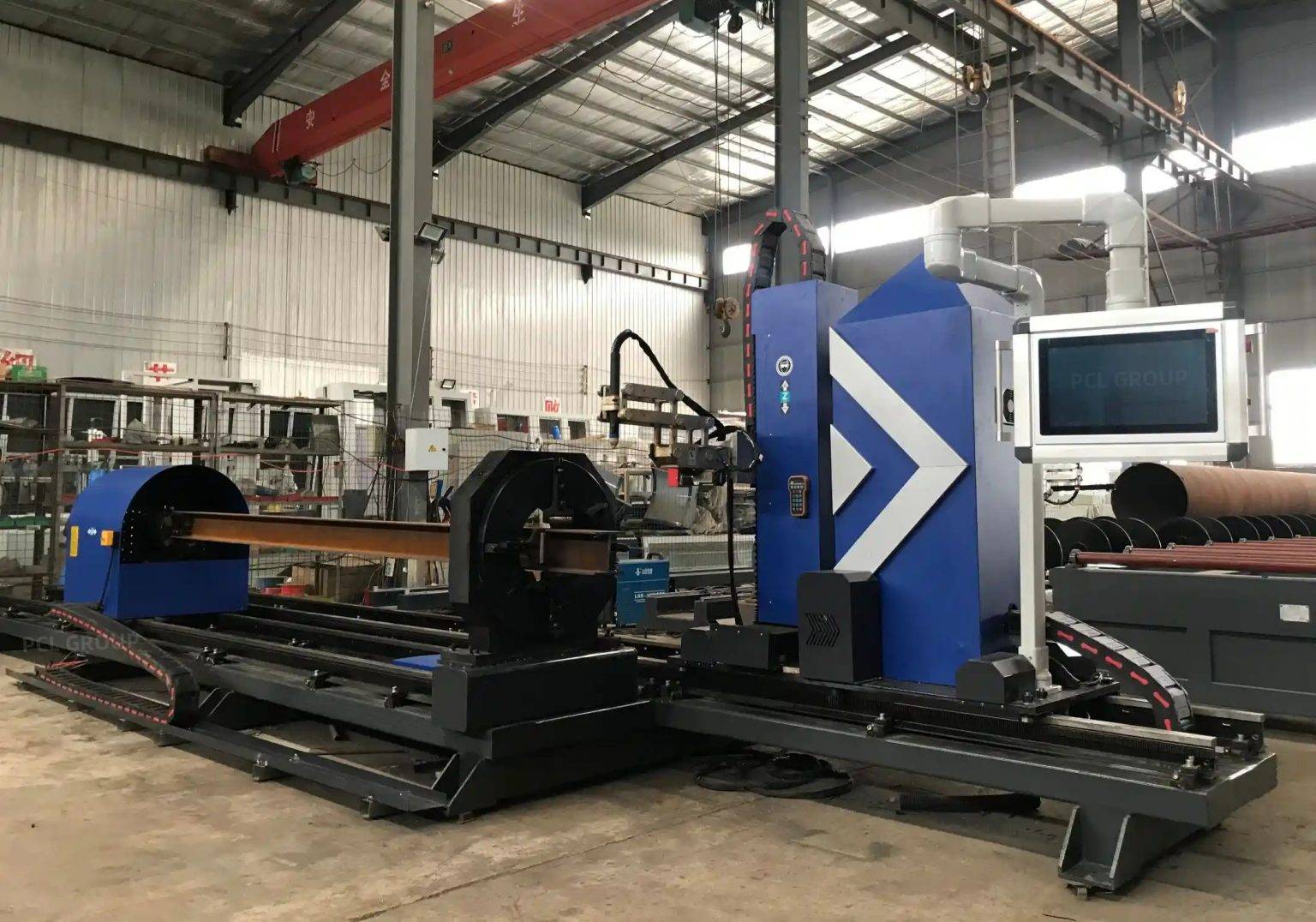
Modern CNC plasma systems utilize advanced kinematics to calculate the varying torch height and angle required to follow the saddle curve. By maintaining a constant standoff distance via torch height control (THC), the machine ensures the plasma arc remains stable, minimizing dross and heat-affected zones (HAZ). The integration of software that accounts for the kerf width at different tilt angles is essential. As the torch tilts to create a 45-degree bevel, the effective width of the cut changes; the CNC must dynamically adjust the toolpath to prevent undersizing the hole or nozzle pipe. This mathematical precision reduces the need for secondary grinding by up to 80%.
The Kinematics of 5-Axis Motion
The 5-axis head must move with high fluidic motion to prevent “dwell marks.” If the machine slows down significantly during a complex rotation, the plasma arc will widen, gouging the material. Industrial engineers focus on the acceleration and deceleration parameters of the A and B axes. High-resolution servomotors are employed to ensure that the torch orientation changes seamlessly as it traverses the circumference of a pipe. This is particularly vital for “Y” and “K” bevel profiles, where the torch must transition between different angles to provide a multifaceted weld prep surface.
Structural Stability: The H-Beam Rail System
The longevity and repeatable accuracy of a plasma cutting machine are heavily influenced by its foundation. In heavy-duty environments, the use of a reinforced H-beam low maintenance rail system is superior to lightweight aluminum extrusions or unsupported gantries. The H-beam provides the torsional rigidity required to support the weight of a heavy 5-axis head moving at high speeds.
From a maintenance perspective, the H-beam configuration offers several advantages for the industrial floor:
- Vibration Dampening: The mass of the steel H-beam absorbs the harmonic vibrations generated by high-speed motion, leading to a smoother cut surface.
- Alignment Retention: Industrial floors are subject to thermal expansion and shifting. A heavy-duty rail system bolted to a leveled H-beam foundation maintains its alignment over years of operation, reducing the frequency of technician recalibrations.
- Debris Management: High-definition plasma cutting produces significant amounts of metallic dust and slag. An H-beam structure allows for the integration of shielded linear guides that prevent particulates from fouling the drive mechanisms.
Reducing Operational Downtime
Low maintenance is not merely about fewer repairs; it is about maximizing the duty cycle of the machine. An H-beam supported gantry system minimizes the “crabbing” effect—where one side of the gantry leads the other—ensuring that long-distance cuts across a 12-meter plate remain perfectly square. By reducing the mechanical wear on the rack and pinion sets, the facility can extend the mean time between failures (MTBF), directly impacting the bottom-line profitability of the pressure vessel project.
Optimizing Weld Preparation with 5-Axis Beveling
In pressure vessel fabrication, the weld preparation is often the most time-consuming step. The 5-axis plasma machine automates the creation of V, X, Y, and K bevels. For thick-walled vessels, an X-bevel is often preferred to balance the shrinkage forces during welding, while a K-bevel is common for nozzle-to-shell connections. The ability to cut these profiles in a single pass, rather than cutting a straight edge and then grinding the bevel, represents a massive reduction in labor hours.
The process involves more than just tilting the torch. It requires sophisticated nesting software that understands the volumetric realities of the cut. For example, when cutting an internal bevel on a hole in a tank shell, the software must calculate the “true land” to ensure the nozzle will seat properly. The 5-axis head executes this by varying the tilt angle as it follows the elliptical path of the intersection, ensuring that the root face is consistent for the welder.
Thermal Management and Material Integrity
Industrial engineers must also consider the thermal impact of the plasma arc. While plasma is a high-heat process, the speed of modern 5-axis systems minimizes the total heat input into the parent metal. This is crucial for maintaining the metallurgical properties of specialized pressure vessel steels, such as P91 or chromoly alloys. By optimizing the cutting speed and gas flow (using oxygen or nitrogen-water injection depending on the material), the machine produces a clean, narrow HAZ, which is vital for passing radiographic or ultrasonic weld inspections later in the production cycle.
Conclusion: Technical Value Proposition
The deployment of a 5-axis plasma cutting machine is a strategic investment for any facility focused on high-pressure components. By prioritizing intersection accuracy through advanced CNC kinematics and ensuring long-term reliability via an H-beam low maintenance framework, manufacturers can achieve a level of precision that manual processes cannot replicate. The reduction in fit-up time and the elimination of extensive secondary processing make 5-axis plasma beveling the cornerstone of modern industrial fabrication. The focus remains on the mechanical synergy between the motion control system and the structural foundation, ensuring that every cut meets the stringent tolerances required for global safety standards in pressure vessel design.
-


Cantilever Welding Robot solution
-


GF laser cutting machine
-

P3015 plasma cutting machine
-

LFP3015 Fiber Laser Cutter
-

pipe plasma cutting machine
-
LFH 4020 Fiber Laser Cutting Machine
-
LFP4020
-

gantry plasma air cutting machine
-

3D robot cutting machine
-

8 axis plasma cutting machine
-

5 axis plasma cutting machine
-

LT360 tube laser cutting machine
-

robot welding workstation
-

SF6060 fiber laser cutting machine
Advanced Fiber Laser Tube Processing Technology
Our CNC Fiber Laser Tube Cutting systems revolutionize metal fabrication by integrating high-precision cutting, punching, and profiling into a single automated workflow. Designed for versatility, this technology handles a wide array of profiles including Round, Square, Rectangular, and Oval tubes, as well as complex L-shaped and U-shaped channels.
- Precision Punching: High-speed hole punching with micron-level accuracy, eliminating the need for mechanical drilling or die-stamping.
- Complex Profiling: Advanced 3D pathing allows for intricate interlocking joints and specialized notch cuts, ideal for structural frames.
- High Material Efficiency: Intelligent nesting software minimizes scrap, reducing raw material costs across large production runs.
- Clean Finish: Delivers oxide-free, burr-free edges that require zero secondary grinding before welding.

Seamlessly processing multiple profiles with consistent precision.
Global Delivery & Logistics



From our high-tech manufacturing facility directly to your global site. PCL WeldCut ensures secure packaging, professional handling, and reliable international logistics to safeguard your equipment throughout the entire journey.
One thought on “Plasma Cutting Machine with 5-Axis Beveling for for Pressure Vessels”
Highly recommend for any professional automotive workshop. Precision is top-notch.