Optimizing Pressure Vessel Fabrication with 5-Axis Plasma Beveling
In the heavy industrial sector, the fabrication of pressure vessels requires adherence to stringent codes such as ASME Section VIII. The primary challenge for industrial engineers lies in the precision of the weld preparation. Unlike standard plate cutting, pressure vessels involve complex cylindrical and spherical geometries that necessitate precise Plasma Cutting techniques. The transition from manual edge preparation to automated 5-axis plasma beveling represents a shift toward higher throughput and repeatable geometric accuracy.
The core of this technology is the ability to maintain a consistent torch standoff distance while navigating the varying topography of a vessel head or shell. By utilizing a 5-axis head, the machine can execute V, X, Y, and K-shaped bevels in a single pass. This eliminates the need for secondary grinding operations, which are both labor-intensive and prone to human error. In high-pressure environments, the integrity of the weld joint starts with the precision of the cut edge.
The Kinematics of 5-Axis Beveling Systems
A standard 3-axis CNC machine operates on the X, Y, and Z planes. While sufficient for flat profiles, it fails to address the requirements of nozzle intersections. A 5-axis system introduces rotation (A-axis) and tilt (B-axis) to the torch head. This allows the plasma stream to remain perpendicular or at a specific oblique angle relative to the curved surface of the workpiece.
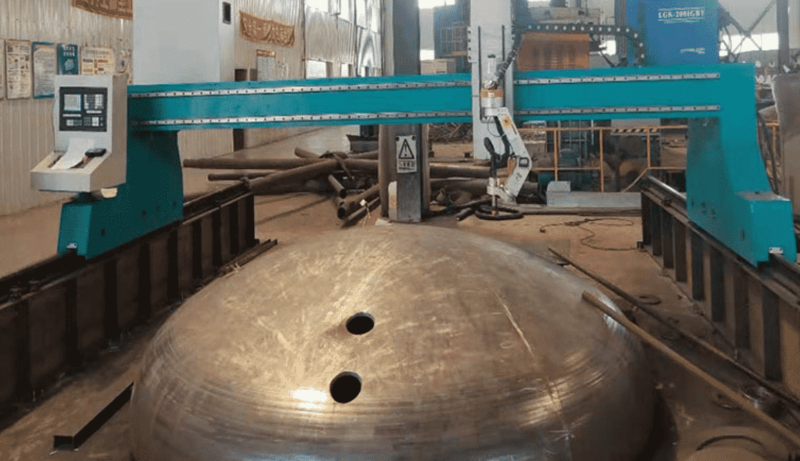
For pressure vessel manufacturers, the “saddle cut” is the most demanding operation. When a nozzle meets a cylindrical shell, the intersection line is a non-linear, three-dimensional path. The 5-axis beveling head adjusts its orientation dynamically to ensure that the root gap and bevel angle remain uniform across the entire circumference of the hole. This uniformity is critical for automated welding processes that follow, as any variation in the joint geometry can lead to lack of fusion or excessive penetration.
Intersection Accuracy and Software Integration
Accuracy in plasma cutting is not merely a function of the motor resolution; it is heavily dependent on the synchronization between the CNC controller and the nesting software. Advanced algorithms must calculate the “kerf compensation” in real-time as the torch tilts. Since the plasma arc is a conical heat source, the width of the cut changes as the angle of attack increases. High-end systems utilize specialized software tailored for vessel fabrication, which automatically generates the cutting paths based on the shell diameter, nozzle diameter, and the required bevel angle.
By achieving high intersection accuracy, fabricators can reduce the “fit-up” time significantly. In traditional shops, large gaps are often filled with weld metal, which increases heat input and risks distorting the vessel. A precise plasma cut ensures a tight fit, minimizing the volume of filler material required and maintaining the metallurgical integrity of the base metal by reducing the width of the Heat Affected Zone (HAZ).
Structural Rigidity: The H-Beam Advantage
The mechanical foundation of a Plasma Cutting Machine determines its long-term reliability. In a pressure vessel shop, where heavy plates are moved by overhead cranes and environments are dusty, a light-duty frame is insufficient. Industrial engineers prioritize H-beam low maintenance designs for the gantry and rails. A heavy-duty H-beam provides the necessary mass to dampen vibrations caused by high-speed acceleration and deceleration of the torch carriage.
A rigid H-beam structure ensures that the gantry remains square over years of operation. In contrast to tubular or sheet-metal frames, structural steel H-beams are less susceptible to thermal expansion and contraction issues. This stability is vital for maintaining the calibration of the 5-axis head. If the gantry flexes even a fraction of a millimeter, the angular accuracy of the bevel is compromised, leading to rejects in X-ray weld inspections.
Maintenance Considerations for Heavy-Duty Gantries
From a maintenance perspective, the H-beam configuration allows for easier access to the linear guides and rack-and-pinion drive systems. Low maintenance is achieved through integrated lubrication systems and the use of oversized bearings that can handle the cantilevered weight of a 5-axis tilting head. Because the plasma process generates significant fine dust (particulates), the open nature of a well-engineered H-beam gantry prevents the accumulation of debris that could otherwise clog enclosed box-section designs.
Furthermore, the use of AC servo motors with high-resolution encoders on a stable frame allows for higher rapid-traverse speeds without overshooting the target coordinates. This efficiency directly impacts the bottom line by reducing the “torch-off” time between cuts, maximizing the duty cycle of the plasma power supply.
Plasma Power Supply and Gas Management
The quality of the bevel is also a product of the plasma gas chemistry. Modern high-definition systems use multi-gas consoles that switch between Oxygen, Nitrogen, and H35 (Argon-Hydrogen) depending on the material thickness and type (carbon steel vs. stainless steel). for Pressure Vessels, which are often constructed from heavy carbon steel plate, using an oxygen-plasma process provides the cleanest edge with the least amount of dross.
Precision gas control is essential during the lead-in and lead-out phases of the cut. If the gas pressure fluctuates when the 5-axis head is mid-bevel, the arc can “wander,” resulting in a gouge in the metal surface. Current-generation plasma systems integrate the gas console directly into the CNC, allowing the machine to adjust flow rates instantaneously based on the torch’s angular velocity. This level of control is what allows plasma to compete with other thermal cutting processes in terms of edge squareness and surface finish.
Eliminating Post-Processing in Vessel Production
The ultimate goal of implementing a 5-axis plasma system is the elimination of manual grinding. In the production of manways and large-diameter nozzles, the time saved by having a “weld-ready” edge straight off the machine can be measured in hours per vessel. When the 5-axis head creates a K-bevel, it prepares both the internal and external weld prep simultaneously. This is particularly useful for vessels that require internal cladding or specific back-gouging procedures.
The efficiency of the plasma process also extends to the piercing stage. Modern height control sensors allow the torch to pierce at a specific height and then retract to the cutting height, protecting the consumables from molten slag blowback. This extends the life of the nozzle and electrode, further contributing to the low-maintenance profile of the system.
Conclusion: The Strategic Investment
For industrial engineers focused on pressure vessel manufacturing, the selection of a plasma cutting system is a balance between geometric capability and structural durability. The 5-axis beveling head provides the geometric flexibility required for complex intersections, while the H-beam gantry ensures the mechanical precision remains consistent over a long service life. By focusing on intersection accuracy and reducing secondary operations, facilities can increase their output while adhering to the highest quality standards required by the energy and chemical sectors. Automated plasma beveling is not just a cutting process; it is a foundational step in ensuring the structural integrity of high-pressure containment systems.
-


LT240S tube laser cutting machine
-
LT120S tube laser cutting machine
-
Sale

Tank Fillet Welding Machine
Original price was: $1,000.00.$900.00Current price is: $900.00. -
Sale

MAK100 tube laser cutting machine
Original price was: $5,500.00.$5,000.00Current price is: $5,000.00. -

portable plasma air cutting machine
$1,200.00 -

2in1 fiber laser cutting machine
-

Air cooling Laser welding machine
-

HF h beam laser cutting machine
-

LT240 laser cutting machine
-

Laser welding machine
-


Cobot Welding Station
-

Gantry welding robot solution
-

Tracked Wheeled AGV Welding robot
-

LFH6020 Fiber laser cutting machine
-
LFP6020
-

robotic welidng machine
Advanced Fiber Laser Tube Processing Technology
Our CNC Fiber Laser Tube Cutting systems revolutionize metal fabrication by integrating high-precision cutting, punching, and profiling into a single automated workflow. Designed for versatility, this technology handles a wide array of profiles including Round, Square, Rectangular, and Oval tubes, as well as complex L-shaped and U-shaped channels.
- Precision Punching: High-speed hole punching with micron-level accuracy, eliminating the need for mechanical drilling or die-stamping.
- Complex Profiling: Advanced 3D pathing allows for intricate interlocking joints and specialized notch cuts, ideal for structural frames.
- High Material Efficiency: Intelligent nesting software minimizes scrap, reducing raw material costs across large production runs.
- Clean Finish: Delivers oxide-free, burr-free edges that require zero secondary grinding before welding.

Seamlessly processing multiple profiles with consistent precision.
Global Delivery & Logistics



From our high-tech manufacturing facility directly to your global site. PCL WeldCut ensures secure packaging, professional handling, and reliable international logistics to safeguard your equipment throughout the entire journey.