Optimizing Pressure Vessel Fabrication via 5-Axis Plasma Technology
In the heavy industrial sector, specifically within the manufacturing of pressure vessels, heat exchangers, and storage tanks, the transition toward automated Plasma Cutting has redefined production throughput. Industrial engineers focus on the mechanical synchronization of 5-axis systems to solve the complexities of spherical and cylindrical geometry. Unlike standard 2D cutting, 5-axis plasma systems introduce rotational and tilting axes—specifically the A and B axes—allowing the torch to maintain a perpendicular or specified angular orientation relative to the curved surface of a vessel wall. This capability is foundational for achieving the precise weld preparations required by ASME and ISO standards.
The Kinematics of 5-Axis Beveling for Weld Preparation
The primary challenge in pressure vessel construction is the preparation of plate edges for high-strength welding. A 5-axis plasma head enables the creation of V, X, Y, and K-type bevels in a single pass. This is achieved through sophisticated CNC interpolation that adjusts the torch angle in real-time as it traverses the workpiece. By maintaining a constant standoff distance via arc voltage height control (AVHC), the system ensures that the beveling profile remains consistent across the entire length of the cut, even if the plate exhibits slight surface irregularities.
From a process engineering perspective, the ability to automate the beveling process eliminates the need for secondary grinding or manual oxy-fuel cutting. This reduction in material handling not only accelerates the production cycle but also minimizes the margin for human error, ensuring that the root face and bevel angle are within tolerances of +/- 0.5 degrees. Such precision is critical when the vessel must withstand internal pressures exceeding several thousand PSI.
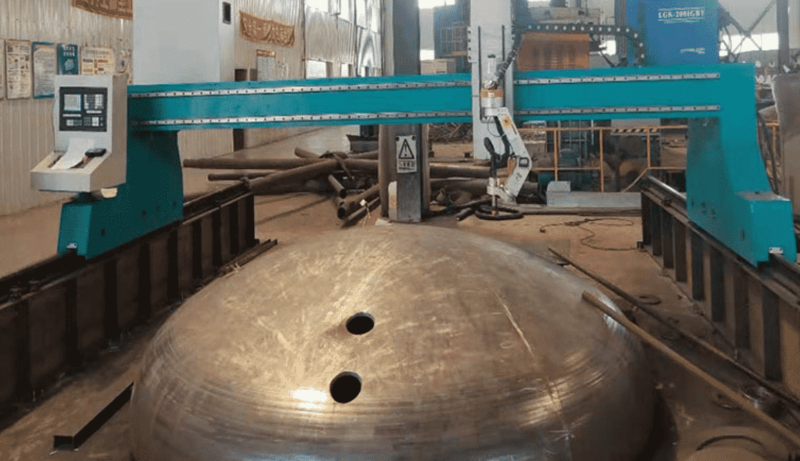
Precision in Complex Intersection Accuracy
Pressure vessels are rarely simple cylinders; they require numerous nozzles, manways, and instrumentation ports. The intersection accuracy of these openings is where 5-axis plasma technology proves its value. When a nozzle intersects a main shell, the resulting hole is not a simple circle but a complex three-dimensional curve known as a saddle cut.
Advanced plasma software utilizes parametric modeling to calculate the exact path of the plasma arc. The 5-axis head adjusts its tilt dynamically to ensure the cut edge is perfectly prepared for the subsequent fit-up. This “fit-up ready” output means the nozzle can be inserted with a uniform gap, which is a prerequisite for high-quality automated welding. Engineering the pathing to account for the kerf width and the plasma arc’s “bolt-hole” effect ensures that even small-diameter openings maintain high circularity and dimensional stability.
Structural Foundation: The H-Beam Advantage
The longevity and accuracy of a Plasma Cutting Machine are heavily dependent on its structural frame. Industrial engineers favor H-beam low maintenance designs for large-scale vessel cutting machines. The H-beam provides a superior strength-to-weight ratio and high torsional rigidity, which is essential when supporting the heavy gantry systems required for 5-axis heads.
The use of heavy-duty H-beams as the primary rails reduces vibration during high-speed traverses. Vibration is the enemy of plasma cut quality; it induces striations on the cut surface and can lead to premature wear of the drive components. By utilizing a stabilized H-beam foundation, the machine requires fewer recalibrations over its service life. The mass of the H-beam acts as a dampener for the harmonic frequencies generated by the high-velocity plasma gas stream and the rapid acceleration of the servo motors.
Operational Efficiency and Maintenance Reduction
Maintenance overhead is a critical KPI for any fabrication facility. Plasma systems designed with robust mechanical components, such as helical rack-and-pinion drives mounted on machined H-beams, offer significant advantages in uptime. Unlike lighter aluminum extrusions, the steel H-beam does not succumb to thermal expansion issues caused by the intense heat of the plasma arc during long-duration cuts on thick-walled vessels.
Low maintenance is further supported by the integration of automated lubrication systems and protected cable carriers. In the context of 5-axis heads, the use of high-flex robotic cabling prevents fatigue-related failures during the complex twisting motions required for beveling. By selecting a machine with a focus on structural rigidity and component protection, engineers can achieve a 95% or higher equipment availability rate.
Thermal Management and the Heat-Affected Zone (HAZ)
A common concern in pressure vessel fabrication is the Heat-Affected Zone (HAZ) created by thermal cutting. High-definition plasma systems utilize narrow-bore nozzles and specialized gas mixtures (such as Oxygen-Nitrogen or H35) to constrict the arc. This constriction increases the energy density, allowing for faster cutting speeds which, paradoxically, reduces the total heat input into the base metal.
By optimizing the feed rate and amperage through the CNC interface, engineers can limit the HAZ to a negligible depth. This is vital for maintaining the metallurgical properties of specialized alloys, such as P91 or high-tensile carbon steels used in vessel shells. The 5-axis head’s ability to maintain an optimal torch angle also ensures that the heat is distributed evenly, preventing localized warping or deformation of large-diameter cylinders.
Data Integration and Process Control
The modern 5-axis plasma machine functions as an edge-computing node within the smart factory. Industry 4.0 integration allows for the direct import of STEP or IGES files from CAD environments. The software automatically unfolds the vessel’s geometry, calculates the necessary bevel offsets, and generates the G-code. This seamless digital-to-physical workflow ensures that the intersection accuracy designed by the engineers is exactly what is produced on the shop floor.
Furthermore, real-time monitoring of consumables—such as the electrode and nozzle—allows for predictive maintenance. The CNC can alert operators before cut quality degrades, ensuring that every hole and bevel meets the rigorous inspection standards of the oil, gas, and nuclear sectors. This level of control is what makes 5-axis plasma the preferred choice for heavy-duty pressure vessel fabrication.
Technical Summary for Industrial Implementation
The implementation of 5-axis plasma cutting in pressure vessel manufacturing represents a significant upgrade in technical capability. By focusing on the structural stability of the H-beam frame and the geometric precision of the 5-axis beveling head, facilities can drastically reduce the labor-intensive stages of weld prep and fit-up. The resulting components exhibit superior edge quality, minimal HAZ, and exact tolerances, which are the fundamental requirements for any high-pressure containment system.
Engineers must evaluate these systems based on their duty cycle, the robustness of their drive systems, and the sophistication of their nesting and beveling software. When these factors are aligned, the result is a production line that is not only faster but inherently more reliable, producing vessels that meet the highest standards of safety and performance.
-


LT240S tube laser cutting machine
-
LT120S tube laser cutting machine
-
Sale

Tank Fillet Welding Machine
Original price was: $1,000.00.$900.00Current price is: $900.00. -
Sale

MAK100 tube laser cutting machine
Original price was: $5,500.00.$5,000.00Current price is: $5,000.00. -

portable plasma air cutting machine
$1,200.00 -

2in1 fiber laser cutting machine
-

Air cooling Laser welding machine
-

HF h beam laser cutting machine
-

LT240 laser cutting machine
-

Laser welding machine
-


Cobot Welding Station
-

Gantry welding robot solution
-

Tracked Wheeled AGV Welding robot
-

LFH6020 Fiber laser cutting machine
-
LFP6020
-

robotic welidng machine
Advanced Fiber Laser Tube Processing Technology
Our CNC Fiber Laser Tube Cutting systems revolutionize metal fabrication by integrating high-precision cutting, punching, and profiling into a single automated workflow. Designed for versatility, this technology handles a wide array of profiles including Round, Square, Rectangular, and Oval tubes, as well as complex L-shaped and U-shaped channels.
- Precision Punching: High-speed hole punching with micron-level accuracy, eliminating the need for mechanical drilling or die-stamping.
- Complex Profiling: Advanced 3D pathing allows for intricate interlocking joints and specialized notch cuts, ideal for structural frames.
- High Material Efficiency: Intelligent nesting software minimizes scrap, reducing raw material costs across large production runs.
- Clean Finish: Delivers oxide-free, burr-free edges that require zero secondary grinding before welding.

Seamlessly processing multiple profiles with consistent precision.
Global Delivery & Logistics



From our high-tech manufacturing facility directly to your global site. PCL WeldCut ensures secure packaging, professional handling, and reliable international logistics to safeguard your equipment throughout the entire journey.