Mechanical Precision in Tank Fillet Welding and Steel Construction
In the realm of heavy industrial steel construction, specifically the fabrication of large-scale storage tanks and pressure vessels, the efficiency of the welding process is the primary determinant of project timelines and structural reliability. The transition from manual arc welding to mechanized tank fillet welding represents a significant leap in industrial engineering. This shift is driven by the need for consistent penetration profiles and the minimization of weld metal volume through narrow gap welding techniques. By utilizing dedicated mechanical cutting for edge preparation and specialized magnetic tractors, engineers can achieve high-integrity joints that meet stringent API or ASME standards.
The Architecture of Narrow Gap Welding in Field Environments
Narrow gap welding is a specialized technique designed to join thick sections of steel plate while minimizing the “V” or “U” groove angle. In traditional welding, wide bevel angles are used to ensure torch access, which leads to excessive heat input and high consumable costs. In tank construction, reducing the bevel angle to a narrow configuration requires precise mechanical guidance.
When applied to the fillet joints of a tank—such as the critical junction between the tank shell and the bottom plate—narrow gap parameters allow for a significant reduction in the number of passes required. This process focuses the arc energy into a confined space, ensuring deep root penetration and a smaller heat-affected zone (HAZ). This is particularly vital in steel structures where thermal distortion can lead to buckling or misalignment of the tank walls.
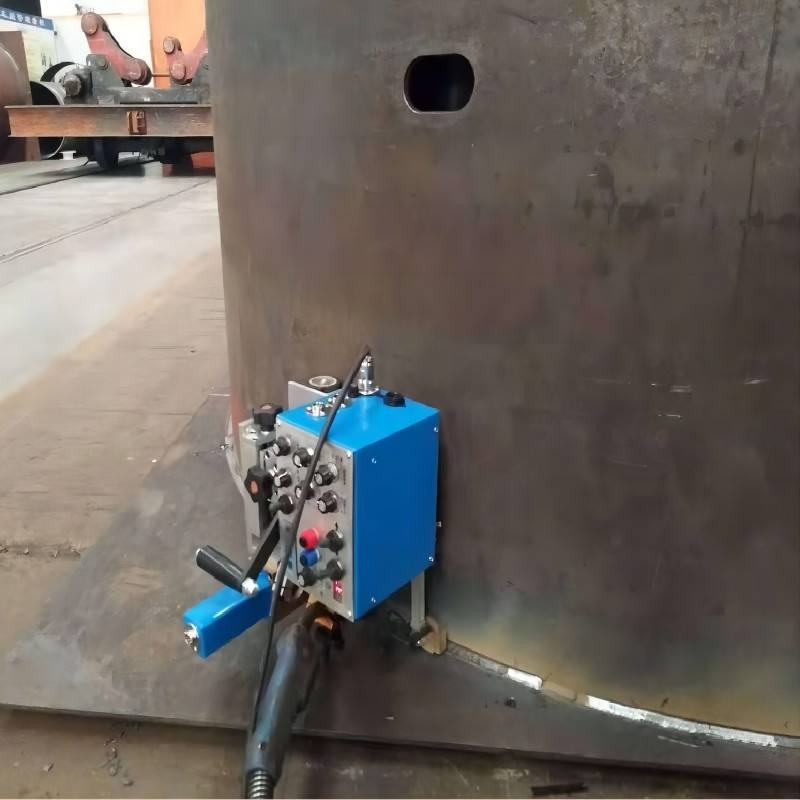
Magnetic Crawler Stability and Field Construction Efficiency
Field construction presents unique challenges that do not exist in controlled shop environments. Wind, uneven terrain, and the sheer scale of vertical structures make traditional manual welding inconsistent. The implementation of a magnetic crawler provides the necessary mechanical stability to maintain a constant torch-to-workpiece distance. These crawlers utilize high-strength permanent magnets or electromagnets to adhere to the steel surface, allowing them to navigate both horizontal and vertical planes with high precision.
The stability provided by the magnetic carriage ensures that the travel speed remains constant. In industrial engineering terms, “travel speed” is a direct variable in the heat input equation. If the speed fluctuates, as it often does with manual operators, the weld profile becomes irregular, leading to potential defects like slag inclusions or lack of fusion. A mechanized crawler eliminates these variables, providing a uniform bead appearance and consistent mechanical properties throughout the entire circumference of the tank.
Optimization of Filler Metal Deposition Rates
One of the most compelling arguments for using a mechanized steel structure welding approach is the optimization of deposition rates. Fillet welding on large tanks involves kilometers of weld beads. By using a mechanized carriage equipped with a wire-feed system, the deposition rate can be increased significantly compared to stick welding (SMAW).
When combined with narrow gap preparations, the volume of weld metal required to fill the joint is reduced by up to 30-50%. This reduction does not merely save on material costs; it also reduces the total arc time, which minimizes the energy consumption of the project and reduces the labor hours required per linear meter of weld. From a project management perspective, this predictability in welding time allows for more accurate scheduling and resource allocation.
Structural Integrity and Defect Mitigation
The integrity of a tank fillet weld is tested by its ability to withstand hydrostatic pressure and environmental loading. Mechanized systems provide a level of repeatability that is essential for passing non-destructive testing (NDT) such as ultrasonic or radiographic inspections. Because the magnetic crawler follows a predetermined path with calibrated oscillation parameters, the risk of human error is marginalized.
Common defects such as undercut and overlap are largely eliminated through the precise control of the torch angle and arc length. In the context of narrow gap welding, where the sidewall fusion is critical, the mechanical precision of the crawler ensures that the arc is directed exactly at the interface of the two plates. This level of accuracy is difficult to sustain manually over long shifts in the field.
Technical Considerations for Equipment Selection
When selecting a mechanical system for tank fillet welding, industrial engineers must evaluate several key technical specifications:
- Tractive Force: The ability of the magnetic crawler to carry the weight of the torch, cables, and potentially the wire feeder while maintaining a vertical climb.
- Speed Control: A closed-loop feedback system that ensures the motor speed remains constant regardless of the battery level or surface friction.
- Oscillation Parameters: The ability to adjust the width and frequency of the torch “weave” to accommodate slight variations in the gap width.
- Heat Resistance: Components must be shielded from the intense radiant heat generated by high-amperage narrow gap processes.
Conclusion: The Future of Mechanized Steel Fabrication
The integration of narrow gap welding and magnetic crawler technology represents a mature, reliable solution for the challenges of modern steel structure assembly. By focusing on mechanical stability and process control, manufacturers can achieve superior weld quality while simultaneously driving down costs. As global demand for storage infrastructure increases, the reliance on these mechanized systems will only grow, setting new benchmarks for speed and safety in the construction industry. The elimination of manual inconsistency through the use of high-traction, precision-controlled carriages is no longer an option but a necessity for competitive industrial engineering.
-


LT240S tube laser cutting machine
-
LT120S tube laser cutting machine
-
Sale

Tank Fillet Welding Machine
Original price was: $1,000.00.$900.00Current price is: $900.00. -
Sale

MAK100 tube laser cutting machine
Original price was: $5,500.00.$5,000.00Current price is: $5,000.00. -

portable plasma air cutting machine
$1,200.00 -

2in1 fiber laser cutting machine
-

Air cooling Laser welding machine
-

HF h beam laser cutting machine
-

LT240 laser cutting machine
-

Laser welding machine
-


Cobot Welding Station
-

Gantry welding robot solution
-

Tracked Wheeled AGV Welding robot
-

LFH6020 Fiber laser cutting machine
-
LFP6020
-

robotic welidng machine
Advanced Fiber Laser Tube Processing Technology
Our CNC Fiber Laser Tube Cutting systems revolutionize metal fabrication by integrating high-precision cutting, punching, and profiling into a single automated workflow. Designed for versatility, this technology handles a wide array of profiles including Round, Square, Rectangular, and Oval tubes, as well as complex L-shaped and U-shaped channels.
- Precision Punching: High-speed hole punching with micron-level accuracy, eliminating the need for mechanical drilling or die-stamping.
- Complex Profiling: Advanced 3D pathing allows for intricate interlocking joints and specialized notch cuts, ideal for structural frames.
- High Material Efficiency: Intelligent nesting software minimizes scrap, reducing raw material costs across large production runs.
- Clean Finish: Delivers oxide-free, burr-free edges that require zero secondary grinding before welding.

Seamlessly processing multiple profiles with consistent precision.
Global Delivery & Logistics



From our high-tech manufacturing facility directly to your global site. PCL WeldCut ensures secure packaging, professional handling, and reliable international logistics to safeguard your equipment throughout the entire journey.