Engineering Bridge Truss Integrity through Advanced Fillet Welding
In the domain of heavy infrastructure, the structural reliability of bridge trusses depends heavily on the quality of circumferential and longitudinal joints. Bridge trusses often utilize large-diameter steel pipes that must withstand immense dynamic loads and environmental stressors. The transition from traditional welding methods to narrow gap welding has redefined the efficiency of these projects. However, the success of a narrow gap joint is not merely a product of the welding arc itself but begins with the precision of the initial pipe profile cutting and the mechanical stability of the welding carriage.
Industrial engineering standards dictate that for material thicknesses exceeding 20mm, traditional V-groove preparations become economically non-viable due to the sheer volume of filler metal required. By implementing narrow gap geometries, the total weld volume is reduced by up to 40 percent. This reduction directly correlates to lower heat input, which is critical for maintaining the metallurgical properties of high-tensile bridge steel. The focus here remains strictly on the mechanical execution of these welds in field environments where stability is frequently compromised by gravity, wind, and surface irregularities.
The Role of Pipe Profile Preparation in Welding Success
Before the welding carriage ever touches the steel, the Pipe Profile Cutting Machine must produce a bevel that allows for consistent penetration. While the cutting process itself is a precursor, its accuracy determines the duty cycle of the welding operation. A pipe profile cutting machine designed for Bridge Trusses must ensure that the root face and bevel angle are consistent across the entire circumference. For fillet welds, particularly in tank-style configurations or large-diameter pipe intersections, any deviation in the fit-up gap can lead to burn-through or lack of fusion.
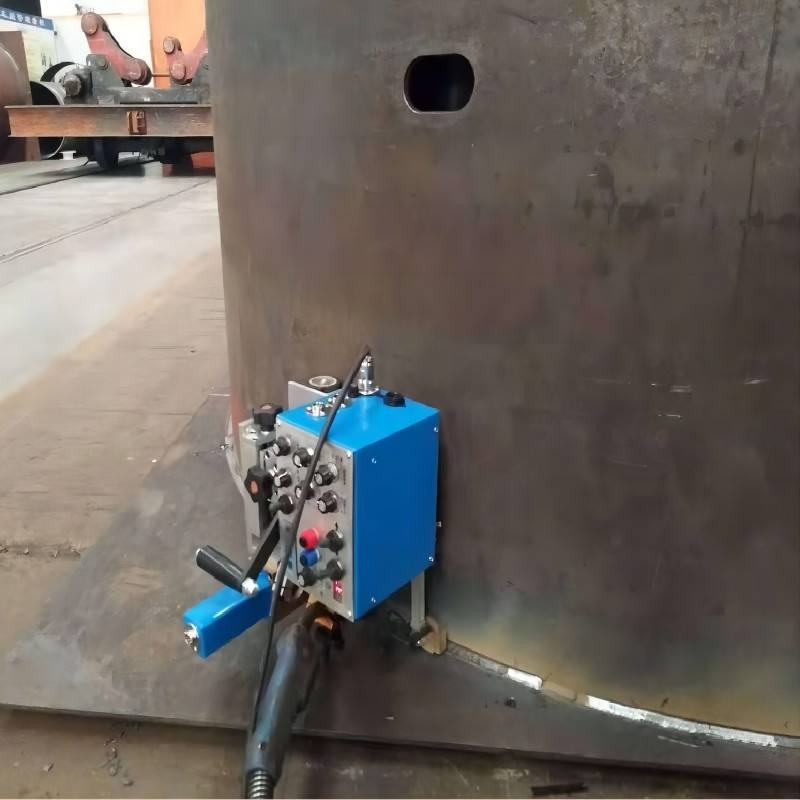
Once the profile is cut, the assembly moves to the welding phase. In bridge construction, the “tank fillet” refers to the heavy-duty fillet welds performed on large-scale cylindrical components. Because these structures cannot always be rotated on turning rolls, the welding equipment must move around the workpiece. This necessitates a solution that provides the stability of a fixed machine with the portability of a manual torch.
Magnetic Crawler Systems and Field Construction Stability
The primary challenge in field welding for bridge trusses is maintaining a constant torch angle and travel speed. Magnetic crawler welding units address this by utilizing high-flux permanent magnets or electromagnets to adhere to the pipe surface. Unlike track-based systems that require time-consuming setup, a magnetic crawler can be deployed directly onto the steel surface, significantly reducing downtime between joints.
From an industrial engineering perspective, the stability of the crawler is the most critical variable in field construction. The crawler must provide sufficient tractive force to overcome the weight of the welding lead and the gravitational pull during vertical or overhead progression. By utilizing a four-wheel-drive magnetic system, the equipment ensures that the torch remains centered within the narrow gap. This mechanical consistency eliminates the “shaking” associated with manual welding, resulting in a uniform weld bead profile that passes ultrasonic and radiographic testing with much higher frequency.
Optimizing the Narrow Gap Fillet Joint
In a tank fillet welding application, the crawler is often equipped with an oscillator. This mechanism moves the torch slightly from side to side within the narrow groove to ensure side-wall fusion. In bridge trusses, where the vibration and load-bearing requirements are extreme, side-wall fusion is non-negotiable. The narrow gap approach limits the width of the weld pool, which minimizes the heat-affected zone (HAZ) and prevents the grain growth that can lead to brittle fractures in bridge components.
The magnetic crawler also allows for the integration of arc voltage control (AVC). This system automatically adjusts the height of the torch to maintain a constant arc length, even if the pipe profile cutting machine left slight irregularities in the surface. In a field environment, where the pipe might not be perfectly round (ovality issues), the ability of the magnetic crawler to track the actual surface of the metal—rather than a theoretical path—is a major advantage for structural integrity.
Throughput and Economic Efficiency in Field Operations
The industrial engineer’s primary goal is the optimization of the deposition rate relative to labor costs and material waste. Manual fillet welding on large bridge trusses is labor-intensive and prone to fatigue-related defects. By switching to a mechanized magnetic crawler, the “arc-on” time can increase from approximately 30 percent to over 70 percent. This is achieved because the machine does not need to stop for repositioning as frequently as a human welder.
Furthermore, pipe profile cutting combined with narrow gap techniques reduces the consumption of welding wire and shielding gas. In a project involving several kilometers of welding, the savings in consumables alone can offset the capital expenditure of the crawler units. Additionally, the stability provided by the magnetic attachment ensures that the bead appearance is consistent, which reduces the need for post-weld grinding and finishing—a significant bottleneck in bridge fabrication shops.
Addressing Environmental Stability Factors
Field construction sites are rarely controlled environments. Wind can dissipate shielding gas, and temperature fluctuations can affect the ductility of the base metal. Magnetic crawlers are often designed with integrated wind shields and pre-heating torch mounts. By carrying the pre-heating equipment ahead of the welding arc, the crawler ensures that the interpass temperature remains within the specified range for the bridge steel. This synchronization of heating and welding is nearly impossible to achieve manually with the same level of precision.
The mechanical nature of the crawler also allows for higher current settings. In traditional fillet welding, the welder is limited by the heat they can physically tolerate. A mechanized system can run at higher amperages, increasing penetration depths without compromising the comfort or safety of the operator. This results in a “deep penetration” fillet weld that is structurally superior for the heavy-duty intersections found in bridge truss designs.
Technical Conclusion on Mechanized Integration
The integration of precise pipe profile cutting and magnetic crawler-based welding represents the pinnacle of industrial engineering in the bridge construction sector. By focusing on the mechanics of the tank fillet welding process and the stability of the field construction environment, firms can achieve a level of structural reliability that manual processes cannot replicate. The move toward narrow gap geometries is not just a trend but a necessary evolution to meet the increasing demands of modern infrastructure. Through the use of magnetic traction and automated oscillation, the industry can ensure that every bridge truss joint is a testament to both efficiency and safety.
-


LT240S tube laser cutting machine
-
LT120S tube laser cutting machine
-
Sale

Tank Fillet Welding Machine
Original price was: $1,000.00.$900.00Current price is: $900.00. -
Sale

MAK100 tube laser cutting machine
Original price was: $5,500.00.$5,000.00Current price is: $5,000.00. -

portable plasma air cutting machine
$1,200.00 -

2in1 fiber laser cutting machine
-

Air cooling Laser welding machine
-

HF h beam laser cutting machine
-

LT240 laser cutting machine
-

Laser welding machine
-


Cobot Welding Station
-

Gantry welding robot solution
-

Tracked Wheeled AGV Welding robot
-

LFH6020 Fiber laser cutting machine
-
LFP6020
-

robotic welidng machine
Advanced Fiber Laser Tube Processing Technology
Our CNC Fiber Laser Tube Cutting systems revolutionize metal fabrication by integrating high-precision cutting, punching, and profiling into a single automated workflow. Designed for versatility, this technology handles a wide array of profiles including Round, Square, Rectangular, and Oval tubes, as well as complex L-shaped and U-shaped channels.
- Precision Punching: High-speed hole punching with micron-level accuracy, eliminating the need for mechanical drilling or die-stamping.
- Complex Profiling: Advanced 3D pathing allows for intricate interlocking joints and specialized notch cuts, ideal for structural frames.
- High Material Efficiency: Intelligent nesting software minimizes scrap, reducing raw material costs across large production runs.
- Clean Finish: Delivers oxide-free, burr-free edges that require zero secondary grinding before welding.

Seamlessly processing multiple profiles with consistent precision.
Global Delivery & Logistics



From our high-tech manufacturing facility directly to your global site. PCL WeldCut ensures secure packaging, professional handling, and reliable international logistics to safeguard your equipment throughout the entire journey.