Mechanized Tank Fillet Welding in Pressure Vessel Construction
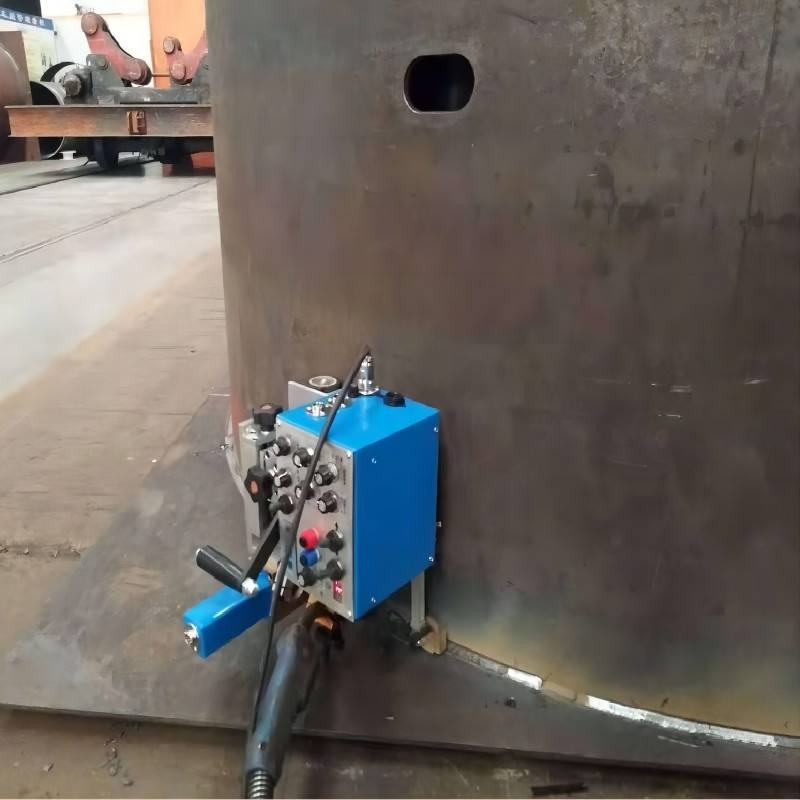
In the heavy industrial sector, specifically within pressure vessel fabrication, the transition from manual stick welding to mechanized systems is driven by the need for repeatable structural integrity. Large-scale storage tanks, often exceeding 50 meters in diameter, present unique challenges regarding vertical and horizontal seam consistency. The use of a magnetic crawler provides a solution for maintaining the torch at a precise distance and angle relative to the joint, regardless of the vessel’s curvature or height.
Unlike traditional stationary equipment, these portable units utilize high-strength permanent magnets or electromagnets to adhere to the steel plate. This adhesion is critical for field construction stability, where environmental factors such as wind and uneven ground surfaces typically interfere with manual welding precision. By automating the travel speed and torch oscillation, engineers ensure that the heat input remains within the specified Procedure Qualification Record (PQR) limits.
Magnetic Adhesion and Drive System Mechanics
The core functionality of a tank welding crawler lies in its drive train and magnetic assembly. Industrial-grade crawlers typically employ a four-wheel drive system powered by high-torque DC motors. The integration of neodymium magnets within the chassis generates a downforce sufficient to hold the weight of the tractor, the welding torch, and the cable harness against gravity.
From an engineering perspective, the pull force must be calculated to account for a safety factor of at least 2:1. This means if the unit weighs 15 kilograms, the magnetic force must exceed 300 Newtons to prevent slippage during vertical climbs. The friction coefficient between the wheels—usually made of heat-resistant silicone or knurled stainless steel—and the steel plate is the secondary factor in ensuring a steady travel speed. Variable speed controls allow for adjustments ranging from 50mm/min to 1500mm/min, accommodating various plate thicknesses and weld pass requirements.
Optimization of Tank Fillet Welding Parameters
Fillet welds, particularly at the junction of the tank shell and the floor plate, are prone to defects such as undercut and lack of fusion if the travel speed is inconsistent. Mechanized crawlers eliminate the “stop-start” issues associated with manual electrode changes.
Consistent Torch Positioning
The torch holder on a crawler is equipped with fine-tune adjustment slides for both the vertical and horizontal axes. This allows the operator to set the lead angle and the work angle with sub-millimeter precision. In tank fillet welding, maintaining a consistent 45-degree angle to the joint is vital for equal leg length distribution. Mechanization ensures that once the torch is set, it remains locked in position for the entire length of the seam.
Oscillation Controls
For thick-walled pressure vessels requiring multi-pass welds, integrated oscillators simulate the weaving motion of a skilled manual welder. The crawler’s control box allows the user to program the weave width, dwell time on either side of the joint, and the oscillation speed. This control is essential for managing the molten puddle and ensuring that the weld metal wets correctly into the toes of the fillet, reducing the risk of stress concentrations.
Enhancing Field Construction Stability
Field construction is inherently less controlled than a factory environment. Factors such as surface oxidation, moisture, and slight plate misalignments are common. A magnetic crawler compensates for these variables through its robust mechanical design.
Track and Guide Systems
While some crawlers are “free-roaming” and follow the joint via a guide arm, others utilize flexible tracks. In the context of large-diameter pressure vessels, the curvature is often gradual enough that the crawler’s internal guidance system can track the seam without additional rails. This reduces setup time significantly. The low center of gravity of the unit ensures that vibrations from the welding arc or external site machinery do not translate into ripples in the weld bead.
Cable Management Solutions
A significant hurdle in automated field welding is the weight and drag of the umbilical—the bundle of gas hoses, power cables, and wire conduits. High-performance crawlers feature reinforced cable mounts that distribute the drag force across the chassis rather than the torch head. This prevents the torch from being pulled out of alignment, which is a common failure point in less sophisticated automation setups.
Economic Impact and Duty Cycle Improvements
The primary metric for evaluating field construction stability and automation is the duty cycle. A manual welder typically operates at a 20% to 30% duty cycle, accounting for fatigue, electrode changes, and repositioning. A mechanized magnetic crawler can reach duty cycles of 70% to 80%.
Reduced Rework Rates
In the construction of pressure vessels for the oil and gas or chemical industries, the cost of a weld failure discovered during radiographic testing (RT) or ultrasonic testing (UT) is immense. Rework involves grinding out the defect, re-prepping the joint, and re-welding—all while the project timeline is delayed. Mechanized systems provide a level of uniformity that significantly lowers the probability of slag inclusions and porosity.
Labor Efficiency
By utilizing crawlers, a single operator can oversee multiple welding heads simultaneously. This shift from manual laborer to system technician increases the linear meters of weld produced per man-hour. In large-scale tank farms, where hundreds of meters of fillet welds are required, the compounding time savings result in a much faster return on investment for the hardware.
Maintenance and Operational Longevity
Industrial engineers must consider the maintenance lifecycle of magnetic crawlers. Given the harsh environment of field welding—characterized by metallic dust, spatter, and high heat—the units must be ruggedized.
1. Heat Shielding: The underside of the crawler must be protected by heat-reflective plates to prevent the magnets from reaching their Curie temperature, which would result in a loss of magnetic force.
2. Sealed Components: Gearboxes and motors should be IP65 rated or higher to prevent the ingress of grinding dust and moisture.
3. Replaceable Wear Parts: Items such as drive wheels and torch contact tips should be easily accessible for rapid field replacement.
Summary of Technical Advantages
The integration of magnetic crawler technology into tank fillet welding workflows represents a major leap in pressure vessel fabrication efficiency. By focusing on field construction stability, manufacturers can achieve weld quality that meets or exceeds stringent international codes such as ASME Section VIII or API 650.
The mechanical reliability of these systems, combined with the precision of automated travel and oscillation, addresses the core challenges of large-scale assembly. As project requirements become more demanding and labor markets tighten, the move toward specialized mechanized welding units is no longer optional but a necessity for competitive industrial engineering firms. Through rigorous adherence to mechanical parameters and proactive maintenance, the use of crawlers ensures that the structural integrity of the world’s most critical storage infrastructure is maintained.
-

Cantilever Welding Robot solution
-

GF laser cutting machine
-

P3015 plasma cutting machine
-

LFP3015 Fiber Laser Cutter
-

pipe plasma cutting machine
-
LFH 4020 Fiber Laser Cutting Machine
-
LFP4020
-

gantry plasma air cutting machine
-

3D robot cutting machine
-

8 axis plasma cutting machine
-

5 axis plasma cutting machine
-

LT360 tube laser cutting machine
-

robot welding workstation
-

SF6060 fiber laser cutting machine
Advanced Fiber Laser Tube Processing Technology
Our CNC Fiber Laser Tube Cutting systems revolutionize metal fabrication by integrating high-precision cutting, punching, and profiling into a single automated workflow. Designed for versatility, this technology handles a wide array of profiles including Round, Square, Rectangular, and Oval tubes, as well as complex L-shaped and U-shaped channels.
- Precision Punching: High-speed hole punching with micron-level accuracy, eliminating the need for mechanical drilling or die-stamping.
- Complex Profiling: Advanced 3D pathing allows for intricate interlocking joints and specialized notch cuts, ideal for structural frames.
- High Material Efficiency: Intelligent nesting software minimizes scrap, reducing raw material costs across large production runs.
- Clean Finish: Delivers oxide-free, burr-free edges that require zero secondary grinding before welding.

Seamlessly processing multiple profiles with consistent precision.
Global Delivery & Logistics



From our high-tech manufacturing facility directly to your global site. PCL WeldCut ensures secure packaging, professional handling, and reliable international logistics to safeguard your equipment throughout the entire journey.