Optimizing Tank Fillet Welding via Mechanized Magnetic Crawlers
In the fabrication of heavy construction machinery and large-scale storage vessels, the transition from manual welding to mechanized systems is driven by the need for repeatability and structural reliability. Unlike shop-floor environments where workpieces can be rotated on positioners, field construction requires equipment that can navigate the workpiece itself. The implementation of magnetic crawler welding systems represents a significant shift in how horizontal and vertical fillet joints are managed in the field. These systems are designed to traverse steel plates with high adhesion, ensuring that the welding torch maintains a consistent path despite the challenges of gravity and surface irregularities.
Industrial engineers prioritize these crawlers because they decouple the welding speed from human fatigue. In tank construction, where fillet welds may extend for dozens of meters, maintaining a constant travel speed is nearly impossible for a manual operator. The mechanized carriage provides a steady motion control system that directly influences the heat input per unit length, a critical variable for preventing distortion in large-diameter shells and thick-walled plate assemblies.
The Role of Arc Voltage Control (AVC) in Field Stability
One of the primary technical hurdles in field welding is the variation in the distance between the torch tip and the workpiece, often caused by plate deformation or slight misalignment during tack welding. Arc voltage control serves as the corrective mechanism in these scenarios. By continuously monitoring the voltage across the welding arc, the system can detect minute changes in arc length. Since voltage is directly proportional to arc length in constant current or modified constant voltage processes, the AVC logic adjusts the vertical slide of the crawler to maintain the programmed standoff distance.
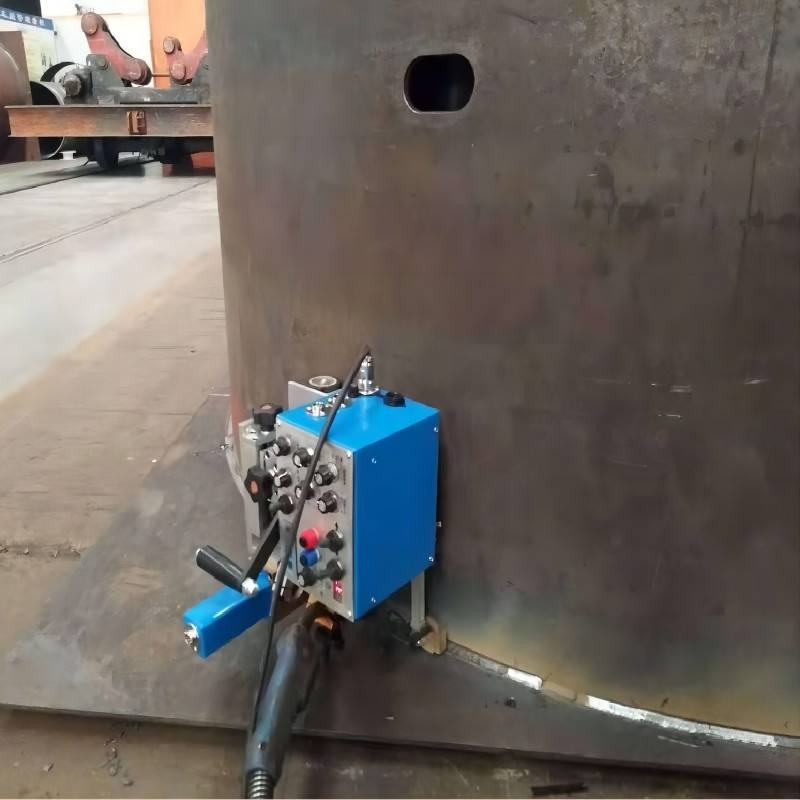
For tank fillet welding, the AVC ensures that the penetration depth remains uniform. If the plate bows inward, the voltage drops, signaling the motor-driven slide to retract the torch. Conversely, if the gap widens, the system lowers the torch to maintain arc stability. This high-frequency adjustment loop is essential for field construction stability, where environmental factors and large-scale tolerances make rigid, non-sensing automation impractical.
Mechanical Integration of Magnetic Traction Units
The physical stability of the welding process relies on the magnetic force of the crawler. These units utilize high-strength permanent magnets or switchable magnetic blocks that allow the carriage to “grip” the tank wall. From an engineering perspective, the traction-to-weight ratio must be carefully calculated to prevent slippage, especially when the unit is carrying a heavy wire feeder and spool. The drive system typically employs a four-wheel or tracked configuration with high-torque stepper motors to ensure smooth movement at low speeds, which is necessary for high-deposition fillet welds.
In the context of construction machinery, such as large crane pedestals or excavator chassis components that require circumferential fillet welds, the crawler must handle varying curvatures. Modern magnetic crawlers feature articulated chassis designs that allow the magnetic pods to stay flush against the surface, regardless of the tank’s radius. This ensures that the center of gravity remains optimized and the torch orientation relative to the joint—the work angle and travel angle—remains constant throughout the operation.
Technical Advantages of Mechanized Fillet Welds over Manual Processes
The shift toward tank fillet welding automation is backed by quantifiable performance metrics. First, the duty cycle of a mechanized crawler is significantly higher than that of a manual welder. While a manual operator may have a “torch-on” time of 30-40%, a magnetic crawler can achieve duty cycles exceeding 75%, stopping only for wire spool changes or repositioning.
Furthermore, the consistency of the weld bead profile reduces the need for secondary grinding. In heavy machinery, fillet welds are often subjected to fatigue loading. Irregularities in the weld toe or inconsistent throat thickness can act as stress concentrators. By using a mechanized system with AVC, the weld profile is smoothed out, resulting in a transition between the plate and the weld that meets stringent non-destructive testing (NDT) requirements without manual intervention.
Implementing Parameter Logic for Multi-Pass Welding
When dealing with thick-walled sections in construction machinery, a single-pass fillet weld is often insufficient. Mechanized crawlers allow for precise multi-pass layering. The engineer can program specific offsets for each pass, ensuring that the root pass provides adequate penetration while subsequent filler passes build the required throat thickness. The AVC plays a vital role here as well, as it adjusts for the changing topography of the weld bead from previous passes.
This level of control is particularly beneficial for Flux-Cored Arc Welding (FCAW), which is the preferred process for field construction due to its high deposition rates and ability to handle windier conditions compared to gas-shielded processes. The crawler ensures that the slag-forming ingredients are distributed evenly, preventing inclusions that typically occur when a manual welder’s hand shakes or varies in speed.
Operational Efficiency and Labor Optimization
From a project management standpoint, the use of magnetic crawlers with AVC changes the labor dynamic on the job site. Rather than requiring multiple highly skilled welders to perform grueling physical labor, a single technician can oversee multiple crawlers. This not only reduces the cost per foot of weld but also improves safety. Operators are removed from the immediate vicinity of welding fumes and intense heat, leading to better long-term health outcomes and reduced site liability.
The setup time for these machines is minimal. Because they do not require complex rails or tracks—relying instead on the magnetic properties of the base material—they can be deployed quickly across different sections of a construction site. This flexibility is the cornerstone of modern industrial engineering in the heavy equipment sector, where project timelines are tight and the cost of rework is prohibitive.
Summary of Engineering Impact
The integration of magnetic crawler systems with integrated arc voltage control represents the pinnacle of mechanized field welding. By focusing on mechanical stability and electronic arc regulation, manufacturers of construction machinery can ensure that their tank and structural assemblies meet global standards for durability. The removal of human variability, combined with the ability to operate in challenging field conditions, makes this technology indispensable for high-volume, high-quality industrial fabrication.
-


LT240S tube laser cutting machine
-
LT120S tube laser cutting machine
-
Sale

Tank Fillet Welding Machine
Original price was: $1,000.00.$900.00Current price is: $900.00. -
Sale

MAK100 tube laser cutting machine
Original price was: $5,500.00.$5,000.00Current price is: $5,000.00. -

portable plasma air cutting machine
$1,200.00 -

2in1 fiber laser cutting machine
-

Air cooling Laser welding machine
-

HF h beam laser cutting machine
-

LT240 laser cutting machine
-

Laser welding machine
-


Cobot Welding Station
-

Gantry welding robot solution
-

Tracked Wheeled AGV Welding robot
-

LFH6020 Fiber laser cutting machine
-
LFP6020
-

robotic welidng machine
Advanced Fiber Laser Tube Processing Technology
Our CNC Fiber Laser Tube Cutting systems revolutionize metal fabrication by integrating high-precision cutting, punching, and profiling into a single automated workflow. Designed for versatility, this technology handles a wide array of profiles including Round, Square, Rectangular, and Oval tubes, as well as complex L-shaped and U-shaped channels.
- Precision Punching: High-speed hole punching with micron-level accuracy, eliminating the need for mechanical drilling or die-stamping.
- Complex Profiling: Advanced 3D pathing allows for intricate interlocking joints and specialized notch cuts, ideal for structural frames.
- High Material Efficiency: Intelligent nesting software minimizes scrap, reducing raw material costs across large production runs.
- Clean Finish: Delivers oxide-free, burr-free edges that require zero secondary grinding before welding.

Seamlessly processing multiple profiles with consistent precision.
Global Delivery & Logistics



From our high-tech manufacturing facility directly to your global site. PCL WeldCut ensures secure packaging, professional handling, and reliable international logistics to safeguard your equipment throughout the entire journey.