Optimizing Tank Fillet Welding via 3D Vision and Magnetic Crawlers
In the heavy industrial fabrication of wind towers, the transition from workshop-controlled environments to field construction introduces significant variables in structural alignment and weld consistency. The implementation of a magnetic crawler welding system equipped with 3D Vision positioning represents a shift toward high-precision mechanized assembly. Unlike stationary systems, these crawlers are engineered to navigate the expansive circumferences and vertical heights of wind tower sections, ensuring that fillet welds—the primary joints securing internal flanges and stiffeners—meet stringent structural fatigue requirements.
Mechanical Architecture of Magnetic Crawler Systems
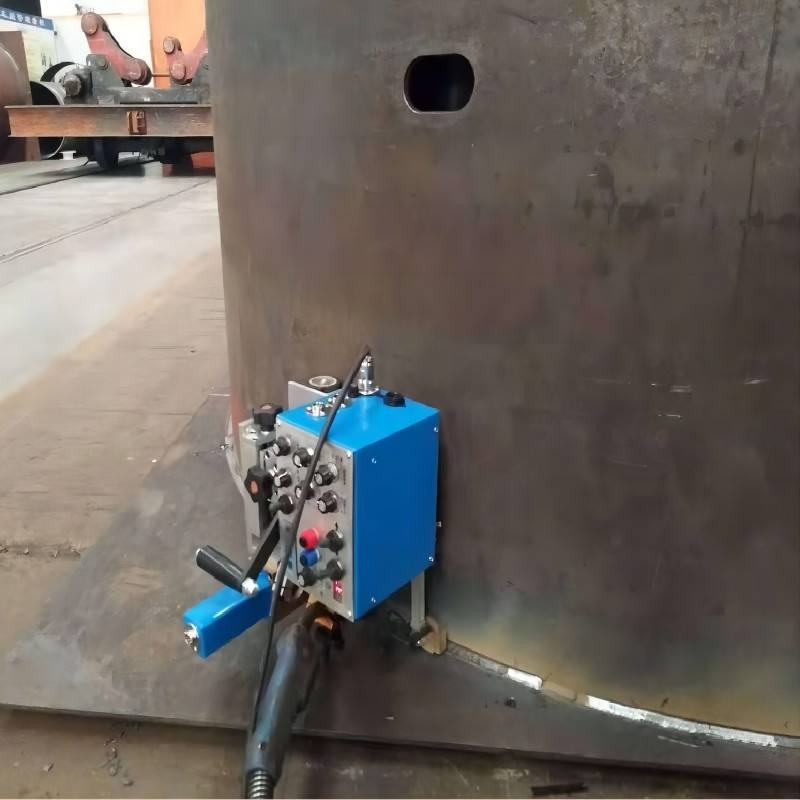
The core of field-stable welding lies in the crawler’s ability to maintain a constant distance and orientation relative to the weld joint. Magnetic crawlers utilize high-flux permanent magnets or switchable electromagnets to generate the necessary clamping force against the curved steel plates. From an industrial engineering perspective, the adhesion force must be calculated to exceed the combined weight of the carriage, the welding torch, the wire feeder, and the lateral forces exerted by cable bundles.
Stability is further reinforced through multi-wheel drive configurations that distribute the load across the plate surface. This distribution prevents localized deformation and ensures that the 3D vision positioning sensor remains vibration-isolated. By using a four-wheel independent drive system, the crawler can compensate for surface irregularities such as mill scale or slight curvature deviations inherent in large-diameter wind tower sections.
3D Vision Positioning for Joint Mapping
The integration of 3D vision is not merely for observation but for real-time topographical mapping of the fillet joint. In wind tower fabrication, the fit-up between the shell and the flange often contains gap variations. The 3D vision system utilizes structured light or high-frame-rate sensors to capture a three-dimensional profile of the joint geometry. This data is processed to determine the precise centerline of the fillet and the volume of the weld groove.
This positioning system eliminates the need for manual torch adjustment. As the crawler moves along the circumference, the vision sensor detects deviations in the joint path caused by thermal expansion or plate misalignment. The control logic then initiates micro-adjustments to the torch cross-slide, maintaining the electrode at the optimal work angle and lead angle. This level of precision is critical for ensuring deep penetration and avoiding undercut, which are common failure points in wind tower structural welds.
Enhancing Field Construction Stability
Field construction stability is the primary challenge in wind tower assembly. External factors such as wind gusts, ambient temperature fluctuations, and ground vibrations can compromise the arc stability and the physical path of the welding carriage. To counteract these variables, the magnetic crawler is designed with a low center of gravity and high-torque stepper motors that provide consistent travel speeds regardless of the inclination angle.
Furthermore, the 3D vision software includes algorithms for “noise” filtration. In a field environment, dust or moisture can interfere with optical sensors. Advanced 3D mapping systems utilize specific wavelengths of light that penetrate smoke and airborne particulates, ensuring that the tracking data remains accurate. This robustness allows for continuous operation during various weather windows, significantly increasing the duty cycle of the welding process compared to manual alternatives.
Technical Parameters of Tank Fillet Welding
Fillet welding in the context of wind tower tanks requires specific heat input controls to manage the Heat Affected Zone (HAZ). The automated crawler allows for the synchronization of travel speed with wire feed speed, a feat difficult to achieve consistently by hand over long distances. For a standard 30mm thick flange-to-shell fillet weld, the crawler can be programmed for multi-pass sequences where the 3D vision system recalibrates the path for each subsequent layer based on the profile of the previous bead.
Key Performance Metrics:
- Travel Speed Consistency: +/- 1% deviation across vertical and horizontal planes.
- Path Tracking Accuracy: Within 0.1mm of the joint centerline.
- Adhesion Safety Factor: Minimum 3:1 ratio of magnetic pull to total payload weight.
- Data Logging: Real-time recording of voltage, amperage, and travel speed for QA/QC compliance.
Synergy Between Path Planning and Real-Time Execution
Effective tank fillet welding in wind tower fabrication relies on the synergy between pre-programmed path planning and real-time vision-based corrections. Before the welding cycle begins, the crawler can perform a dry run where the 3D sensor maps the entire circumference. This map serves as a baseline, identifying areas of wide gaps or tight fit-ups that require specific parameters. During the actual weld cycle, the system compares the live data with the baseline map, adjusting the welding parameters dynamically to ensure a uniform throat thickness.
This dual-layered approach to positioning ensures that the mechanical limitations of the field-assembled plates are mitigated. If the sensor detects a gap exceeding a pre-defined threshold, it can automatically trigger a weaving pattern or adjust the travel speed to increase weld metal deposition. This level of autonomy ensures that the final structure can withstand the cyclical loading stresses inherent in offshore and onshore wind environments.
Eliminating Operator Fatigue and Improving Safety
By delegating the welding task to a vision-guided magnetic crawler, the industrial engineer addresses both safety and productivity. Manual welding of internal wind tower components requires technicians to work in cramped, poorly ventilated spaces for extended periods. This leads to fatigue-induced defects. Automated crawlers remove the operator from the immediate vicinity of the arc, allowing them to monitor multiple units from a remote interface. This transition from “welder” to “system operator” improves the overall ergonomic profile of the construction site while ensuring that the quality of the fillet weld is a function of system calibration rather than individual skill variability.
Conclusion on Industrial Implementation
The deployment of 3D vision-enabled magnetic crawlers for Wind Tower fabrication represents a refined engineering solution to a complex logistical problem. By focusing on the mechanics of magnetic adhesion and the precision of 3D joint mapping, manufacturers can achieve workshop-level quality in the unpredictability of the field. The result is a more resilient wind tower structure, faster assembly timelines, and a significant reduction in rework costs. As wind turbines continue to scale in height and weight, the reliance on such mechanized stability will become the standard for all tank fillet welding operations in the renewable energy sector.
-


LT240S tube laser cutting machine
-
LT120S tube laser cutting machine
-
Sale

Tank Fillet Welding Machine
Original price was: $1,000.00.$900.00Current price is: $900.00. -
Sale

MAK100 tube laser cutting machine
Original price was: $5,500.00.$5,000.00Current price is: $5,000.00. -

portable plasma air cutting machine
$1,200.00 -

2in1 fiber laser cutting machine
-

Air cooling Laser welding machine
-

HF h beam laser cutting machine
-

LT240 laser cutting machine
-

Laser welding machine
-


Cobot Welding Station
-

Gantry welding robot solution
-

Tracked Wheeled AGV Welding robot
-

LFH6020 Fiber laser cutting machine
-
LFP6020
-

robotic welidng machine
Advanced Fiber Laser Tube Processing Technology
Our CNC Fiber Laser Tube Cutting systems revolutionize metal fabrication by integrating high-precision cutting, punching, and profiling into a single automated workflow. Designed for versatility, this technology handles a wide array of profiles including Round, Square, Rectangular, and Oval tubes, as well as complex L-shaped and U-shaped channels.
- Precision Punching: High-speed hole punching with micron-level accuracy, eliminating the need for mechanical drilling or die-stamping.
- Complex Profiling: Advanced 3D pathing allows for intricate interlocking joints and specialized notch cuts, ideal for structural frames.
- High Material Efficiency: Intelligent nesting software minimizes scrap, reducing raw material costs across large production runs.
- Clean Finish: Delivers oxide-free, burr-free edges that require zero secondary grinding before welding.

Seamlessly processing multiple profiles with consistent precision.
Global Delivery & Logistics



From our high-tech manufacturing facility directly to your global site. PCL WeldCut ensures secure packaging, professional handling, and reliable international logistics to safeguard your equipment throughout the entire journey.