Engineering Precision in Wind Tower Longitudinal and Circumferential Joins
Industrial fabrication of wind towers demands rigorous adherence to structural tolerances and weld quality standards. As diameters increase to support larger turbines, the mechanical challenges of maintaining torch positioning on curved surfaces become more pronounced. The transition toward automated Tank Fillet Welding systems represents a shift in how engineers manage the assembly of massive steel sections. Unlike stationary workshop equipment, the application of 3D vision-guided systems for profile processing focuses on real-time adaptation to the workpiece’s physical irregularities.
The core objective is the consistent execution of fillet welds at the junction of internal stiffeners and shell plates. This process requires a system that can navigate the internal and external circumferences of a tower section while maintaining a constant contact angle and travel speed. By utilizing a mechanized carriage designed for heavy-duty environments, fabricators can achieve higher duty cycles than manual operations, directly impacting the overall throughput of the production facility.
Mechanical Principles of the Magnetic Crawler
The Magnetic Crawler serves as the primary mobility platform for welding in wind tower construction. From an industrial engineering perspective, the stability of this platform is paramount. High-strength permanent magnets or electromagnets are integrated into the drive wheels or the chassis to provide the necessary flux density to counteract gravity. This allows the machine to traverse vertical and overhead positions on the steel shell without the need for external tracks or guide rails.
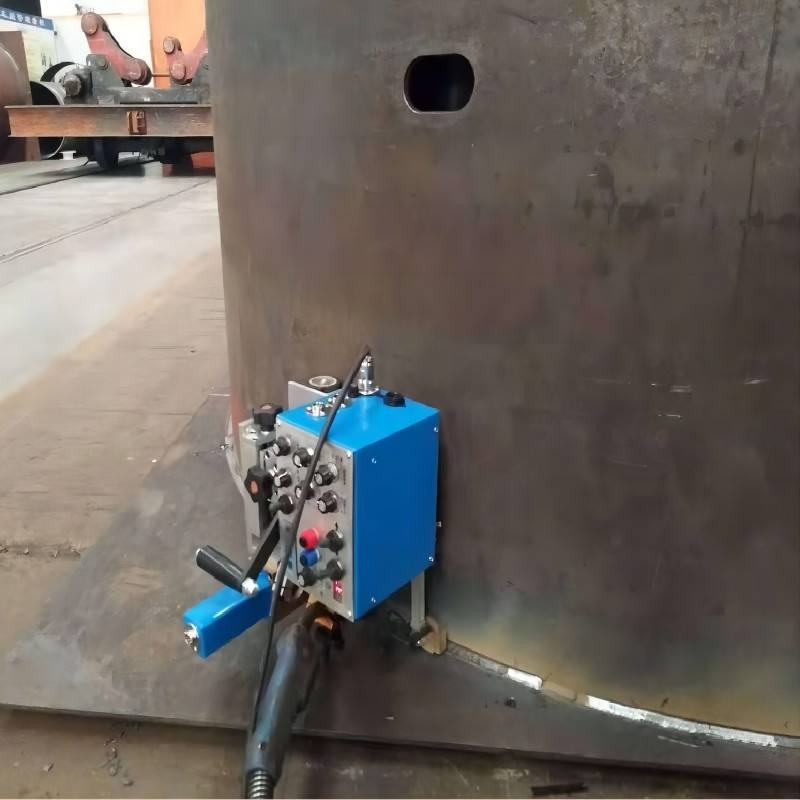
Stability is governed by the attraction force relative to the weight of the welding payload, which includes the wire feeder, torch assembly, and vision sensors. Engineers must calculate the magnetic pull-off force to ensure that the friction coefficient between the wheels and the steel surface remains sufficient to prevent slipping, especially when the surface is contaminated with mill scale or moisture. The drive system typically employs high-torque stepper or servo motors with planetary gearboxes to provide the fine speed control required for high-quality fillet beads.
3D Vision Positioning and Surface Mapping
In the absence of manual guidance, 3D Vision Positioning acts as the sensory input for the crawler’s control logic. This system utilizes optical sensors to map the geometry of the fillet joint in three-dimensional space. By analyzing the intersection of the two plates, the vision system calculates the precise “V” or “L” shape of the join, identifying the root point where the weld metal must be deposited.
This is not merely about tracking a line; it is about depth perception and volume calculation. The 3D sensor identifies variations in the gap width and the alignment of the plates. If the plates are not perfectly flush—a common occurrence in large-scale field construction—the vision system adjusts the torch position and the welding parameters in real-time. This compensates for structural fit-up errors that would otherwise lead to weld defects like undercut or lack of fusion. The data loop between the vision sensor and the motion controller ensures that the torch maintains an optimal work angle and lead angle relative to the dynamic geometry of the wind tower section.
Optimizing Field Construction Stability
Field construction of wind towers presents environmental variables that do not exist in controlled shop environments. Wind, temperature fluctuations, and uneven terrain can affect the vibration profile of the tower sections during assembly. The Wind Tower Fabrication process must therefore utilize equipment that is ruggedized for site conditions.
The integration of 3D vision allows the machine to remain stable even when the tower section undergoes thermal expansion or contraction. Because the vision system references the actual workpiece rather than a pre-programmed path, it is inherently more stable and accurate in the field. The crawler’s low center of gravity and wide magnetic footprint provide a vibration-dampening effect, ensuring that the arc remains steady. This mechanical stability is critical for fillet welds, where the consistency of the leg length and throat thickness determines the fatigue life of the tower.
Process Integration and Weld Bead Morphology
The technical focus of fillet welding in these applications is the morphology of the weld bead. Industrial engineers prioritize a smooth transition between the weld metal and the base material to minimize stress concentrations. The 3D vision system facilitates this by controlling the oscillation width of the torch. By dynamically adjusting the weave pattern based on the joint volume detected by the sensors, the system ensures that the fillet weld is neither convex nor excessively concave.
Furthermore, the use of automated crawlers reduces the heat-affected zone (HAZ) by maintaining a precise and constant travel speed. Manual welding often suffers from “stop-start” inconsistencies, which are points of potential failure in a wind tower’s structure. The mechanized approach provides a continuous bead, which is essential for the long-term structural integrity required to withstand the aerodynamic loads experienced by wind turbines.
Data-Driven Quality Control in Fabrication
A significant advantage of combining 3D vision with magnetic crawlers is the ability to record digital twins of the weld. As the vision system scans the joint, it logs the dimensional data of the fit-up and the subsequent weld profile. This data provides an immediate quality assurance record, allowing engineers to verify that the fillet weld meets the design specifications without waiting for secondary non-destructive testing (NDT) results.
From a workflow management perspective, this reduces the rework cycle. If the vision system detects a gap that exceeds the allowable tolerance for the current welding procedure, it can signal the operator or automatically adjust the wire feed speed and voltage to fill the void. This level of process control is a hallmark of modern industrial engineering, where the goal is to build quality into the process rather than inspecting it at the end.
Economic Impact on Wind Energy Infrastructure
The deployment of these specialized machines significantly lowers the cost per megawatt of wind energy by reducing the labor-intensive nature of tower assembly. By focusing on Tank Fillet Welding efficiency, manufacturers can accelerate the assembly of the tower segments, which are often the bottleneck in the supply chain. The reduction in consumables waste, achieved through precise wire placement and controlled arc parameters, further contributes to the economic viability of the project.
In conclusion, the synergy between 3D vision positioning and magnetic crawler technology represents a highly specialized solution for the unique challenges of wind tower fabrication. By prioritizing mechanical stability, real-time path correction, and data-driven process control, engineers can ensure that these massive structures are built to last for decades in harsh environments, all while maintaining the high production rates required by the global energy transition.
-


LT240S tube laser cutting machine
-
LT120S tube laser cutting machine
-
Sale

Tank Fillet Welding Machine
Original price was: $1,000.00.$900.00Current price is: $900.00. -
Sale

MAK100 tube laser cutting machine
Original price was: $5,500.00.$5,000.00Current price is: $5,000.00. -

portable plasma air cutting machine
$1,200.00 -

2in1 fiber laser cutting machine
-

Air cooling Laser welding machine
-

HF h beam laser cutting machine
-

LT240 laser cutting machine
-

Laser welding machine
-


Cobot Welding Station
-

Gantry welding robot solution
-

Tracked Wheeled AGV Welding robot
-

LFH6020 Fiber laser cutting machine
-
LFP6020
-

robotic welidng machine
Advanced Fiber Laser Tube Processing Technology
Our CNC Fiber Laser Tube Cutting systems revolutionize metal fabrication by integrating high-precision cutting, punching, and profiling into a single automated workflow. Designed for versatility, this technology handles a wide array of profiles including Round, Square, Rectangular, and Oval tubes, as well as complex L-shaped and U-shaped channels.
- Precision Punching: High-speed hole punching with micron-level accuracy, eliminating the need for mechanical drilling or die-stamping.
- Complex Profiling: Advanced 3D pathing allows for intricate interlocking joints and specialized notch cuts, ideal for structural frames.
- High Material Efficiency: Intelligent nesting software minimizes scrap, reducing raw material costs across large production runs.
- Clean Finish: Delivers oxide-free, burr-free edges that require zero secondary grinding before welding.

Seamlessly processing multiple profiles with consistent precision.
Global Delivery & Logistics



From our high-tech manufacturing facility directly to your global site. PCL WeldCut ensures secure packaging, professional handling, and reliable international logistics to safeguard your equipment throughout the entire journey.