Optimizing Wind Tower Fabrication: The Role of 3D Vision in Magnetic Crawler Systems
In the industrial landscape of renewable energy, the structural integrity of wind tower sections depends heavily on the precision of longitudinal and circumferential joints. However, the internal components, such as base rings, stiffeners, and flange attachments, require specialized Fillet Welding Automation to ensure long-term fatigue resistance. As wind towers scale toward 150-meter hub heights and beyond, the mass of the steel plates—often exceeding 50mm in thickness—necessitates a move away from manual arc welding toward stabilized, carriage-based systems. This transition is not merely about speed; it is about the repeatable application of thermal energy and filler metal in challenging field environments.
Mechanical Adhesion and Field Construction Stability
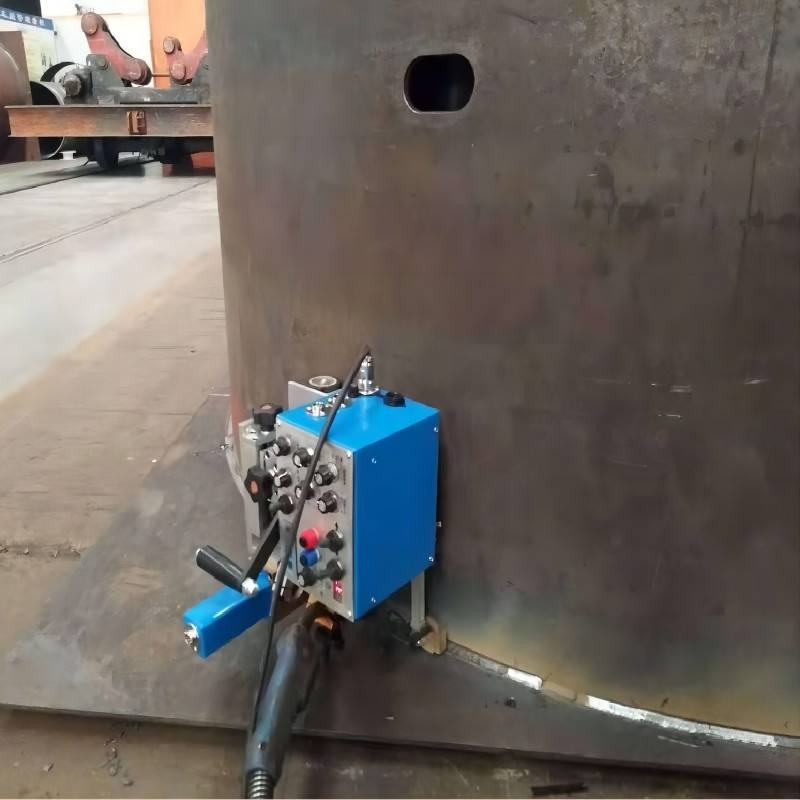
The primary challenge in tank fillet welding for wind towers is maintaining a constant torch-to-workpiece distance while navigating curved surfaces. Traditional scaffolding or manual positioning is inefficient and introduces ergonomic risks. The engineering solution lies in the Magnetic Crawler Systems. These units utilize high-intensity permanent magnets or switchable electromagnets to adhere to the steel shell. The magnetic flux must be calibrated to provide enough force to support the weight of the welding head, wire feeder, and umbilical cables, even when the crawler is in a vertical or overhead orientation.
Stability in field construction is further complicated by surface contaminants such as mill scale, oxidation, or moisture. A robust crawler design incorporates independent drive wheels and a low center of gravity to prevent “crabbing” or slipping. From an industrial engineering perspective, the traction-to-weight ratio is the critical KPI. If the magnetic force is too high, friction increases, leading to motor strain and erratic travel speeds. If too low, the oscillation of the weld pool can cause the carriage to vibrate, leading to porosity and undercut in the fillet profile.
3D Vision Positioning for Weld Path Accuracy
While the magnetic crawler provides the physical platform, 3D Vision Positioning provides the data required for precise torch placement. In wind tower fabrication, the “pipe” sections are rarely perfectly cylindrical. Gravity-induced deformation, known as “ovality,” and fit-up tolerances at the fillet junctions create gaps that vary along the circumference. A 3D vision sensor, mounted ahead of the welding torch, scans the joint geometry in real-time. This is not a robotic operation but a closed-loop sensing system that adjusts the mechanical slides of the crawler.
Advanced Joint Tracking Without Robotics
The vision system utilizes structured light or sensor-based triangulation to map the root opening and the leg length of the fillet. This data is processed by an onboard controller that manages the cross-slide actuators. By compensating for the deviations in the tank wall, the system ensures that the arc remains centered in the joint. This eliminates the need for a human operator to make constant manual adjustments to the torch steering, which is particularly beneficial inside the cramped and often poorly ventilated interiors of wind tower cans.
Thermal Management and Deposition Rates
Fillet welds in wind towers are typically multi-pass operations. The 3D vision system facilitates “layer logic,” where the system remembers the topology of the previous pass to optimize the placement of the subsequent bead. This is vital for maintaining the required throat thickness without over-welding, which can lead to excessive distortion and wasted consumables. By automating the travel speed based on the detected gap volume, the Wind Tower Fabrication process achieves a much higher duty cycle compared to manual stick or semi-automatic MIG/MAG welding.
Technical Specifications of the Magnetic Drive Train
The drive system of a tank fillet welding crawler must deliver high torque at low RPMs. Standard configurations involve worm gear reducers coupled with stepper motors. The stepper motors provide the necessary holding torque to stay stationary on a vertical wall during setup. Industrial engineers prioritize “creep speed” consistency, as the welding of thick-walled towers requires travel speeds as low as 100mm per minute. Any pulsation in the drive train will manifest as “stutter” in the weld bead ripple pattern, which is a common cause for NDT (Non-Destructive Testing) failure during ultrasonic inspections.
Environmental Adaptation in Field Welding
Field construction of wind towers often occurs in coastal or high-wind areas. Unlike a controlled factory environment, the “tank” acts as a chimney, creating internal drafts that can disrupt shielding gas coverage. Magnetic crawlers used in these scenarios are often equipped with specialized gas shrouds and wind shields. The stability of the magnetic base ensures that even if the umbilical cable is buffeted by wind, the torch maintains its spatial relationship with the fillet joint. This mechanical rigidity is the cornerstone of field-grade automated welding.
Integration with Submerged Arc and Flux-Cored Processes
While the focus remains on the crawler’s mobility, the choice of welding process is equally important. Flux-Cored Arc Welding (FCAW) is frequently paired with magnetic crawlers for fillet joints due to its ability to handle out-of-position work. The vision system’s ability to maintain a consistent stick-out (electrode extension) is critical here. If the stick-out varies due to the crawler bouncing or shifting, the current fluctuates, leading to inconsistent penetration. The 3D vision sensor mitigates this by providing the Z-axis height data to the motorized slide, keeping the electrical parameters within the specified Welding Procedure Specification (WPS).
Operational Efficiency and ROI in Heavy-Duty Fabrication
From a cost-analysis standpoint, the implementation of 3D vision-guided magnetic crawlers reduces the “arc-off” time significantly. In manual operations, the welder must stop to reposition, clean slag, and stretch. A crawler can traverse an entire 30-meter circumference with minimal stops. Furthermore, the reduction in weld defects translates directly to a reduction in gouging and repair costs, which are disproportionately expensive in thick-plate wind tower sections. The system effectively turns a skilled welder into a system operator, capable of overseeing two or three crawlers simultaneously, thereby tripling the output per man-hour.
Conclusion: The Engineering Synergy
The synergy between Magnetic Crawler Systems and 3D vision sensors represents the pinnacle of mechanical automation in the wind energy sector. By focusing on the physical realities of tank fillet welding—such as magnetism, traction, and real-time path correction—fabricators can achieve the high-volume production required for modern wind farms. This approach avoids the complexity of robotics while delivering the precision required for critical structural components, ensuring that wind towers can withstand the dynamic loads of a twenty-year service life in the harshest environments on earth.
-


LT240S tube laser cutting machine
-
LT120S tube laser cutting machine
-
Sale

Tank Fillet Welding Machine
Original price was: $1,000.00.$900.00Current price is: $900.00. -
Sale

MAK100 tube laser cutting machine
Original price was: $5,500.00.$5,000.00Current price is: $5,000.00. -

portable plasma air cutting machine
$1,200.00 -

2in1 fiber laser cutting machine
-

Air cooling Laser welding machine
-

HF h beam laser cutting machine
-

LT240 laser cutting machine
-

Laser welding machine
-


Cobot Welding Station
-

Gantry welding robot solution
-

Tracked Wheeled AGV Welding robot
-

LFH6020 Fiber laser cutting machine
-
LFP6020
-

robotic welidng machine
Advanced Fiber Laser Tube Processing Technology
Our CNC Fiber Laser Tube Cutting systems revolutionize metal fabrication by integrating high-precision cutting, punching, and profiling into a single automated workflow. Designed for versatility, this technology handles a wide array of profiles including Round, Square, Rectangular, and Oval tubes, as well as complex L-shaped and U-shaped channels.
- Precision Punching: High-speed hole punching with micron-level accuracy, eliminating the need for mechanical drilling or die-stamping.
- Complex Profiling: Advanced 3D pathing allows for intricate interlocking joints and specialized notch cuts, ideal for structural frames.
- High Material Efficiency: Intelligent nesting software minimizes scrap, reducing raw material costs across large production runs.
- Clean Finish: Delivers oxide-free, burr-free edges that require zero secondary grinding before welding.

Seamlessly processing multiple profiles with consistent precision.
Global Delivery & Logistics



From our high-tech manufacturing facility directly to your global site. PCL WeldCut ensures secure packaging, professional handling, and reliable international logistics to safeguard your equipment throughout the entire journey.