Mechanical Optimization of Tank Fillet Welding
In the domain of heavy steel structure fabrication, specifically the construction of large-diameter storage tanks, the fillet weld serves as a critical junction for structural stability. Unlike shop-controlled environments, field construction demands a specialized approach to automation. The magnetic crawler has emerged as the primary mechanical vehicle for delivering consistent weld quality in these environments. By utilizing high-flux permanent magnets or switchable magnetic bases, these systems adhere to the tank wall, overcoming gravitational forces that typically compromise manual weld consistency.
Industrial engineers prioritize the stability of the welding carriage because any vibration or slip directly impacts the bead profile and penetration depth. When executing fillet welds at the base of a tank (the shell-to-bottom joint), the crawler must maintain a constant distance from the joint root. The integration of 3D vision allows the system to perceive the physical geometry of the intersection, ensuring that the torch angle remains bisected relative to the vertical shell and horizontal floor plates. This level of mechanical precision is essential for meeting API 650 or similar international standards for atmospheric storage tanks.
3D Vision Positioning and Seam Alignment
The implementation of 3D vision in field construction stability goes beyond simple edge detection. In the context of steel structures, plates are often subject to thermal distortion, pre-existing curvature, or fit-up gaps that exceed nominal tolerances. A 3D vision system utilizing optical sensors captures the spatial coordinates of the fillet joint in real-time. By generating a point cloud of the weld zone, the system calculates the exact center of the root.
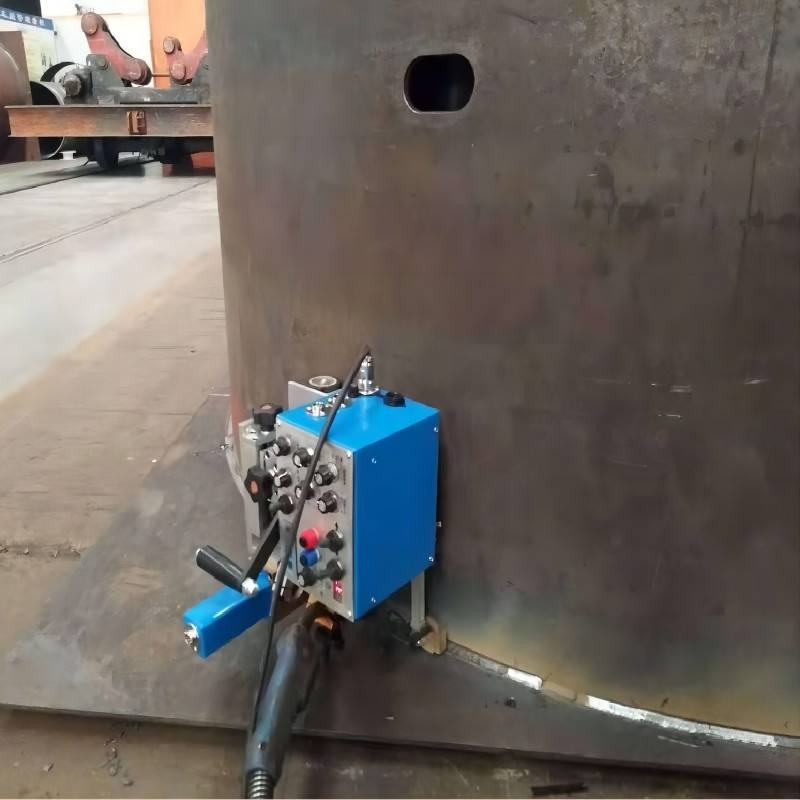
This data is fed into a closed-loop control system that adjusts the lateral and vertical position of the welding torch. Unlike open-loop systems that rely on the operator’s manual tracking, 3D vision compensates for the “drift” that occurs when a crawler traverses long distances across a tank’s circumference. The vision system identifies the fillet weld geometry and ensures the arc is maintained at the optimum vertex, regardless of minor deviations in the steel plate’s alignment. This precision reduces the likelihood of undercut or lack of fusion, which are common failure points in manually welded tank structures.
Dynamics of Magnetic Crawler Adhesion
The reliability of a magnetic crawler is dictated by its traction-to-weight ratio. For tank fillet welding, the crawler must support the weight of the wire feeder, the welding torch, and the vision sensors while moving along a vertical surface. Industrial engineers specify magnetic arrays that provide a safety factor of at least 3:1 relative to the total payload. This ensures that the system does not slip during the welding process, which would cause an immediate discontinuity in the weld bead.
Furthermore, the crawler’s drive system must be synchronized with the welding power source. As the 3D vision system detects a change in the joint gap, the crawler’s travel speed can be modulated to maintain a consistent weld volume. If the gap widens, the travel speed slows down, allowing for more filler metal deposition. This automated adjustment is critical for achieving the required throat thickness in a fillet weld, ensuring the joint can withstand the hydrostatic pressures exerted by the stored contents of the tank.
Environmental Resilience in Field Construction
Field construction presents environmental variables that are absent in a factory setting. Wind, ambient temperature fluctuations, and surface oxidation on the steel plates can all interfere with welding operations. The 3D vision sensors used in these applications are typically housed in ruggedized, IP67-rated enclosures to protect against dust and moisture. More importantly, the vision algorithms must be capable of filtering out the intense light of the welding arc and the smoke generated during the process.
By utilizing specific wavelengths of light for the 3D mapping and high-speed image processing, the system maintains its track on the seam without being “blinded” by the process. This stability is what allows for continuous, multi-pass welding on large-scale steel structures. The ability to perform long-seam welding without frequent stops and starts significantly improves the metallurgical properties of the weld, as it minimizes the number of crater points and potential leak paths in the tank structure.
Efficiency Gains and Quality Control Metrics
From an industrial engineering perspective, the transition from manual fillet welding to automated seam tracking via magnetic crawlers is justified by the significant reduction in rework. In manual tank construction, the repair rate for fillet welds can be substantial due to welder fatigue and the difficulty of maintaining a consistent posture over several hundred meters of welding. Automated systems provide a uniform heat input, which reduces the overall distortion of the tank shell.
The data captured by the 3D vision system also serves as a digital record of the construction process. Engineers can analyze the joint fit-up data and the corresponding weld parameters for every centimeter of the tank. This level of traceability is increasingly required for high-stakes infrastructure projects. By focusing on the mechanical stability of the crawler and the precision of the vision-based positioning, companies can achieve a higher “arc-on” time, directly translating to faster project completion and lower labor costs per ton of steel.
Conclusion on Structural Integrity
The application of 3D vision positioning to magnetic crawler welding systems represents a targeted solution for the challenges of steel structure fabrication. By strictly adhering to the mechanical requirements of tank fillet welding—stability, adhesion, and precise geometry tracking—this technology bridges the gap between manual labor and full-scale automation. It ensures that the critical joints of storage tanks are executed with a level of consistency that meets rigorous industrial standards, ultimately enhancing the safety and longevity of the infrastructure.
-


LT240S tube laser cutting machine
-
LT120S tube laser cutting machine
-
Sale

Tank Fillet Welding Machine
Original price was: $1,000.00.$900.00Current price is: $900.00. -
Sale

MAK100 tube laser cutting machine
Original price was: $5,500.00.$5,000.00Current price is: $5,000.00. -

portable plasma air cutting machine
$1,200.00 -

2in1 fiber laser cutting machine
-

Air cooling Laser welding machine
-

HF h beam laser cutting machine
-

LT240 laser cutting machine
-

Laser welding machine
-


Cobot Welding Station
-

Gantry welding robot solution
-

Tracked Wheeled AGV Welding robot
-

LFH6020 Fiber laser cutting machine
-
LFP6020
-

robotic welidng machine
Advanced Fiber Laser Tube Processing Technology
Our CNC Fiber Laser Tube Cutting systems revolutionize metal fabrication by integrating high-precision cutting, punching, and profiling into a single automated workflow. Designed for versatility, this technology handles a wide array of profiles including Round, Square, Rectangular, and Oval tubes, as well as complex L-shaped and U-shaped channels.
- Precision Punching: High-speed hole punching with micron-level accuracy, eliminating the need for mechanical drilling or die-stamping.
- Complex Profiling: Advanced 3D pathing allows for intricate interlocking joints and specialized notch cuts, ideal for structural frames.
- High Material Efficiency: Intelligent nesting software minimizes scrap, reducing raw material costs across large production runs.
- Clean Finish: Delivers oxide-free, burr-free edges that require zero secondary grinding before welding.

Seamlessly processing multiple profiles with consistent precision.
Global Delivery & Logistics



From our high-tech manufacturing facility directly to your global site. PCL WeldCut ensures secure packaging, professional handling, and reliable international logistics to safeguard your equipment throughout the entire journey.