Optimization of Tank Fillet Welding via 3D Vision and Magnetic Crawlers
In the heavy industry sector of shipbuilding, the structural integrity of fluid storage tanks and ballast compartments is paramount. The primary challenge for industrial engineers lies in managing the high degree of dimensional variance inherent in large-scale steel fabrication. Unlike controlled factory environments, shipyard assembly involves “as-built” conditions that rarely align perfectly with theoretical CAD models. To address this, the implementation of 3D vision spatial mapping provides a non-contact method for identifying the exact coordinates of joint intersections before the welding cycle begins.
The focus of this technical overview is the application of automated pipe profile cutting and subsequent fillet welding within tank structures. This process relies on a synergy between specialized positioning sensors and robust mechanical transport systems. By moving away from manual labor in confined spaces, shipyards can achieve a higher duty cycle and consistent weld penetration, which are critical for liquid-tight integrity.
Mechanical Adhesion and Magnetic Crawler Stability
Field construction in shipbuilding requires equipment that can operate on vertical and overhead planes. The magnetic crawler stability is the cornerstone of this automation. These units utilize high-strength permanent magnets or switchable magnetic tracks to adhere to the hull plating. From an industrial engineering perspective, the traction force must be calculated to overcome the weight of the welding torch, wire feeder, and cable loom while maintaining a constant velocity.
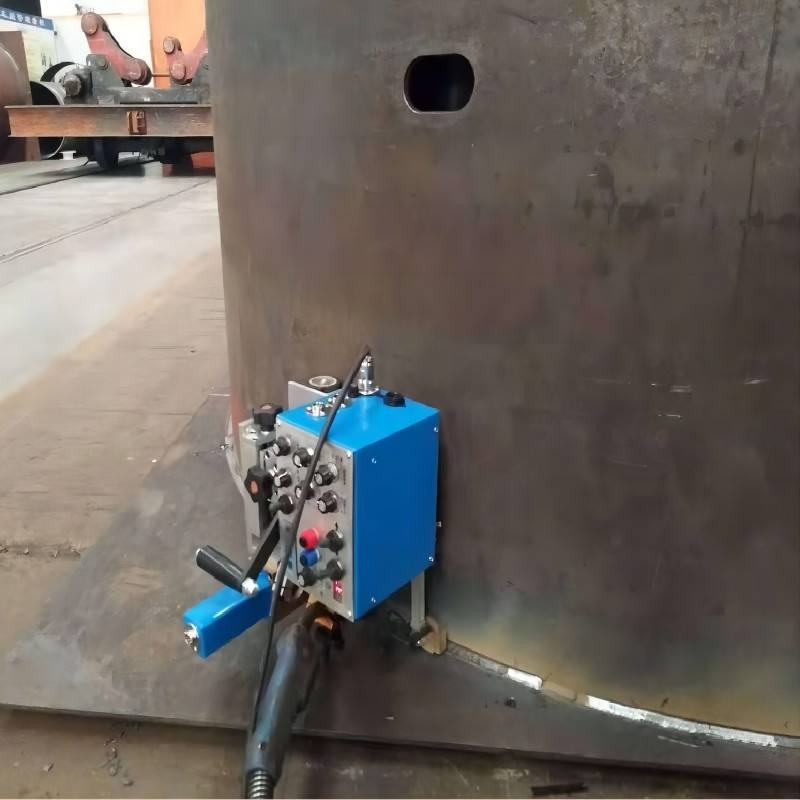
Stability in this context refers to the suppression of vibration and the maintenance of a constant “torch-to-work” distance. In tank fillet welding, the crawler traverses the seam where the pipe profile meets the bulkhead. Any deviation in the crawler’s path results in arc instability and potential weld defects such as undercut or lack of fusion. By using a localized crawler instead of a large-scale gantry, the system gains the flexibility to enter manholes and operate within the internal ribs of a vessel.
3D Vision Positioning and Gap Compensation
The core difficulty in automated fillet welding is the variation in fit-up gaps. Traditional automation follows a pre-programmed path, which fails if the pipe profile is slightly offset or if the tank wall has warped during previous heat cycles. The integration of 3D vision positioning allows the system to scan the joint geometry in real-time or via a pre-weld pass. This sensor technology creates a point cloud of the fillet area, identifying the root of the joint and the leg length requirements.
This data is processed to adjust the torch oscillation and travel speed dynamically. If the 3D scan detects a wider gap at one section of the pipe profile, the controller slows the crawler and increases the weave width to ensure a structural fill. This level of adaptability is what differentiates modern industrial engineering solutions from rigid legacy automation. It ensures that the “field-built” reality is accommodated without requiring manual grinding or re-cutting of expensive pipe sections.
Kinematics of Pipe Profile Intersection
When a pipe is joined to a curved or flat tank surface, the resulting intersection is a complex saddle curve. The pipe profile integration requires precise geometry to ensure a uniform fillet weld. Industrial engineers focus on the “beveling” and “profiling” stages to ensure that the contact point between the pipe and the tank wall allows for optimal gas-shielded arc access. The 3D vision system identifies the orientation of the pipe relative to the wall, ensuring the torch angle remains bisecting the joint throughout the 360-degree path.
The kinematics involve coordinated movement between the crawler’s drive motors and the torch’s cross-slide actuators. This two-axis synchronization, guided by the vision data, maintains the electrode’s aim at the root of the fillet. This precision is vital for deep-tank applications where the weld must withstand significant hydrostatic pressure and cyclic loading during sea states.
Field Construction and Environmental Durability
Shipyard environments are characterized by high humidity, abrasive dust, and fluctuating temperatures. Any automation tool, specifically a magnetic crawler, must be engineered for high IP (Ingress Protection) ratings. The 3D vision optics are typically protected by air knives or replaceable shields to prevent weld spatter and smoke from obscuring the sensors. Industrial engineering standards dictate that the downtime for sensor maintenance must be less than 5% of the total shift time to maintain economic viability.
Furthermore, the portability of the system is a key performance indicator (KPI). A magnetic crawler must be light enough for a two-person team to deploy into a tank, yet powerful enough to carry out high-deposition welding. The shift from manual stick welding to automated gas-metal arc welding (GMAW) via crawlers reduces the total man-hours per tank by approximately 40%, while significantly improving the ergonomic conditions for the workforce.
Consistency in Fillet Weld Geometry
The quality of a fillet weld in a shipbuilding tank is measured by its throat thickness and leg length symmetry. Manual welding often results in “over-welding,” where excess filler metal is used to compensate for lack of confidence in the joint. This adds unnecessary weight to the ship and increases thermal distortion. The 3D vision system ensures that the weld is laid down exactly to the design specification, no more and no less. This precision reduces filler wire consumption and post-weld cleanup costs.
Data Integration and Quality Assurance
In the modern shipyard, every weld is a data point. The 3D vision system doesn’t just guide the torch; it logs the joint geometry and the parameters used to weld it. This creates a digital twin of the tank’s structural assembly. Industrial engineers use this data to perform trend analysis, identifying if certain pipe profiles are consistently arriving with poor fit-up, allowing for upstream process improvements in the cutting shop.
Operational Workflow and Industrial Efficiency
To maximize throughput, the workflow is structured as follows:
1. The pipe profile is cut to match the tank’s internal coordinates.
2. The magnetic crawler is positioned near the joint.
3. The 3D vision sensor performs a rapid scan to calibrate the “as-built” position.
4. The system executes the fillet weld with real-time tracking.
5. The crawler is moved to the next pipe profile with minimal setup time.
By focusing on these mechanical and sensory strengths, shipbuilding facilities can overcome the limitations of manual labor and the rigidity of traditional automation. The use of magnetic crawlers ensures that the stability required for high-quality welding is maintained regardless of the orientation, while 3D vision provides the “intelligence” needed to navigate the complexities of ship tank construction. This approach represents the pinnacle of practical industrial engineering in the maritime sector, emphasizing reliability, precision, and field-readiness.
-


LT240S tube laser cutting machine
-
LT120S tube laser cutting machine
-
Sale

Tank Fillet Welding Machine
Original price was: $1,000.00.$900.00Current price is: $900.00. -
Sale

MAK100 tube laser cutting machine
Original price was: $5,500.00.$5,000.00Current price is: $5,000.00. -

portable plasma air cutting machine
$1,200.00 -

2in1 fiber laser cutting machine
-

Air cooling Laser welding machine
-

HF h beam laser cutting machine
-

LT240 laser cutting machine
-

Laser welding machine
-


Cobot Welding Station
-

Gantry welding robot solution
-

Tracked Wheeled AGV Welding robot
-

LFH6020 Fiber laser cutting machine
-
LFP6020
-

robotic welidng machine
Advanced Fiber Laser Tube Processing Technology
Our CNC Fiber Laser Tube Cutting systems revolutionize metal fabrication by integrating high-precision cutting, punching, and profiling into a single automated workflow. Designed for versatility, this technology handles a wide array of profiles including Round, Square, Rectangular, and Oval tubes, as well as complex L-shaped and U-shaped channels.
- Precision Punching: High-speed hole punching with micron-level accuracy, eliminating the need for mechanical drilling or die-stamping.
- Complex Profiling: Advanced 3D pathing allows for intricate interlocking joints and specialized notch cuts, ideal for structural frames.
- High Material Efficiency: Intelligent nesting software minimizes scrap, reducing raw material costs across large production runs.
- Clean Finish: Delivers oxide-free, burr-free edges that require zero secondary grinding before welding.

Seamlessly processing multiple profiles with consistent precision.
Global Delivery & Logistics



From our high-tech manufacturing facility directly to your global site. PCL WeldCut ensures secure packaging, professional handling, and reliable international logistics to safeguard your equipment throughout the entire journey.