Optimizing Shipbuilding Through Advanced Pipe Profile Processing
In the heavy industry sector, specifically shipbuilding, the complexity of internal tank structures requires a rigorous approach to fabrication and assembly. The transition from manual welding to automated systems is not merely a matter of speed but of structural integrity and dimensional precision. The integration of 3D vision positioning allows for the real-time adjustment of welding trajectories, which is critical when dealing with the large-scale elastic deformations common in ship hull blocks. Unlike laboratory settings, the shipyard environment presents variables such as thermal expansion and structural shifting that demand a more adaptive technological approach.
The Role of 3D Vision in Complex Fillet Geometry
Traditional pre-programmed paths often fail in shipbuilding because the “as-built” state of a tank rarely matches the “as-designed” CAD model perfectly. 3D vision systems serve as the sensory bridge between the digital design and the physical workpiece. By utilizing structured light or stereoscopic imaging, the system scans the fillet joint immediately ahead of the weld pool. This scanning process generates a high-resolution point cloud that identifies the exact root opening and groove angle.
This data is processed locally to adjust the torch position in real-time. In tank Fillet Welding, where longitudinal and transverse bulkheads meet the hull plating, the 3D vision system compensates for gaps caused by fit-up tolerances. By calculating the cross-sectional area of the joint on the fly, the system can modulate travel speed and wire feed rates to ensure consistent throat thickness, effectively eliminating the risk of undercut or lack of fusion.
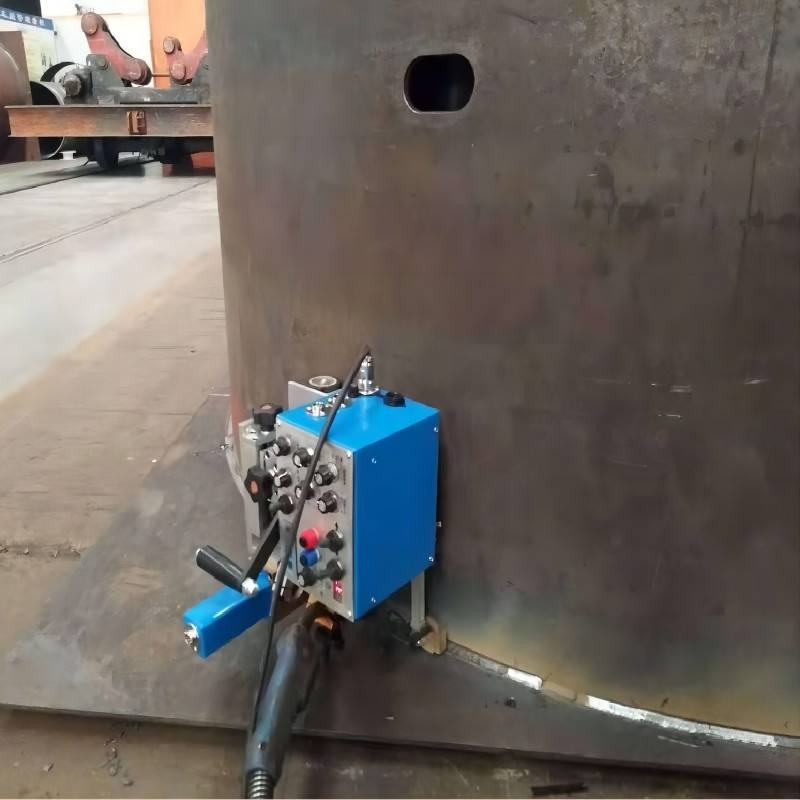
Magnetic Crawler Systems: Ensuring Field Construction Stability
The primary challenge of automating welds inside a ship’s tank is accessibility and orientation. Magnetic crawler technology provides the necessary mobility to traverse vertical, overhead, and curved surfaces without the need for fixed tracks or heavy gantry systems. These units utilize high-strength permanent magnets or electromagnets to generate sufficient tractive force to carry the welding head, wire feeders, and 3D sensors while maintaining a constant distance from the workpiece.
Stability in field construction is paramount. Shipyards are vibration-heavy environments where overhead cranes and nearby grinding operations can disrupt sensitive equipment. Magnetic crawlers are designed with low-center-of-gravity chassis and high-torque drivetrains to dampen these external vibrations. The localized adherence ensures that the vision system remains indexed to the joint, providing a stable platform for high-deposition welding processes like Flux-Cored Arc Welding (FCAW) or Gas Metal Arc Welding (GMAW).
Mechanical Integration and Pipe Profile Fit-Up
The efficiency of the fillet weld is heavily dependent on the quality of the pipe profile cutting performed during the sub-assembly phase. When pipes penetrate tank bulkheads or serve as internal stiffeners, the profile must be cut to match the curvature of the receiving surface perfectly. A precise mechanical cut ensures that the fillet weld can be executed with a uniform leg length. High-precision mechanical cutting heads, integrated with the same 3D mapping logic, ensure that pipe ends are beveled and contoured to minimize the volume of filler metal required.
By achieving a tighter fit-up, the heat-affected zone (HAZ) is minimized, which is crucial for maintaining the metallurgical properties of the high-tensile steels used in modern vessel construction. This synergy between precise profile cutting and crawler-based welding reduces the total man-hours per block significantly.
Adaptive Control and Gap Compensation
One of the most significant advantages of using vision-integrated crawlers in tank construction is the ability to handle non-linear joints. As the crawler moves along the fillet of a curved tank wall, the 3D vision system identifies the deviation from the expected path. The system’s control logic employs field construction stability algorithms to prevent the oscillation of the torch from overshooting the joint boundaries. This is particularly important in multi-pass welding where the geometry changes with each subsequent layer.
The 3D sensor tracks the edge of the previous weld bead, allowing the crawler to stack beads with mathematical precision. This level of control is unattainable through manual operation in the cramped, poorly ventilated confines of a ship’s double bottom or wing tank.
Reduction of Rework and NDT Failures
Non-Destructive Testing (NDT) is a bottleneck in ship delivery schedules. Most manual weld failures in tanks are attributed to welder fatigue or poor visibility. Automated crawlers do not suffer from these human factors. The consistency provided by the automated 3D vision feedback loop results in a drastic reduction in porosity and slag inclusions. Because the system maintains an optimal arc length and torch angle regardless of the crawler’s orientation, the volumetric integrity of the weld remains high.
Furthermore, the data logged by the 3D vision system during the welding process can be used as a digital twin record. This provides engineers with a “birth certificate” for every joint, detailing the fit-up conditions and welding parameters used, which streamlines the classification society’s approval process.
Environmental Resilience in Shipyard Operations
Equipment used in shipbuilding must withstand extreme conditions, including salt spray, metallic dust, and temperature fluctuations. The 3D vision sensors are typically housed in pressurized, cooled enclosures to prevent the ingress of dust and to protect the optics from the intense heat of the arc. The magnetic crawlers are built with sealed bearings and corrosion-resistant alloys. This ruggedization ensures that the automation remains functional across various climate zones and construction stages, from the open block assembly area to the enclosed dry dock.
Conclusion: The Future of Tank Construction
The application of 3D vision positioning and magnetic crawler technology represents a fundamental shift in how ship tanks are constructed. By focusing on the mechanical stability of the platform and the adaptive capabilities of the sensing technology, shipbuilders can achieve levels of quality and efficiency that were previously impossible. The integration of tank fillet welding automation ensures that the most difficult joints in a vessel are the most reliable, ultimately leading to safer and more durable maritime structures.
-


LT240S tube laser cutting machine
-
LT120S tube laser cutting machine
-
Sale

Tank Fillet Welding Machine
Original price was: $1,000.00.$900.00Current price is: $900.00. -
Sale

MAK100 tube laser cutting machine
Original price was: $5,500.00.$5,000.00Current price is: $5,000.00. -

portable plasma air cutting machine
$1,200.00 -

2in1 fiber laser cutting machine
-

Air cooling Laser welding machine
-

HF h beam laser cutting machine
-

LT240 laser cutting machine
-

Laser welding machine
-


Cobot Welding Station
-

Gantry welding robot solution
-

Tracked Wheeled AGV Welding robot
-

LFH6020 Fiber laser cutting machine
-
LFP6020
-

robotic welidng machine
Advanced Fiber Laser Tube Processing Technology
Our CNC Fiber Laser Tube Cutting systems revolutionize metal fabrication by integrating high-precision cutting, punching, and profiling into a single automated workflow. Designed for versatility, this technology handles a wide array of profiles including Round, Square, Rectangular, and Oval tubes, as well as complex L-shaped and U-shaped channels.
- Precision Punching: High-speed hole punching with micron-level accuracy, eliminating the need for mechanical drilling or die-stamping.
- Complex Profiling: Advanced 3D pathing allows for intricate interlocking joints and specialized notch cuts, ideal for structural frames.
- High Material Efficiency: Intelligent nesting software minimizes scrap, reducing raw material costs across large production runs.
- Clean Finish: Delivers oxide-free, burr-free edges that require zero secondary grinding before welding.

Seamlessly processing multiple profiles with consistent precision.
Global Delivery & Logistics



From our high-tech manufacturing facility directly to your global site. PCL WeldCut ensures secure packaging, professional handling, and reliable international logistics to safeguard your equipment throughout the entire journey.