Optimizing Ship Tank Fabrication Through Advanced Profile Cutting
In the heavy industry of shipbuilding, the structural integrity of internal fluid storage units depends heavily on the precision of tank Fillet Welding. These compartments are subject to immense hydrostatic pressure and structural stress, necessitating a fabrication process that minimizes tolerances. The engineering challenge lies in the intersection of large-diameter pipe profiles and curved tank walls. Traditional manual layout methods are no longer sufficient to meet the throughput requirements of modern shipyards. Instead, the implementation of Pipe Profile Cutting Machines equipped with 3D Vision positioning has become the standard for achieving the necessary fit-up quality.
By utilizing 3D vision to map the actual geometry of the workpiece, engineers can compensate for material deviations and surface irregularities common in heavy steel plates. This ensures that the bevel and the profile of the pipe match the tank’s inner contour perfectly. When the fit-up gap is controlled within sub-millimeter tolerances, the subsequent welding process—specifically when utilizing magnetic tractors—becomes significantly more predictable and stable.
The Role of 3D Vision Positioning in Surface Compensation
The primary bottleneck in shipyard pipe-to-tank assembly is the variance in raw material dimensions. Steel plates used in tank construction often possess slight undulations or deviations from the theoretical CAD model. A 3D vision system integrated into the cutting machine scans the work area to create a high-density point cloud. This data allows the cutting head to adjust its trajectory in real-time, ensuring the cut profile accounts for the actual curvature of the tank wall.
From an industrial engineering perspective, this “as-built” compensation eliminates the need for secondary grinding or onsite modifications. The 3D vision system identifies the coordinate system of the pipe and the target surface, performing a spatial transformation that aligns the cutting path with the physical reality of the steel. This level of accuracy is vital for maintaining a consistent root opening, which is the foundational requirement for high-quality fillet welds.
Oxy-Fuel Cutting Precision for Heavy-Wall Ship Components
While various thermal cutting methods exist, oxy-fuel remains the preferred choice for the thick-walled pipes and structural members found in shipbuilding tanks. The process relies on the chemical reaction between oxygen and the base metal, providing deep penetration and a stable thermal profile. In a profile cutting machine, the movement of the oxy-fuel torch is synchronized with the rotational axis of the pipe and the longitudinal movement of the carriage.
The integration of 3D vision allows for variable bevel angles along the cut path. As the pipe intersects the tank wall at different angles, the machine automatically adjusts the torch tilt to maintain a constant welding groove. This geometric consistency is critical for the magnetic crawler systems that follow, as any variation in the groove width would lead to fluctuations in the weld bead volume and potential defects such as undercut or lack of fusion.
Stability Mechanics of Magnetic Crawler Welding Systems
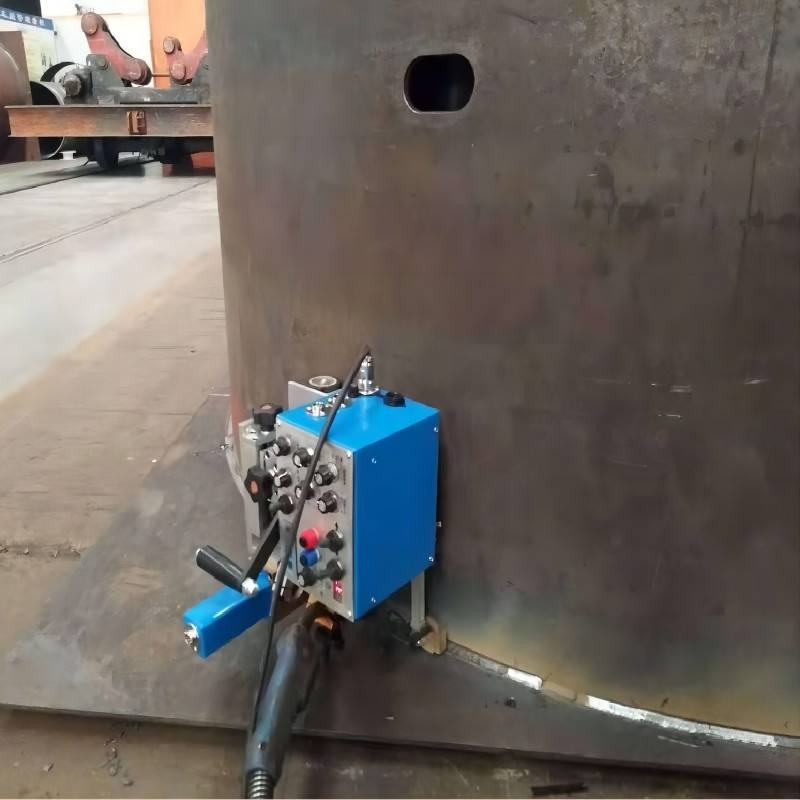
Once the pipe profiles are accurately cut and tacked into position inside the tank, the focus shifts to the welding execution. In the confined and often vertical environments of ship tanks, manual welding is prone to fatigue-related errors. The application of a magnetic crawler provides a mechanized solution that ensures consistent travel speeds and torch positioning.
These systems utilize high-strength permanent magnets or electromagnets to adhere to the steel surface. This magnetic flux allows the crawler to traverse vertical and overhead sections without losing traction. For tank fillet welding, the crawler tracks the joint interface, maintaining a steady arc length. The stability of the crawler is directly influenced by the quality of the surface preparation; therefore, the precision of the initial 3D-guided cut is paramount. A smooth, dross-free oxy-fuel cut allows the magnetic wheels to maintain a uniform distance from the metal, preventing jerky movements that could compromise the weld pool.
Field Construction Stability and Environmental Adaptability
Shipyards are harsh environments characterized by temperature fluctuations, moisture, and vibration. Equipment used in shipbuilding fabrication must be robust enough to handle these variables. Magnetic crawlers are designed for such field construction stability. Unlike complex articulated systems, the crawler’s low center of gravity and direct contact with the workpiece make it less susceptible to external vibrations.
The simplicity of the magnetic drive system also ensures that the equipment can be deployed quickly across different sections of the tank. Because the 3D vision positioning on the cutting machine has already ensured a near-perfect fit-up, the crawler can operate at optimized parameters without the need for constant operator intervention. This synergy between precise pre-processing and stable mechanized welding reduces the rework rate significantly, which is a key performance indicator (KPI) for any shipbuilding facility.
Industrial Engineering Impact: Efficiency and Weld Integrity
Integrating 3D vision with pipe profile cutting and magnetic crawler welding creates a closed-loop quality environment. From a workflow analysis, the reduction in “fit-up and fix” time translates to a higher vessel completion rate. The fillet welds produced are uniform, with consistent leg lengths and throat thicknesses, meeting the stringent requirements of maritime classification societies.
Furthermore, the heat-affected zone (HAZ) is managed more effectively. Because the cutting machine produces a precise edge, the heat input required during welding is minimized and stabilized. This reduces the risk of thermal distortion in the tank walls, preserving the structural geometry of the hull. The elimination of manual layout also reduces the risk of human error in complex intersections, where trigonometric calculations are otherwise prone to mistakes.
Conclusion on Mechanized Tank Assembly
The transition toward 3D vision-guided cutting and magnetic crawler welding represents a strategic shift in shipbuilding. By focusing on the mechanical relationship between the cutting trajectory and the physical steel surface, shipbuilders can achieve levels of precision that were previously unattainable in field conditions. This methodology prioritizes structural stability, repeatability, and economic efficiency, ensuring that the internal tank structures of modern vessels are built to withstand the rigors of global maritime operations. The focus remains on the marriage of vision-based data and robust mechanical execution, providing a stable foundation for the future of maritime engineering.
-


LT240S tube laser cutting machine
-
LT120S tube laser cutting machine
-
Sale

Tank Fillet Welding Machine
Original price was: $1,000.00.$900.00Current price is: $900.00. -
Sale

MAK100 tube laser cutting machine
Original price was: $5,500.00.$5,000.00Current price is: $5,000.00. -

portable plasma air cutting machine
$1,200.00 -

2in1 fiber laser cutting machine
-

Air cooling Laser welding machine
-

HF h beam laser cutting machine
-

LT240 laser cutting machine
-

Laser welding machine
-


Cobot Welding Station
-

Gantry welding robot solution
-

Tracked Wheeled AGV Welding robot
-

LFH6020 Fiber laser cutting machine
-
LFP6020
-

robotic welidng machine
Advanced Fiber Laser Tube Processing Technology
Our CNC Fiber Laser Tube Cutting systems revolutionize metal fabrication by integrating high-precision cutting, punching, and profiling into a single automated workflow. Designed for versatility, this technology handles a wide array of profiles including Round, Square, Rectangular, and Oval tubes, as well as complex L-shaped and U-shaped channels.
- Precision Punching: High-speed hole punching with micron-level accuracy, eliminating the need for mechanical drilling or die-stamping.
- Complex Profiling: Advanced 3D pathing allows for intricate interlocking joints and specialized notch cuts, ideal for structural frames.
- High Material Efficiency: Intelligent nesting software minimizes scrap, reducing raw material costs across large production runs.
- Clean Finish: Delivers oxide-free, burr-free edges that require zero secondary grinding before welding.

Seamlessly processing multiple profiles with consistent precision.
Global Delivery & Logistics



From our high-tech manufacturing facility directly to your global site. PCL WeldCut ensures secure packaging, professional handling, and reliable international logistics to safeguard your equipment throughout the entire journey.